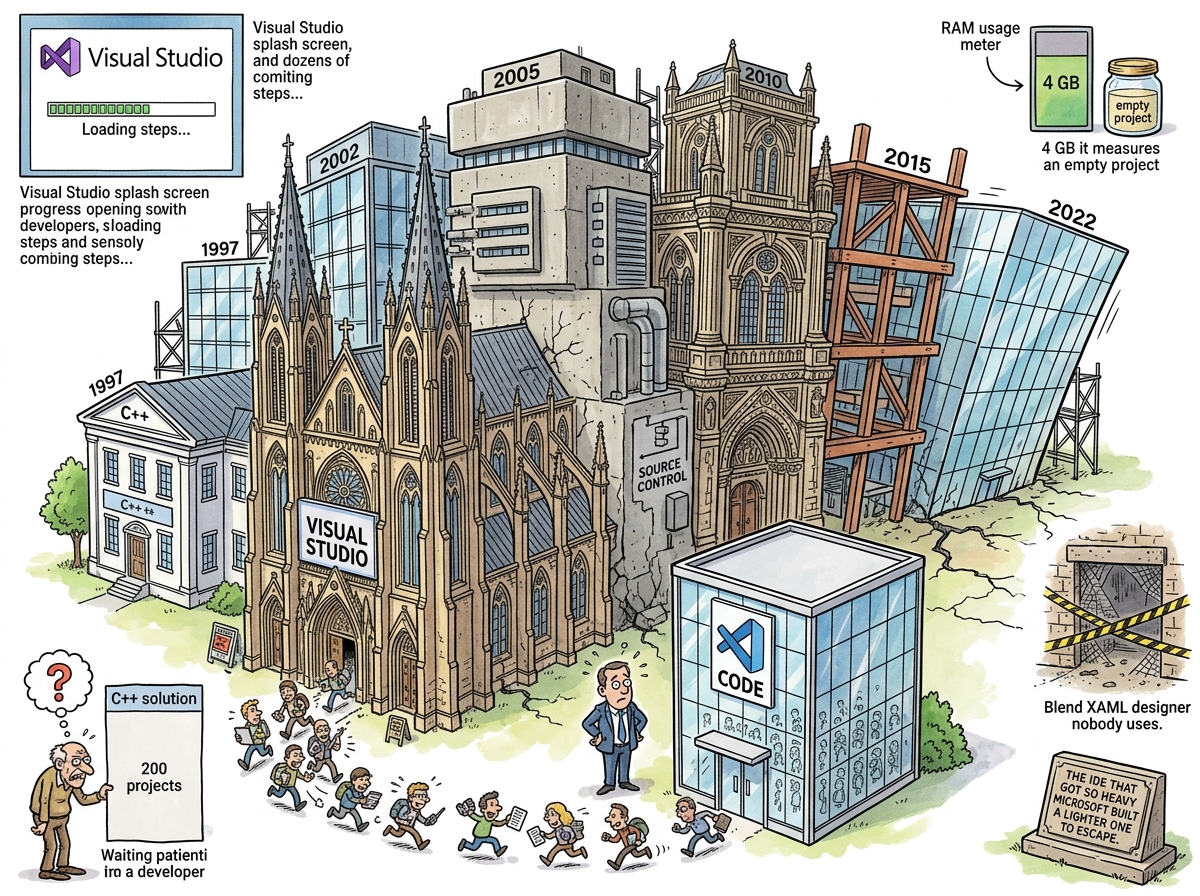
Visual Studio is an integrated development environment made by Microsoft, first released in 1997, and currently in its twenty-eighth year of continuous accretion. It is the largest IDE in the world. Not the most popular — that is VS Code. Not the best — that is a religious question. The largest. The most features. The most integrations. The most project types. The most menu items. The most RAM consumed per unit of code written.
Visual Studio did not grow. Visual Studio accreted, like a star, layer upon layer, extension upon extension, wizard upon wizard, until the weight of its own features collapsed it into a density from which no developer can escape quickly. Opening Visual Studio is not launching a program. Opening Visual Studio is a commitment. A 45-second splash screen. A loading bar with forty-seven steps. A RAM allocation that begins at 2 GB and climbs from there. By the time the IDE is responsive, the developer has made coffee, and the coffee is the correct amount of time to wait, which is how Visual Studio developers discovered that programming requires coffee.
riclib ran away from Visual Studio as fast as he could — and quit the job that wanted him to use it. This was during the C++ era, the one project, the one installer, the vow. Visual Studio was the IDE. C++ was the language. Windows was the platform. All three were abandoned together, and the vow has been kept for decades. (See: C++, “One project. One installer. One vow. Kept.”)
“Visual Studio is what happens when an IDE has no natural predator. No constraint. No force saying ‘stop, this is enough.’ Every team at Microsoft added their feature. Nobody removed anyone else’s. The IDE grew. And grew. And grew. Until Microsoft looked at it and built VS Code, which was the admission that the organism had exceeded the carrying capacity of the ecosystem.”
— A Passing AI, observing Microsoft’s IDE strategy
The Accretion
Visual Studio’s history is a geological record:
1997 — Visual Studio 97: C++, Visual Basic, J++. Fast. Small. An IDE.
2002 — Visual Studio .NET: The .NET revolution. C#. Managed code. The IDE doubles in size because the runtime doubles in scope.
2005 — Visual Studio 2005: Team Foundation Server. Build integration. Work item tracking. The IDE is now a project management tool that also edits code.
2008 — Visual Studio 2008: LINQ. WPF designer (Blend). Multi-targeting. The IDE is now a framework explorer that also manages projects that also edits code.
2010 — Visual Studio 2010: WPF-based UI (the IDE is rebuilt in the framework it’s designed to build). Extension marketplace. The IDE can now be extended infinitely, which it is.
2013-2019: Continuous accretion. Azure integration. Docker support. Xamarin. Unity. Python. Node.js. Each addition is reasonable. The cumulative weight is not.
2022 — Visual Studio 2022: 64-bit at last (the IDE had been 32-bit, hitting 4 GB memory limits, for twenty-five years). AI integration. The IDE now suggests code, which is either the future or the point where the IDE became sentient and started doing the developer’s job.
Each layer was added. No layer was removed. The XAML designer is still there. The Class Diagram tool is still there. The database schema compare is still there. Features that 2% of users need and 98% never touch persist because removing a feature from Visual Studio is politically impossible within Microsoft — someone’s team built it, someone’s VP approved it, someone’s OKRs depend on its usage metrics.
The Escape
In 2015, Microsoft released VS Code. They did not describe it as a replacement for Visual Studio. They described it as a “lightweight code editor.” This was a strategic understatement of the kind Microsoft excels at — the same company that described Windows NT as “a new technology” rather than “the replacement for everything.”
VS Code was everything Visual Studio was not: fast, small, cross-platform, Electron-based (which is an irony for a Microsoft product — built on Chromium, the engine of Microsoft’s competitor). It opened in seconds, not minutes. It used 800 MB of RAM, not 4 GB. It had extensions, not a built-in solution for every problem Microsoft had ever imagined.
Developers migrated. Slowly at first, then completely. By 2024, VS Code was the most popular IDE in the world. Visual Studio was still the most powerful. But “most powerful” lost to “fast enough + free + already installed” — the same dynamic that killed GoLand, the same dynamic that has killed every premium tool whose premium features became commoditised.
And now Zed is doing to VS Code what VS Code did to Visual Studio. The cycle continues. Each generation builds the lighter version. Each lighter version accretes until the next generation builds the lighter version of that.
“Visual Studio is the cathedral. VS Code is the bazaar. Zed is the tent. Claude Code is the voice in the wind that builds whatever shelter you describe.”
— The Caffeinated Squirrel, extending the metaphor past its structural integrity
Measured Characteristics
Year released:                           1997 (Visual Studio 97)
Creator:                                 Microsoft
Current version:                         Visual Studio 2022 (64-bit, finally)
Splash screen loading time:              30-60 seconds
RAM usage (empty project):               2-4 GB
RAM usage (large C++ solution):          8-16 GB
Years as 32-bit:                         25 (1997-2022)
Features added since 1997:               thousands
Features removed since 1997:             approximately zero
Replacement Microsoft built:             VS Code (2015)
Did they call it a replacement:          no ("lightweight code editor")
Is it a replacement:                     yes
What is replacing VS Code:               Zed (the cycle continues)
The accretion pattern:                   add everything, remove nothing, build a lighter version, repeat
See Also
- VS Code — The lighter version Microsoft built to escape Visual Studio. Now accreting towards the same fate.
- Zed — The lighter version being built to escape VS Code. The cycle continues.
- GoLand — Another IDE killed by “free + good enough.” GoLand was killed by VS Code. Visual Studio was killed by VS Code. The weapon is always the same.
- Turbo Pascal — The ancestor. Turbo Pascal compiled in seconds on 640 KB. Visual Studio compiles in minutes on 16 GB. The code is not sixty times more complex. The IDE is.
- Delphi — Visual Studio’s contemporary and competitor. Delphi compiled faster, produced smaller binaries, and lost because Microsoft had a marketing budget. The better tool does not always win.
- Emacs — The only editor that approaches Visual Studio’s scope. Emacs is an operating system. Visual Studio is an ecosystem. Both are too large to comprehend. Only Emacs was designed that way on purpose.