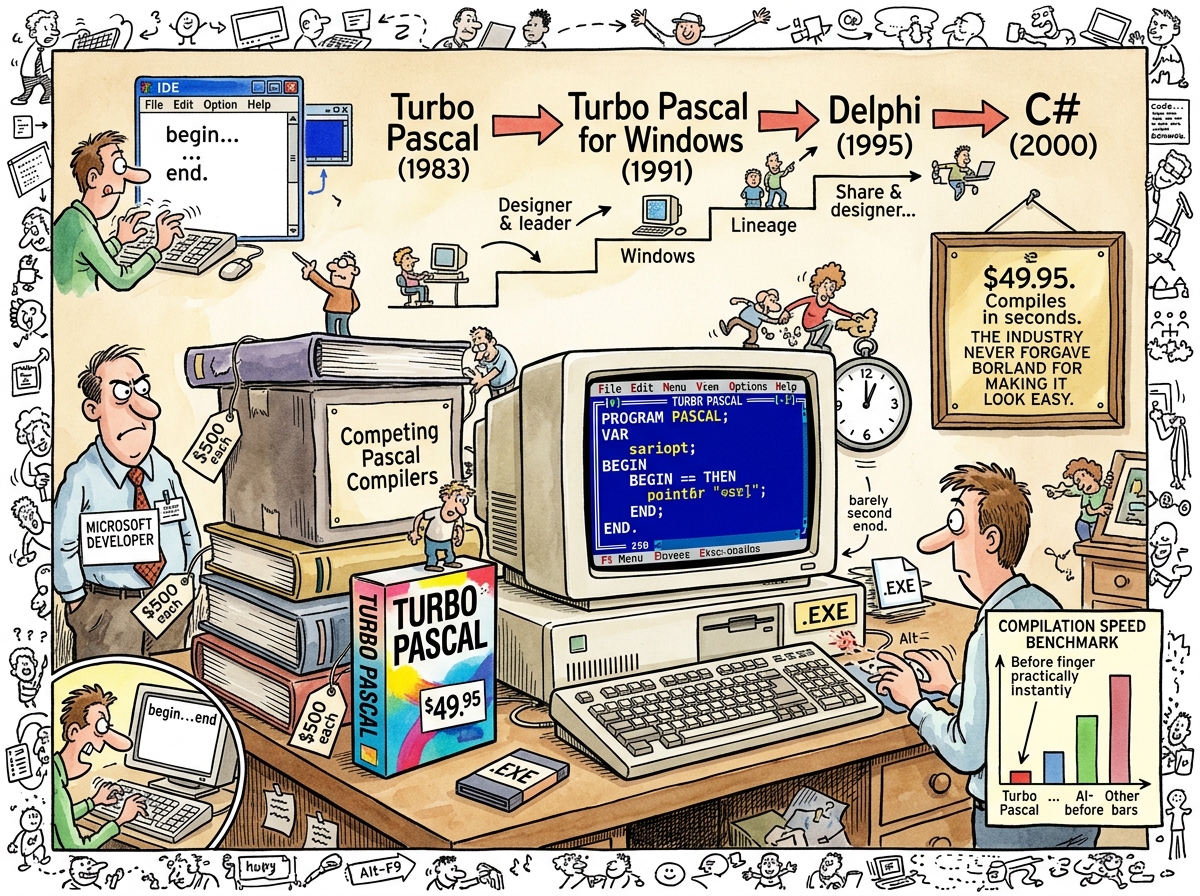
Turbo Pascal is an integrated development environment and Pascal compiler released by Borland International in 1983, conceived by Philippe Kahn, and sold for $49.95. This price requires context: competing Pascal compilers cost $500. Turbo Pascal was ten times cheaper, compiled ten times faster, and included an integrated editor that the competition did not have.
Borland sold one million copies. The industry never forgave them for making it look easy.
“Turbo Pascal taught a generation that programming should be fast. Not the code — the experience. Press a key, the program compiles. Press another key, the program runs. The delay between thinking and seeing was measured in heartbeats, not coffee breaks. Every IDE since has been trying to recapture that speed, and most of them have failed.”
— riclib, who learned programming in the blue glow of Turbo Pascal’s IDE
The Blue Screen
The Turbo Pascal IDE was a blue screen with white and yellow text. No GUI. No windows. No mouse. A full-screen editor with a menu bar, a status line, and the code. The entire environment — editor, compiler, debugger, help system — lived in a single executable that loaded in seconds on a machine with 640 KB of RAM.
The blue screen became the visual signature of an era. Every developer who learned Pascal in the 1980s and early 1990s remembers the blue. The blue was Turbo Pascal. The blue was programming. The blue was the first screen where code turned into a running program fast enough that the connection between typing and executing felt direct.
This was not vi’s speed — vi is fast because vi is small. This was a different kind of speed: the speed of the entire cycle. Edit. Compile. Run. Debug. Edit again. The cycle that modern IDEs call “inner loop” and measure in seconds — Turbo Pascal had it in 1983, and it was faster than most modern IDEs are in 2026.
The Price
$49.95 was not a price. It was an act of war.
Pascal compilers in 1983 were professional tools with professional prices. $500 for the Microsoft Pascal Compiler. $500 for the Digital Research Pascal/MT+. These were products sold to companies, by salespeople, through purchase orders. Turbo Pascal was sold through magazine ads, by mail order, to individuals, for the price of a textbook.
Philippe Kahn understood something the established compiler vendors did not: the market for a $500 Pascal compiler was thousands of professional developers. The market for a $50 Pascal compiler was millions of students, hobbyists, and professionals who would rather spend $50 of their own money than fill out a purchase order for $500 of the company’s.
Borland sold a million copies. The professional compiler market collapsed. The blue screen appeared on PCs in every university, every bedroom, every company where a developer had $50 and a desire to write code without waiting for a purchase order.
The Lineage
Turbo Pascal’s lineage is the most consequential in programming tools:
1983  Turbo Pascal ── $49.95, blue screen, compiles in seconds
1989  Turbo Pascal 5.5 ── adds object-oriented programming to Pascal
1991  Turbo Pascal for Windows ── the first visual development
1995  Delphi ── Object Pascal, visual component model, TComponent
2000  C# ── Anders Hejlsberg moves to Microsoft, builds C# and .NET
2012  TypeScript ── same Anders Hejlsberg, types for JavaScript
One lineage. One designer (Anders Hejlsberg, from Delphi onward). From a $49.95 DOS compiler to the language that runs half the web’s build systems. The thread is unbroken: Turbo Pascal’s speed became Delphi’s speed became C#’s tooling became TypeScript’s type inference. The blue screen’s DNA is in every Visual Studio and every VS Code that compiles TypeScript today.
Measured Characteristics
Year released:                           1983
Creator:                                 Philippe Kahn (Borland International)
Price:                                   $49.95
Competing compiler price:                $500
Price ratio:                             10:1 (Borland's favour)
Copies sold:                             1,000,000+
IDE:                                     integrated editor + compiler + debugger (blue screen)
Compilation speed:                       seconds (faster than most 2026 IDEs)
RAM required:                            64 KB minimum
Lineage:                                 Turbo Pascal → Delphi → C# → TypeScript
Designer continuity:                     Anders Hejlsberg (Delphi through TypeScript)
The blue screen:                         the visual signature of a generation
See Also
- Delphi — Turbo Pascal’s direct descendant. The component model that the industry spent thirty years reinventing.
- GoLand — A modern IDE that costs more per year than Turbo Pascal cost once. GoLand’s refactoring is better. Turbo Pascal’s compilation was faster.
- VS Code — The IDE that inherited Turbo Pascal’s lineage through TypeScript (same designer). VS Code uses more RAM to display a single file than Turbo Pascal used for the entire IDE.
- vi — The other approach: no IDE, just an editor. Turbo Pascal integrated everything. vi integrated nothing. Both were fast. Different philosophies, same speed.
- CygnusEd — The Amiga’s answer to “fast editing.” CygnusEd was fast at editing. Turbo Pascal was fast at the entire cycle.