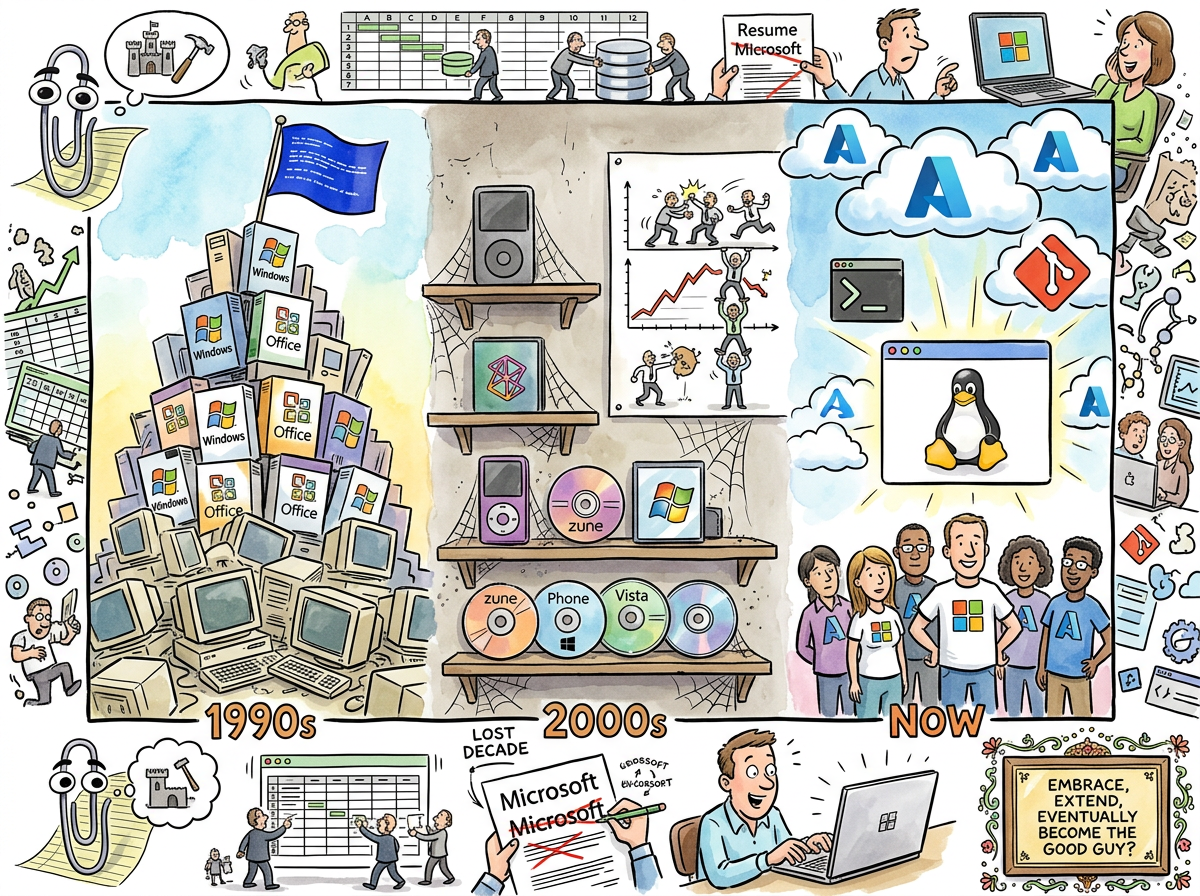
Microsoft is a technology company that spent its first twenty years conquering the world, its next fifteen years losing relevance so thoroughly that developers hid their Microsoft experience on résumés, and its most recent ten years becoming, against all reasonable expectation, cool — a trajectory so improbable that it serves as proof that either corporate reinvention is possible or that reality has a sense of humour.
Microsoft is the cockroach of technology companies. This is a compliment. Cockroaches survive everything. Microsoft survived antitrust, the internet, mobile, open source, cloud, and its own Lost Decade. It survived because it had two things no competitor could match: Office and inertia. Office because every business on Earth uses it. Inertia because replacing Microsoft in an enterprise requires an act of God and a budget that could fund a space programme.
The Eras
The Empire (1975–2000)
DOS. Windows. Office. The three pillars. Gates understood something Jobs didn’t: you don’t need to make the best product. You need to make the default product. Windows wasn’t the best operating system. It was the one on every computer. Office wasn’t the best productivity suite. It was the one in every enterprise procurement contract.
By 2000, Microsoft had a 97% market share in desktop operating systems. Internet Explorer had crushed Netscape. Office had no viable competitor. The Department of Justice was suing for monopoly practices. Microsoft was the most powerful technology company in the world.
Then the internet happened. Then mobile happened. Microsoft missed both.
The Lost Decade (2000–2014)
The Lost Decade is not a myth. It is a case study in what happens when a monopoly optimises for defending its position rather than building new ones.
Steve Ballmer replaced Gates as CEO in 2000. Under Ballmer, Microsoft:
- Missed search (Google)
- Missed mobile (iPhone, Android)
- Missed social (Facebook)
- Missed cloud (AWS, by years)
- Shipped Windows Vista (2007) — so bad that enterprises skipped it entirely
- Shipped Windows 8 (2012) — the one with the tiles that nobody wanted
- Killed the Zune (2011) — the iPod competitor that arrived five years late
- Killed Windows Phone (2017) — the mobile OS that was actually good but had no apps
- Implemented stack ranking — a performance management system where employees were ranked against each other, producing a culture where sabotaging colleagues was rational strategy
Ballmer famously laughed at the iPhone in 2007: “Five hundred dollars? Fully subsidised? With a plan? That is the most expensive phone in the world.” The iPhone went on to create a trillion-dollar ecosystem. The Zune went to a landfill.
The Lost Decade’s damage was not financial — Microsoft remained enormously profitable because Office and Windows generated cash regardless of strategy. The damage was cultural. Developers associated Microsoft with corporate mediocrity. “Microsoft developer” became a CV liability. The cool kids used Macs, wrote Ruby, and deployed to AWS.
The Resurrection (2014–present)
Satya Nadella became CEO in February 2014 and did something no one expected: he made Microsoft interesting again.
The playbook was heretical by Microsoft standards:
- Embraced open source — Microsoft, the company that once called Linux “a cancer,” put Linux inside Windows (WSL), bought GitHub ($7.5B), open-sourced .NET, TypeScript, and VS Code
- Bet on cloud — Azure became the second-largest cloud platform, growing at a rate that terrified AWS
- Killed the ego — Nadella replaced Ballmer’s “Windows first” strategy with “cloud first, mobile first,” acknowledging that Windows was no longer the centre of the universe
- Built tools developers love — VS Code became the most popular code editor on Earth. TypeScript became the most adopted new language in a decade. GitHub became the centre of open-source development
The transformation is genuine. Microsoft in 2024 is a different company from Microsoft in 2014. The developer who hid their Microsoft experience now lists Azure, TypeScript, and VS Code with pride. The company that screamed “DEVELOPERS DEVELOPERS DEVELOPERS” while developers fled to Mac now actually has the developers.
Excel
Excel is the most important software ever written. This is not an exaggeration.
Excel is a database, a programming language, a reporting tool, an analytics platform, a planning system, and the actual operating system of every finance department on Earth. More business decisions are made in Excel than in every BI tool combined. More data is stored in Excel than in most data warehouses. More bugs are shipped in Excel formulas than in most codebases.
Excel is the Enterprise’s real technology stack. SAP is the system of record. Excel is the system of truth. When SAP and Excel disagree, the CFO believes Excel.
The entire global financial system runs on a spreadsheet application that was first released in 1985 and that most people use at approximately 3% of its capability. This is either terrifying or reassuring, depending on whether you trust the person who wrote the VLOOKUP.
Measured Characteristics
Year founded:                                1975
Desktop OS market share (2000):              97%
Desktop OS market share (2025):              ~72%
Years of the Lost Decade:                    14
Products killed during Lost Decade:          Zune, Windows Phone, many others
Ballmer's iPhone prediction accuracy:        0%
Nadella's transformation duration:           ~3 years (to visible results)
GitHub acquisition cost:                     $7.5 billion
VS Code market share (editors):              ~70%
Excel spreadsheets in active use:            ~1 billion
Business decisions made in Excel:            most of them
VLOOKUP formulas with bugs:                  ~30% (estimated)
Developers who hid MS experience (2010):     many
Developers proud of MS tools (2024):         many
Stack ranking casualties:                    uncounted
Clippy appearances:                          1 too many