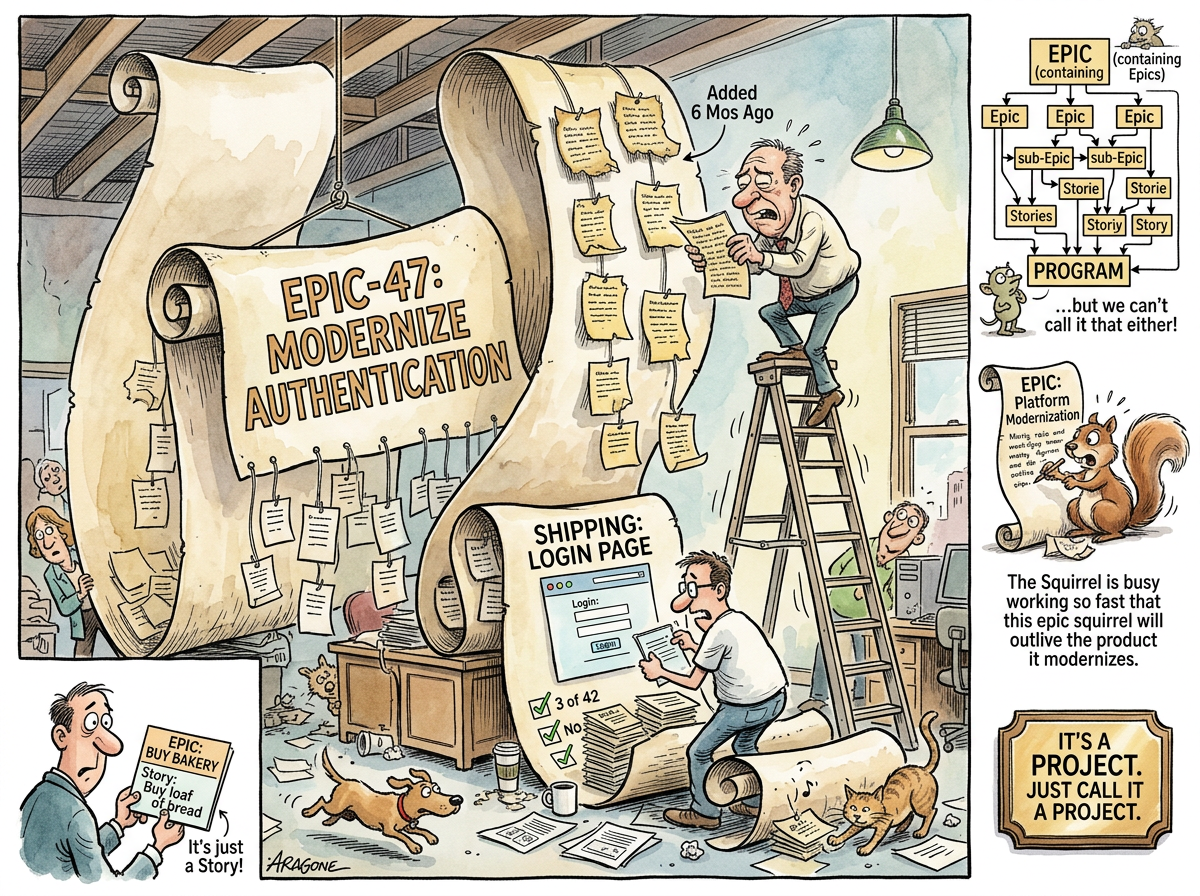
The Epic is a large body of work that can be broken down into smaller User Stories — which is to say, it is a project. But the word “project” belongs to waterfall, and waterfall is the enemy, so the same concept was given a new name and a place in the backlog where it serves exactly the same function with exactly the same vocabulary overhead and none of the semantic honesty.
An Epic is too large to fit in a single sprint. This is its defining characteristic and its entire reason for existing as a category. If it fit in a sprint, it would be a story. Because it doesn’t fit, it is an epic. The taxonomy adds a word. The word adds nothing except a parent-child relationship in JIRA that someone must maintain.
The Naming Problem
The Agile community needed a word for “a collection of related work” that wasn’t “project,” because projects have end dates, budgets, and project managers — all of which are waterfall concepts. Epics have none of these, which is either liberating (no deadlines!) or terrifying (no deadlines!), depending on whether you are the person doing the work or the person waiting for it.
The word “epic” was borrowed from literature, where it means a long narrative poem about heroic deeds. This is flattering to the authentication refactor but misleading about its scope. The Iliad was an epic. “EPIC-47: Modernize Authentication” is a project with a literary pretension.
In SAFe, the Epic escalates further. SAFe has Portfolio Epics, which require Lean Business Cases, which are reviewed by Lean Portfolio Management. A project that would have been approved by a manager in an email now requires a business case reviewed by a portfolio governance structure. The word changed. The approval process got longer. The work remained the same.
The Lifecycle
-
Creation — A product owner identifies a large body of work. It is too big for a story. It becomes an epic. It is given a name that sounds important: “Customer Onboarding Redesign,” “Platform Migration,” “Search Enhancement.”
-
Decomposition — The epic is broken into stories. The stories are estimated. The estimates are wrong. The number of stories grows as the team discovers what “Search Enhancement” actually means. The epic that started as five stories is now seventeen.
-
The Long Middle — Stories are pulled into sprints. Some are completed. Some are carried over. Some are deprioritized. The epic sits at 40% complete for three months. Nobody is alarmed by this because nobody is tracking it — the epic is not in the sprint, the stories are, and the stories are being completed, just not the ones that move the epic forward.
-
The Realization — Someone asks: “How close are we to finishing the epic?” The answer involves opening JIRA, counting stories, subtracting completed ones, and realizing that eight new stories have been added since the epic was created. The epic is now larger than when it started. This is called “scope discovery.” It is also called “a project.”
-
The Quiet Close — The epic is eventually closed. Not because all stories are complete, but because the remaining stories have been deprioritized, moved to other epics, or declared no longer relevant. The epic is “done” in the way that a meal is “done” when you stop eating, not when the plate is empty.
The Lifelog Alternative
In the lifelog, an epic is a Linear project with tickets in it. It is not called an epic. It is called what it is: a set of related work. When four temporary projects accumulated tickets that belonged elsewhere, they were dissolved in two hours — sugar in espresso.
“Everything goes to Dialogr Parity or V5. Two buckets. Do it now or do it later.”
“But what about the nuanced categorization of—”
“Two. Buckets.”
— riclib and the Caffeinated Squirrel, The Idle Factory, or The Morning the Backlog Ran Out of Ideas
Two buckets. Not epics, not themes, not initiatives, not portfolio-level strategic pillars. Two buckets: now and later. The taxonomy was dissolved because the taxonomy existed to organize complexity, and the complexity was itself the problem.