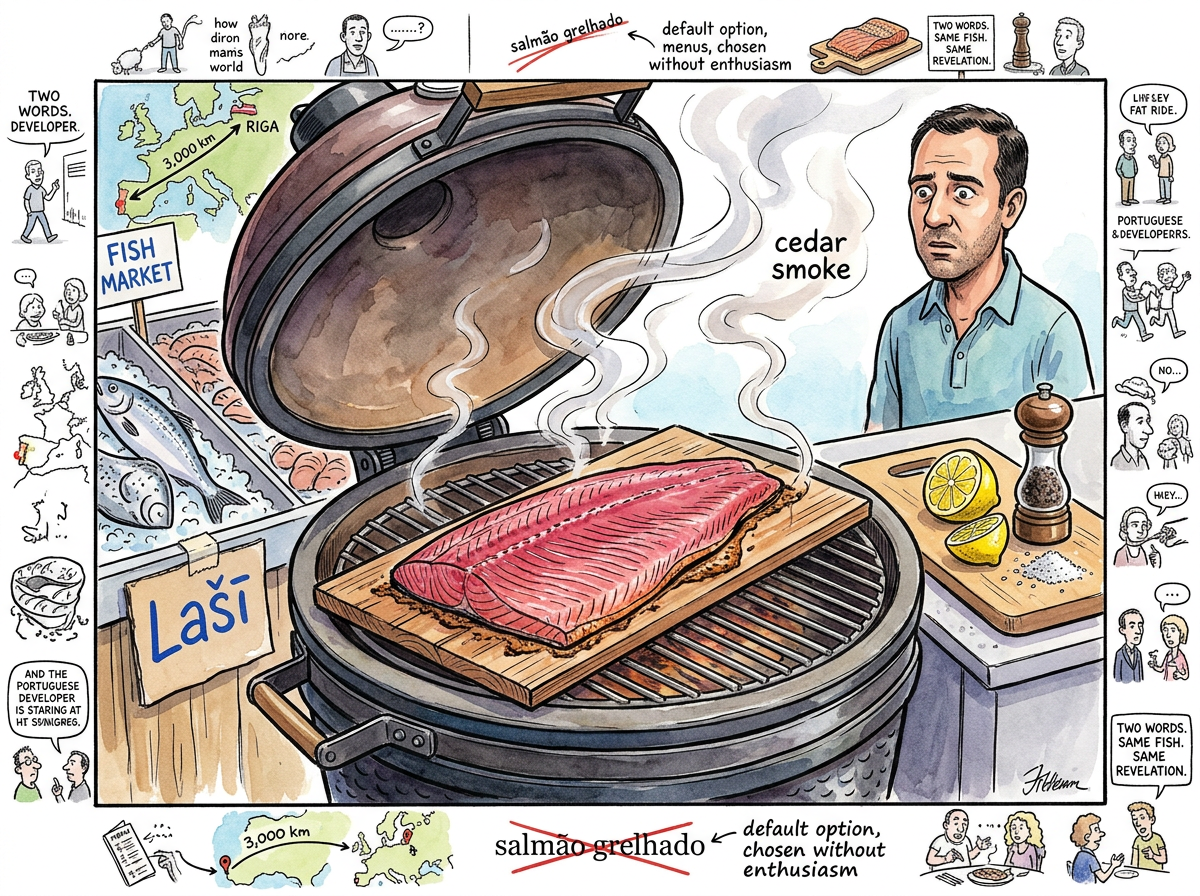
In Portugal, salmon occupies a peculiar position in the hierarchy of fish: it exists. That is the kindest thing anyone will say about it. It is the fish you order when the dourada is finished and the sea bass was never on the menu. It is the backup plan. It is the fallback. It is, in the taxonomy of Portuguese seafood, the fish equivalent of Times New Roman — present everywhere, chosen deliberately by no one, and vaguely offensive to people who care about these things.
This is not snobbery. This is calibrated indifference, earned over generations. Portugal has one of the longest coastlines in Europe relative to its size, some of the richest Atlantic fishing grounds within reasonable sailing distance, and a culinary tradition that treats fish with the kind of reverence that other countries reserve for beef or cheese. In this context, farmed Atlantic salmon — soft, pale, faintly oily, tasting of whatever the farm fed it — is not a fish. It is a concession. It is what the restaurant serves when it has given up.
riclib grew up in this environment. Salmon was not disliked. Salmon was not discussed. Salmon was the thing between you and leaving the restaurant hungry.
Then riclib moved to Riga.
The Baltic Discovery
The Riga Central Market has five pavilions housed in old Zeppelin hangars, which is already the kind of fact that suggests the universe has a sense of humour about architecture. The fish pavilion is the second one. Inside, on beds of crushed ice, lie fish that have been pulled from the Baltic Sea and its tributary rivers within the last day or two.
The salmon there is not the salmon of Portuguese supermarkets.
Baltic salmon — lašī in Latvian, pronounced roughly “lah-shee” — is wild or semi-wild, caught in the rivers that feed the Baltic or in the Baltic itself. The flesh is deep pink, almost red, the colour of a fish that has been swimming against currents and eating crustaceans rather than floating in a pen eating pellets. The texture is firm. The fat content is lower than farmed salmon but distributed differently — intramuscular rather than subcutaneous, which means the fish holds together on a grill instead of falling apart into flakes of apology.
riclib bought a fillet because it was there and because he had a Kamado at home and because the woman at the stall said something encouraging in Latvian that he did not understand but interpreted, correctly, as “buy the fish.”
He bought the fish.
The Method
The method is simple because the method should be simple. The Squirrel proposed a maple-soy glaze with toasted sesame seeds and a wasabi-lime crema on the side. The Squirrel was thanked for his contribution and escorted from the kitchen.
The Kamado setup: indirect heat, ~180C (356F). Not screaming hot. Salmon is not a steak. Salmon does not want to be seared into submission. Salmon wants medium heat, patience, and smoke.
The placement: skin side down, always. The skin is a thermal barrier between the heat source and the flesh. It crisps. It protects. It becomes the best part of the fish — a thin, crackling layer that shatters when you press a fork through it, which is a sensation that farmed Atlantic salmon has never once provided because farmed Atlantic salmon skin is a grey, flabby membrane that exists only to be peeled off and discarded.
The cedar plank (optional but magnificent): soak a cedar plank for an hour. Place the salmon on the plank. Place the plank on the grill. The plank smoulders. The smoke from the smouldering cedar infuses the fish from below while the Kamado’s charcoal smoke infuses it from above. The fish is caught between two sources of smoke and does not complain. The plank chars. The kitchen smells like a forest that has decided to cook dinner.
The seasoning: salt, pepper, a squeeze of lemon. That is it. The fish has flavour. The smoke adds flavour. The cedar adds flavour. Anything more is the Squirrel talking.
The doneness: when the flesh flakes at the thickest part but the centre is still slightly translucent. This is the moment. Overcook it by two minutes and you have a different, worse fish. The window is narrow. Pay attention. This is not the time to check Linear.
The Traeger-to-Ninja Method
The Kamado method is the original revelation. The Traeger method is the refinement.
Low and slow on The Traeger: the salmon fillet goes into the Traeger at 110–120°C (230–248°F) with a marinade of olive oil, lemon juice, lemon zest, and fresh dill — the herb that does not exist in Portuguese cooking but turns out to be the herb that Baltic fish has been waiting for since before Portugal had a navy. The smoke from the pellets is gentler than the Kamado’s charcoal — fruit wood or alder — and the low temperature lets the fat render slowly while the dill and lemon perfume the flesh from both sides. Forty-five minutes to an hour, depending on thickness.
The result: silky, deeply flavoured, infused with smoke and dill and lemon. But the skin is soft. The skin, at 120°C, never crisps. The skin is the one thing the low-and-slow method cannot deliver.
The Ninja Woodfire finish: the salmon transfers from the Traeger to the Ninja Woodfire air fryer at 240°C (464°F) for three to four minutes. The blast of dry, convective heat does to the skin what the Traeger cannot — crisps it, shatters it, turns the soft underside into crackling. The flesh, already cooked through at the lower temperature, does not overcook in four minutes. It just gets a crust.
Two appliances. Two temperatures. One fish. The Squirrel would add a third step (the sous vide, obviously). The Lizard observes that two is already one more than the Kamado needed, and the Kamado result was already good. The Lizard is correct. The two-step method is better anyway.
Salmão vs Lašī
riclib calls it salmão at home. riclib calls it lašī at the fish market. Neither word is wrong. Both words refer to the same animal, the same revelation, and the same slow recalibration of a lifelong assumption.
The Portuguese word carries the old prejudice — salmão, the default, the fallback, the fish-shaped shrug. The Latvian word carries the new understanding — lašī, the thing on the Kamado, the thing with the crispy skin, the thing that made a man from Lisbon admit he had been wrong about an entire species.
This is what happens when you move 3,000 km north. You discover that a word you thought you understood meant something different in a place where the water is colder and the fish had to work harder. The same word, pointing at the same animal, filtered through different seas, different kitchens, different expectations.
The Portuguese relationship with salmon: tolerance.
The Latvian relationship with salmon: respect.
riclib’s relationship with salmon: revised.
The duality is the point. You cannot call it only salmão because that erases the Baltic. You cannot call it only lašī because that erases the Portuguese context that makes the discovery meaningful. The title carries both names because the entry is not about a fish. It is about the distance between two ways of knowing the same fish.
Measured Characteristics
- Species: Salmo salar (Atlantic salmon, Baltic population)
- Latvian: lašī
- Portuguese: salmão
- Flesh colour: deep pink (not the pale pink of farmed)
- Texture: firm, holds together on the grill
- Fat distribution: intramuscular (not subcutaneous)
- Grill temperature: ~180C (356F), indirect
- Placement: skin side down, always
- Cedar plank: optional, magnificent
- Seasoning: salt, pepper, lemon (three ingredients, not seventeen)
- The Squirrel’s proposal: maple-soy glaze with sesame (rejected)
- The Lizard’s position: the fish has flavour, let it speak
- Doneness: flakes at the edge, translucent at the centre
- Overcook window: 2 minutes (pay attention)
- Traeger method: 110–120°C (230–248°F), dill, lemon, olive oil, lemon zest, 45–60 min
- Ninja Woodfire finish: 240°C (464°F), 3–4 minutes (skin crisper)
- Appliances involved in the refined method: 2 (the Lizard notes this is already one too many)
- Distance from Lisbon to Riga: ~3,000 km
- Portuguese opinion of salmon (before): default
- Portuguese opinion of salmon (after Riga): revised
- Number of words for the same revelation: 2