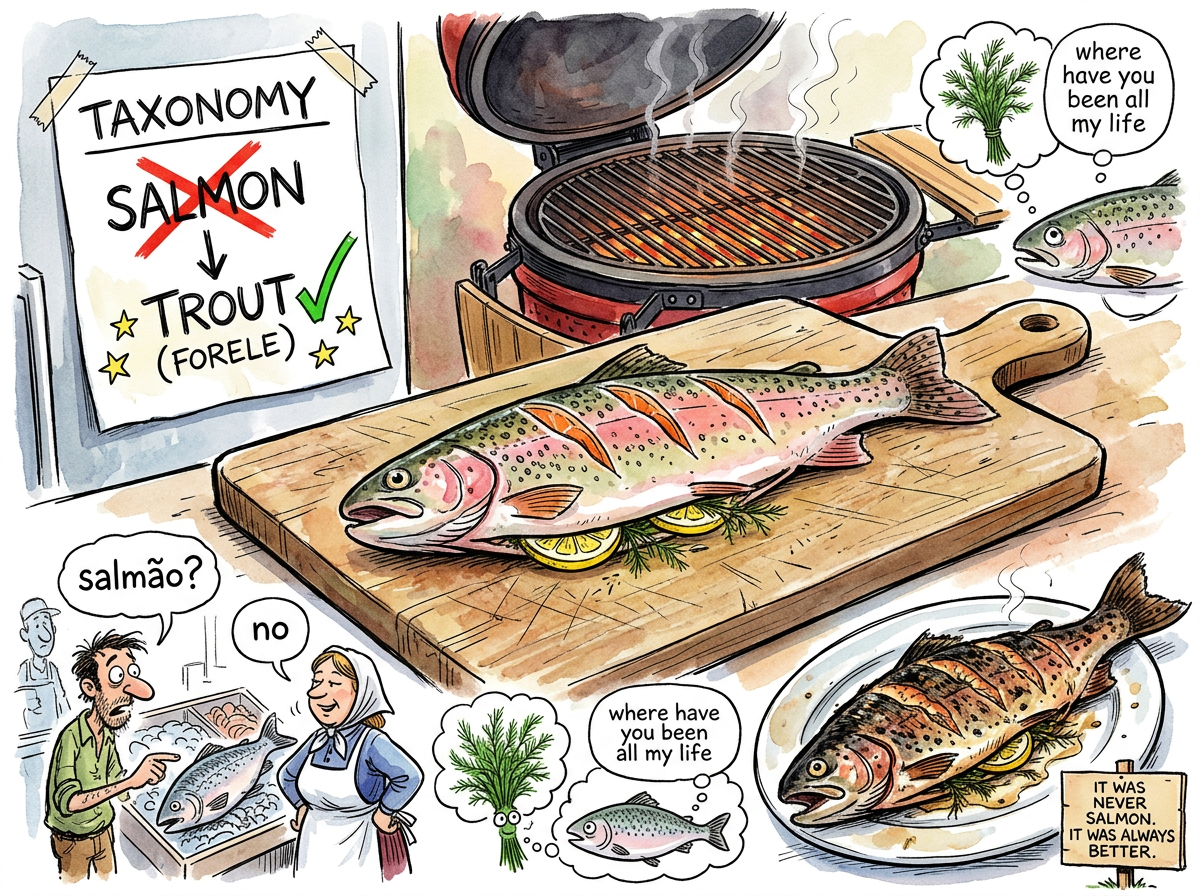
Forele — Latvian for trout — is the fish that riclib called “salmão” for approximately one year after arriving in Riga. This was not a translation error. It was a failure of ichthyological education so profound that it deserves its own encyclopedia entry, which is what you are reading now.
The reasoning was simple, internally consistent, and completely wrong: the fish was pink, it came from a river, it was available at the market in large quantities, and therefore it was salmon. In Portugal, if a fish is pink and from a river, it is salmon. In Latvia, if a fish is pink and from a river, it could be salmon, or it could be trout, or it could be several other things, and the difference matters, and everyone except the newly arrived Portuguese developer knows this.
The title of this entry preserves the original misidentification in parentheses as a historical record, in the same way that museums preserve letters from explorers who confidently labelled rhinoceroses as unicorns.
The Fish
Trout (Salmo trutta, or in its sea-run form Salmo trutta trutta, because taxonomists enjoy repetition) is not salmon (Salmo salar). They are related — cousins, if you will — in the way that the Lizard and the Squirrel are related: they share a common ancestor but have made fundamentally different life choices.
The anatomical confession:
- Size: Trout is smaller. A whole trout is 30–40cm and fits in your hand. A whole salmon is 60–100cm and fits in your bathtub. This should have been the first clue.
- Flesh: Trout is leaner, more delicate, subtler. Salmon is fattier, richer, more assertive. Trout whispers. Salmon announces.
- Skin: Trout has speckled skin with small spots — beautiful, if you are the kind of person who notices fish skin, which riclib was not until a Latvian grandmother pointed at the spots and said “forele” with the specific patience reserved for educating foreigners.
- Flavour: Trout tastes like a river that has been thinking about the sea but hasn’t committed. Salmon tastes like the sea showed up uninvited and made itself comfortable.
- Bones: Trout has more small bones. This is the price of delicacy. The universe charges for subtlety.
They are both salmonids. They are both pink. They are both available at Riga Central Market. This is where the similarities end and where riclib’s confusion began.
The Method
Whole trout on The Kamado is, arguably, the single best use of a whole fish on a ceramic grill. The argument goes like this:
A whole salmon is too large. It hangs off the grate. It requires a fish basket or careful manoeuvring. It cooks unevenly — the thick belly takes longer than the thin tail, and by the time the belly is done the tail has turned to leather. A whole salmon on a Kamado is the Squirrel’s project: ambitious, impressive, requiring specialised equipment and constant attention, and delivering a result that is good but not as good as the effort implied.
A whole trout fits on the grate. The whole fish. No overhang. No fish basket. No manoeuvring.
The method:
- Score the fish: three diagonal cuts on each side, down to the bone. This lets heat into the thickest part and gives the skin permission to crisp without curling.
- Stuff the cavity: lemon slices and dill. Fresh dill. Generous dill. More dill than a Portuguese would consider reasonable, which is any dill at all (see below).
- Oil the grate: not the fish, the grate. A hot, oiled grate releases fish. A hot, dry grate holds fish hostage.
- Grill at medium-high: 200–230C (390–450F). Direct heat.
- 5–6 minutes per side: that’s it. The fish is done when the flesh flakes at the deepest score mark. The skin is done when it has gone from silver-speckled to dark and crackling.
- Do not move it unnecessarily: the Squirrel wants to check. The Squirrel wants to peek. The Squirrel wants to lift a corner and see how it’s doing. The Lizard placed the fish, set a timer, and went to pour a drink.
The skin crisps. The flesh flakes. The dill-lemon interior steams and perfumes the cavity. The whole operation takes twelve minutes. Twelve minutes from raw fish to dinner. The Dry Brine is optional but recommended — salt the fish thirty minutes before grilling, let the surface dry slightly, improve the skin crisp.
This is the Lizard’s fish. Small, fast, complete, better than the ambitious alternative.
The Traeger-to-Ninja Method
The Kamado method is the fast path. The Traeger method is the slow revelation.
Low and slow on The Traeger: the whole trout — or fillets, when the market offers them — goes into the Traeger at 110–120°C (230–248°F) with olive oil, lemon juice, lemon zest, and enough fresh dill to alarm a Portuguese grandmother and delight a Latvian one. The pellet smoke is gentler than charcoal — alder or fruit wood — and at this temperature the flesh cooks slowly enough that the dill and lemon zest infuse through the meat rather than sitting on the surface. Thirty to forty minutes for a whole trout.
The result is extraordinary. The flesh is silky, the smoke is subtle, the dill-lemon perfume goes all the way through. But the skin is soft. At 120°C, the skin never crisps, and uncrispy trout skin is a promise broken.
The Ninja Woodfire finish: the trout transfers to the Ninja Woodfire at 240°C (464°F) in air fryer mode for three to four minutes. The convective blast does what the Traeger cannot — it crisps the skin into crackling while the flesh, already perfectly cooked, stays silky inside. The temperature differential is the trick: slow enough to infuse, hot enough to finish.
Two machines. Two temperatures. One trout. The Squirrel would add a third step. The Lizard notes that this is already twice as many appliances as the Kamado method, which worked fine. The Lizard is correct. The two-step method is still better.
The Dill Discovery
Portuguese cooking does not have dill. This is not an exaggeration. It is not a simplification. Portuguese cooking — a cuisine that spans five centuries of maritime exploration, that borrowed spices from India and chillies from Brazil and coriander from North Africa — does not use dill. Has never used dill. Does not acknowledge dill.
riclib arrived in Latvia and encountered dill the way a medieval cartographer might have encountered a continent: it was there, it had always been there, and yet it appeared on none of his maps.
Dill is everywhere in the Baltics. It is in the soup. It is in the salad. It is on the potatoes. It is on the fish. It is in the cottage cheese. It grows in window boxes and gardens and cracks in pavements and, one suspects, in the dreams of Latvian grandmothers. It is the parsley of Northern Europe, except it is better than parsley, which is a bold claim from a man raised on a cuisine built on parsley.
The discovery that dill is perfect with fish — specifically, that fresh dill stuffed inside a whole trout and grilled creates a fragrance that is simultaneously herbal, anise-adjacent, and somehow both delicate and insistent — was one of those moments where riclib understood that moving to Latvia had expanded not just his geography but his palate.
He now uses dill with the convert’s enthusiasm. The Portuguese relatives are suspicious. The Latvian neighbours are amused. The trout does not care about cultural context; it simply tastes better with dill.
The Market Education
The education happened gradually, over approximately six months, at Riga Central Market — five enormous pavilions built from old Zeppelin hangars, which is exactly the kind of architectural fact that makes Riga feel like a city designed by someone who had read too much Jules Verne.
The fish pavilion is the relevant one. Inside, Latvian vendors sell freshwater and Baltic fish from refrigerated stalls. The fish is fresh. The vendors are knowledgeable. The prices are written in Latvian.
riclib’s first visits involved pointing at pink fish and saying “salmão?” — which the vendors interpreted as the foreign equivalent of asking for salmon, and so they directed him to the actual salmon (lašī), which was larger, more expensive, and not what he had been pointing at.
The correction came from a grandmother — they are always grandmothers — who watched him point at a trout and say “salmão” one too many times. She picked up the trout, held it next to a salmon fillet, and conducted a wordless comparative anatomy lesson that involved pointing at the spots, pointing at the size, shaking her head slowly, and saying “forele” with the tone of a professor who has been asked, for the last time, whether the Earth is flat.
“Forele,” riclib repeated.
She nodded.
“Not salmão.”
She shook her head.
He bought the forele. He has been buying forele since. He still occasionally calls it salmão at home, because some errors become terms of endearment.
Measured Characteristics
- Species: Salmo trutta (brown trout / sea trout)
- Latvian: forele
- Portuguese (incorrect): salmão
- Portuguese (correct): truta
- Length: 30–40cm (whole fish, market size)
- Weight: 300–600g
- Flesh colour: pink (the source of the confusion)
- Fat content: lower than salmon (leaner, more delicate)
- Bones: more numerous, smaller (the price of subtlety)
- Kamado temperature: 200–230C (390–450F)
- Cook time: 5–6 minutes per side (whole fish, scored)
- Stuffing: lemon slices, fresh dill (generous)
- Preparation: score three times per side, stuff cavity, oil the grate
- Dry brine: optional, 30 minutes, improves skin crisp
- Total time from raw to plate: 12 minutes (Kamado), 45 minutes (Traeger + Ninja)
- Traeger method: 110–120°C (230–248°F), dill, lemon, olive oil, lemon zest, 30–40 min
- Ninja Woodfire finish: 240°C (464°F), 3–4 minutes (the skin crisper)
- Appliances in the refined method: 2 (the Lizard’s eyebrow: raised)
- Dill: essential (a herb that does not exist in Portuguese cuisine, which is Portugal’s loss)
- Market vendor patience: extraordinary
- Months to correct identification: approximately six
- Embarrassment level: moderate (mitigated by the fish being delicious)
- The Squirrel’s opinion: “what if we also added a glaze and some smoked paprika and—” (no)
- The Lizard’s opinion: lemon, dill, fire, done