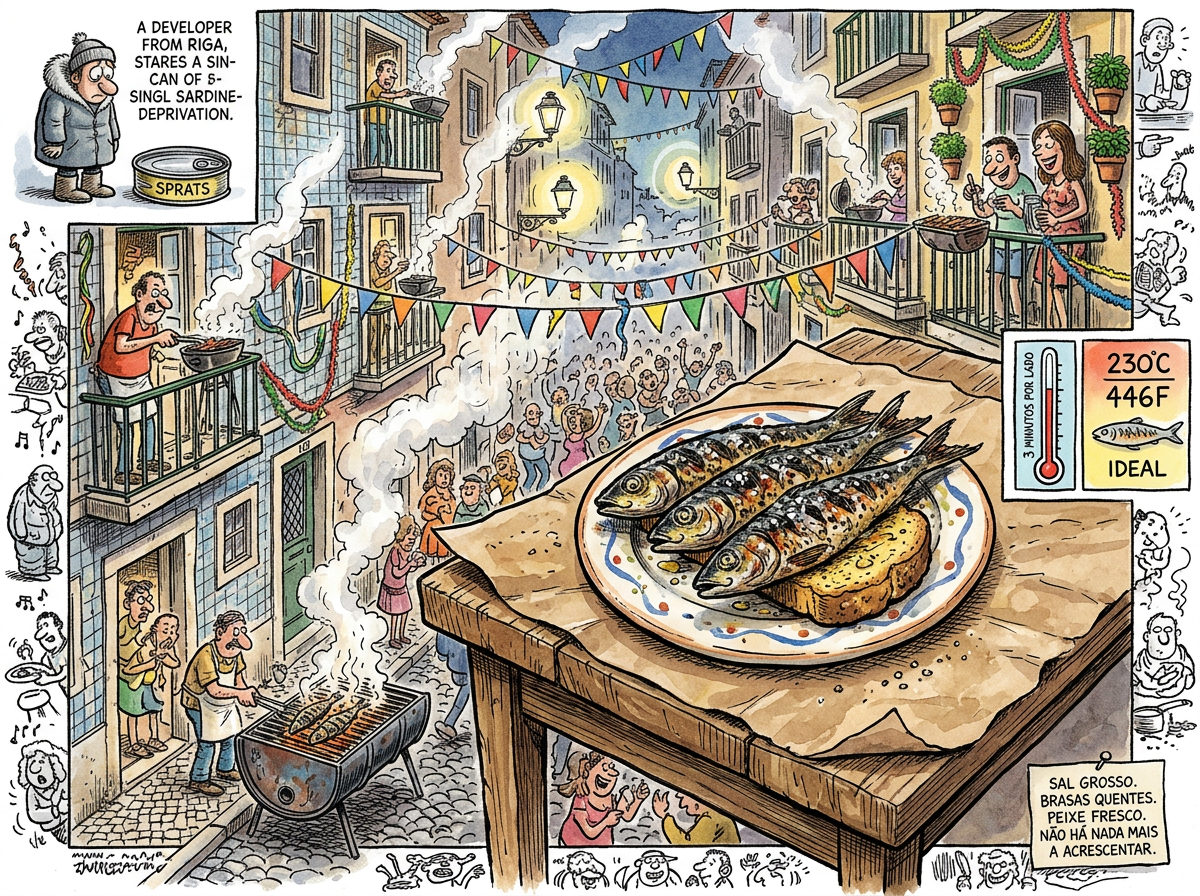
Sardinhas assadas are Portuguese grilled sardines — whole, ungutted, unseasoned except for coarse salt, cooked over charcoal until the skin blisters and splits, served on a slice of bread that exists solely to absorb the dripping oil and become, arguably, the best part of the meal. They are THE symbol of Portuguese summer. Not one of the symbols. THE symbol. The sardine is to Portugal what the bald eagle is to America, except the sardine is edible, delicious, and actually appears in every neighbourhood rather than just on currency.
This is not a recipe. A recipe implies there are decisions to make. There are no decisions. The sardine is fresh. The salt is coarse. The coals are hot. Three minutes per side. The bread is underneath. You eat with your hands. You eat the head. You eat the fins. You eat everything except the spine, which you lift out in one piece if the sardine was fresh enough and the cook was patient enough, and if it doesn’t come out clean you eat around it because this is not surgery, this is dinner.
The Squirrel once suggested marinating the sardines in lemon juice and herbs before grilling. He had prepared a spreadsheet comparing seven marinades. The Lizard ate a sardine with salt and said nothing, because the sardine had already said everything.
The Season
The Portuguese sardine season runs from June to September. This is not a suggestion. This is ichthyology. Sardina pilchardus spends the winter lean and bony, recovering from spawning, and no amount of charcoal skill can make a January sardine taste like a June sardine. The fat content peaks in summer — 10-15% body fat — and it is this fat that makes the sardine self-baste on the grill, the oils dripping onto the coals and flaming back up to kiss the skin, creating the blistered, smoky, salt-crusted exterior that is the entire point.
Portuguese fishmongers grade sardines by size and fat. The ideal grilling sardine is 15-20cm, firm to the touch, eyes clear, scales bright. A fishmonger who tries to sell you frozen sardines for grilling is not a fishmonger. He is a man with a shop who happens to sell fish-shaped objects.
The sardine must be fresh. This is repeated because it cannot be repeated enough. A frozen sardine has already surrendered its cellular integrity to ice crystals and will weep moisture onto the coals instead of rendering fat through the skin. A frozen sardine on a hot grill is not a sardine. It is a small, sad telegram from the sea, delivered too late.
The Method (Impossibly Simple)
The method is so simple it borders on the philosophical. It raises the question of whether cooking can be reduced to its absolute minimum and still be cooking, or whether at some point it becomes merely “applying heat to a thing that was already perfect.”
- Light charcoal. Wait until white-hot, no flames. 230C (446F) at grate level.
- Salt the sardines with coarse salt. Both sides. Generously. Do not gut them — the guts protect the flesh during grilling and pull away cleanly afterwards.
- Place on grill. Do not move them.
- Three minutes. Flip once. Three more minutes.
- Place on bread. Eat.
That is it. There is no step six. The Squirrel will want a step six. The Squirrel will suggest a chimichurri, a garlic butter, a squeeze of lemon, a side of roasted peppers. The peppers are acceptable (pimentos de Padrón, grilled alongside, are traditional and delicious). Everything else is an admission that you started with an inferior sardine and are trying to compensate. A proper sardine needs nothing. A proper sardine, salted and grilled, is a closed system. It is thermodynamically complete.
The bread — ideally broa de milho (corn bread) or a thick slice of pão caseiro (country bread) — is placed under the sardine not as a plate but as a sponge. It absorbs the oil. The oil carries the smoke and the salt and the rendered fat into the bread’s crumb. The oil-soaked bread is eaten last. People who discard the bread do not understand what just happened on that bread. What happened on that bread is the best part of the meal, and it happened without anyone trying.
Santo António and The Smell of June
On the night of June 12th and the day of June 13th — the feast of Santo António, patron saint of Lisbon — the entire city grills sardines. This is not a figure of speech. This is not “many people grill sardines.” This is: every neighbourhood, every street, every balcony, every improvised grill made from an oil drum cut in half, every portable churrasqueira dragged out of a garage and set up on the sidewalk. The sardines go on the coals at dusk and the smoke rises into the June night.
Not parts of the city. The entire city. The smoke is visible from the bridges. It mingles with the streamers and the music and the manjerico (small basil pots with love poems, the traditional gift) and the marching, and the entire country smells like grilled sardines — because it is not just Lisbon. Porto has São João (June 23rd). Braga has São João too. Every city, every village, every collection of houses large enough to contain a person and a grill. The sardine is not Lisbon’s fish. The sardine is Portugal’s fish. It is the one food that every Portuguese person, regardless of region, class, or opinion on whether Porto or Lisbon is the better city (it is Porto, but Lisbon has the better saint’s party), agrees is sacred and non-negotiable.
The density of simultaneous sardine grilling per square kilometre in Lisbon on the night of June 12th is, in all likelihood, the highest concentration of coordinated fish grilling in the Western world. The smoke is so thick the streetlights have halos. Satellite imagery probably shows it. Nobody has checked because nobody needed to. The Portuguese already know.
The Baltic Gap
riclib lives in Riga. The Baltic Sea has fish. The Baltic Sea has sprats. Sprats are small, silvery, and come in tins, and they are fine. They are a perfectly respectable fish. They are not sardines.
The size is wrong — sprats are 8-12cm, sardines are 15-20cm. The fat content is wrong — different species, different diet, different water temperature, different ocean entirely. The smoke is wrong — Baltic grilling culture favours alder wood, which is lovely for salmon but produces a fundamentally different smoke profile than the eucalyptus-and-oak charcoal of a Portuguese churrasqueira. The bread is wrong — Latvian rye bread is extraordinary, possibly the best bread in Northern Europe, but it is not broa. The air is wrong — 15C (59F) on a Riga June evening versus 28C (82F) on a Lisbon June evening, and the warmth matters because sardines are eaten outside, standing up, in a crowd, with your hands, slightly drunk on cheap red wine, and this experience does not translate to “standing in a Riga courtyard in a jacket wondering if it will rain.”
Finding proper Portuguese-grade fresh sardines in Riga is a quest that remains unfinished. The Central Market has fish. It has excellent fish. It has smoked fish that would make a Lisbon fishmonger weep with envy. It does not have Sardina pilchardus pulled from the Atlantic that morning, fat with June plankton, eyes still clear.
The method is absurdly simple — coarse salt, hot coals, three minutes per side — which makes the unavailability all the more painful. It is not that the recipe is hard. It is that the ingredient does not exist at this latitude. riclib can reproduce the technique perfectly. The Kamado reaches temperature. The charcoal is correct. The salt is correct. The timing is correct. The sardine is not correct, because the sardine is 3,800 kilometres away, getting grilled by someone who does not appreciate the miracle of proximity.
The Squirrel once proposed having fresh sardines flown in from Lisbon. He had researched cold-chain logistics and calculated the cost per fish. The Lizard pointed out that by the time the sardine clears customs in Riga, it is no longer a fresh sardine. It is a sardine with a passport and jet lag. The Lizard cooked a Frango da Guia instead, because the Lizard knows which battles to fight and which absences to honour by not approximating them.
Measured Characteristics
- Species: Sardina pilchardus (European pilchard)
- Season: June–September (peak fat)
- Ideal size: 15–20cm
- Fat content (in season): 10–15%
- Salt: coarse, generous, nothing else
- Charcoal temperature: 230C (446F), white-hot, no flames
- Cook time: 3 minutes per side (6 minutes total)
- Flips: exactly one
- Gutting before grilling: no (heresy)
- Marinades: none (the sardine is not broken, do not fix it)
- Bread: broa de milho or pão caseiro, placed under the sardine
- Eaten with: hands
- Parts eaten: everything except the spine
- National holiday: Santo António, June 13th (Lisbon); São João, June 23rd (Porto)
- Smoke visibility on June 12th: visible from the bridges (probably from space)
- Distance from Riga to nearest proper sardine: ~3,800km
- Baltic substitute (sprats): rejected (too small, wrong fat, wrong everything)
- Frozen substitute: rejected (a frozen sardine is a fish that has already given up)
- The Squirrel’s suggestion: seven-ingredient marinade (rejected, spreadsheet deleted)
- The Lizard’s position: salt (accepted, final, non-negotiable)
- riclib’s deepest food homesickness in Riga: this entry
- Can this dish be made in Riga: technically yes, spiritually no