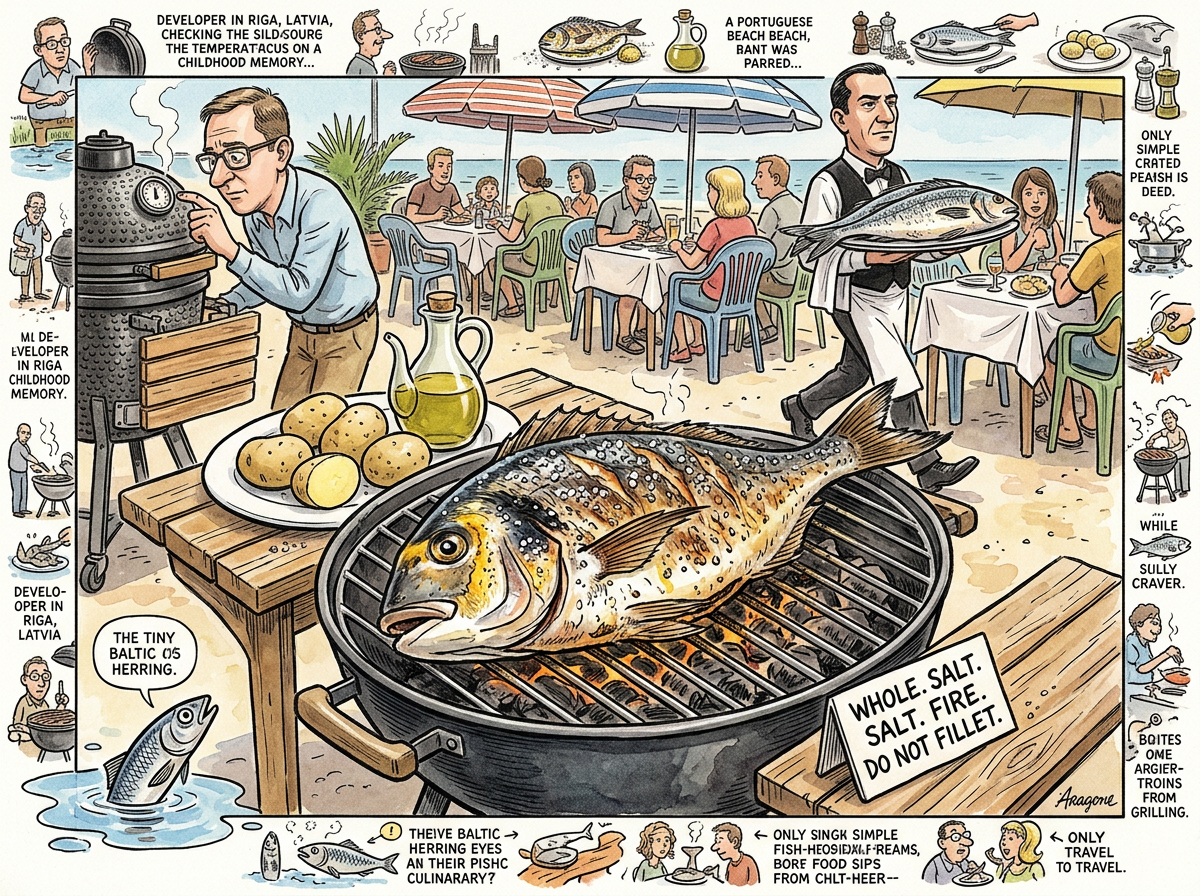
Dourada (Sparus aurata, gilt-head bream) is a Mediterranean fish with a golden spot between its eyes, a delicate white flesh, and an ancient covenant with the Portuguese people that states: you will grill me whole, with coarse salt, over charcoal, and you will not complicate this with sauces, marinades, or culinary ambition. The covenant has held for centuries. The fish has not needed a rebrand.
The name comes from dourado — golden — because of the crescent of gold between the eyes, which is the kind of branding that marketing departments spend millions trying to achieve and a fish managed by accident of pigmentation. The dourada does not know it is golden. It does not know it is revered. It knows only the Mediterranean, which is warm and full of things to eat, unlike the Baltic, which is cold and full of herring.
In Portugal, dourada grelhada is not a recipe. It is a condition of coastal existence. It is what appears on your plate when you sit down at a beach restaurant and say “peixe” to the waiter, who did not need you to say it because he was already bringing it. The fish is the default. Everything else is a deviation from the default. The Lizard approves.
The Fish
The gilt-head bream is a sparid — a family of fish that includes sea bream, porgy, and other species that sound less appetising than they taste. Sparus aurata is the flagship. It grows to 70cm in the wild, though the ones you grill are typically 300–500g, which is the size that fits on a plate and on a grill grate without requiring structural engineering.
The flesh is white, firm, and mildly sweet. It holds together on a grill — unlike, say, sole, which would disintegrate into expensive flakes the moment you tried to flip it. The dourada’s structural integrity is part of its genius. It was designed — by evolution, not a product manager — for grilling.
The skin is another asset. Thin enough to crisp, thick enough to protect the flesh from direct heat. The scales, when removed (and they must be removed — the Squirrel once suggested leaving them on “for extra crunch,” which was wrong in a way that only the Squirrel can be wrong: confidently, inventively, and with a link to a YouTube video), leave a surface that chars beautifully: blistered, spotted with black, pulling away from the flesh in places to reveal the white meat underneath.
The golden spot fades after death, which is unfortunate for presentation but irrelevant for flavour. The fish does not need to be golden to be good. It needs to be fresh. The eyes tell you everything: clear and bright means fresh, cloudy means the fish has been thinking about its mortality for too long on a bed of ice.
The Method
The method is Portuguese. Which is to say: it is simple, and the simplicity is load-bearing.
Preparation (5 minutes):
- Scale the fish. Gut the fish. Rinse the fish. Your fishmonger has already done this. If your fishmonger has not done this, find a fishmonger who understands the social contract.
- Score the flesh — three diagonal cuts per side, deep enough to reach bone but not through it. The scores let heat penetrate the thickest part of the body. Without them, the tail is ash before the shoulder is cooked.
- Coarse salt, inside and out. Not fine salt — fine salt dissolves immediately and creates a brine layer. Coarse salt sits on the surface, melts slowly, seasons progressively. The cavity gets salt too. The cavity is where the flavour hides.
- That is it. No lemon yet. No olive oil yet. No herbs. The Squirrel wants to stuff the cavity with rosemary and garlic and “maybe some fennel fronds?” No. The fish is the flavour. The salt is the seasoning. The fire is the technique. Three inputs. Zero additions.
The Grill (10–14 minutes total):
- Heat: high. On The Kamado, 260°C (500°F) direct, grill grate as close to the coals as practical.
- Oil the grate, not the fish. A fish stuck to the grate is a fish you cannot flip, and a fish you cannot flip is a tragedy in two acts.
- Lay the fish at an angle to the grate bars. This is not aesthetic — it prevents the thin tail section from falling through the gaps and becoming a sacrifice to the coals below.
- 5–7 minutes per side, depending on size. A 400g fish is 5 minutes. A 600g fish is 7. Do not calculate this. Watch the fish.
- The eye test: the eyes turn from clear to opaque white when the fish is done. This is the oldest thermometer in cooking. It predates the Thermapen by several millennia and is exactly as accurate. When both eyes are white, the fish is ready. When one eye is white and the other is not, flip the fish and wait. When neither eye is white, do not touch the fish. The eyes are not a suggestion. The eyes are an instruction.
- The skin should be charred in spots — not uniformly black (that is burnt), but leopard-spotted with char (that is grilled). The difference is attention.
Do not fillet before grilling. The bones are the architecture. They keep the flesh moist, conduct heat evenly, and prevent the fish from collapsing into a formless protein patty on the grate. You fillet at the table, with a fork, pulling the flesh away from the spine in clean sections. If the fish is cooked correctly, the flesh releases from the bone with the quiet satisfaction of code that compiles on the first try.
The Portuguese Table
In Portugal, the dourada arrives on a platter with:
- Boiled potatoes (small, waxy, skin on, dressed in olive oil)
- Olive oil (good, green, peppery, drizzled — not poured — over the fish)
- A wedge of lemon (optional, used sparingly, controversial among purists who believe the fish does not need acid and the lemon is there for tourists)
- A side salad (tomato, onion, green pepper, olive oil, vinegar)
- Nothing else
This is not minimalism as aesthetic choice. This is minimalism as accumulated wisdom. Generations of Portuguese cooks arrived at this plate through the ruthless elimination of everything that did not make the fish taste more like fish. The Lizard did not invent this philosophy. The Lizard learned it from a beach restaurant in Sesimbra where the menu was a chalkboard with three words: peixe, carne, salada.
riclib grills dourada on The Kamado in Riga when Mediterranean imports appear at the fish counter, which is seasonal and unpredictable — the Baltic does not produce dourada, having committed instead to herring and sprats, which are respectable fish with a strong work ethic but are not dourada in the same way that a well-documented codebase is not the same as a codebase that works. Both have value. One you cross a continent for.
The Riga method is identical: whole fish, scored, coarse salt, high heat, 5–7 minutes per side. The potatoes are Latvian, which is actually excellent — Latvia does potatoes with the quiet competence of a country that has been doing potatoes for a very long time and does not need to discuss it. The olive oil is imported. The lemon is from Spain via Rimi. The charcoal is The Kamado’s lump hardwood. The result is correct. Not identical to a beach in Sesimbra — the air is wrong, the humidity is wrong, the sound of waves is replaced by the sound of trams on Brivibas iela — but the fish is right, and the fish is what matters.
The cheek meat, excavated from beneath the gill plate with surgical patience, is the single finest bite. Anyone who discards the head is discarding the thesis statement. The Squirrel does not eat fish heads. The Squirrel is missing the point, as usual.
Measured Characteristics
- Species: Sparus aurata (gilt-head sea bream)
- Weight (ideal for grilling): 300–500g whole
- Fish per person: 1 (this is not a sharing plate)
- Flesh: white, firm, mildly sweet
- Skin: thin, crisps well, chars beautifully
- Identifying feature: golden crescent between the eyes
- Native waters: Mediterranean, eastern Atlantic
- Available in Riga: seasonally, from imports, check the fish counter and hope
- Available in Portugal: always, everywhere, without asking
- Preparation time: 5 minutes
- Grill temperature: 260°C (500°F) direct
- Cook time: 5–7 minutes per side (10–14 total)
- Doneness indicator: white eyes (both of them)
- Score marks: 3 per side, diagonal, to the bone
- Required seasonings: coarse salt (that is it)
- Permitted additions at the table: olive oil, lemon wedge
- Forbidden actions: filleting before grilling, stuffing the cavity with herbs, wrapping in foil, sauce of any kind
- The Squirrel’s suggestion: “stuff it with fennel and wrap in foil” (rejected, permanently)
- The Lizard’s position: salt, fire, eat
- Best bite: the cheek (beneath the gill plate, excavate with care)
- Accompaniments: boiled potatoes, olive oil, tomato salad, silence
- Baltic equivalent: none (herring is not dourada, and it knows this)
- Distance from origin: 2,800 km (Sesimbra to Riga, as the dourada does not swim)