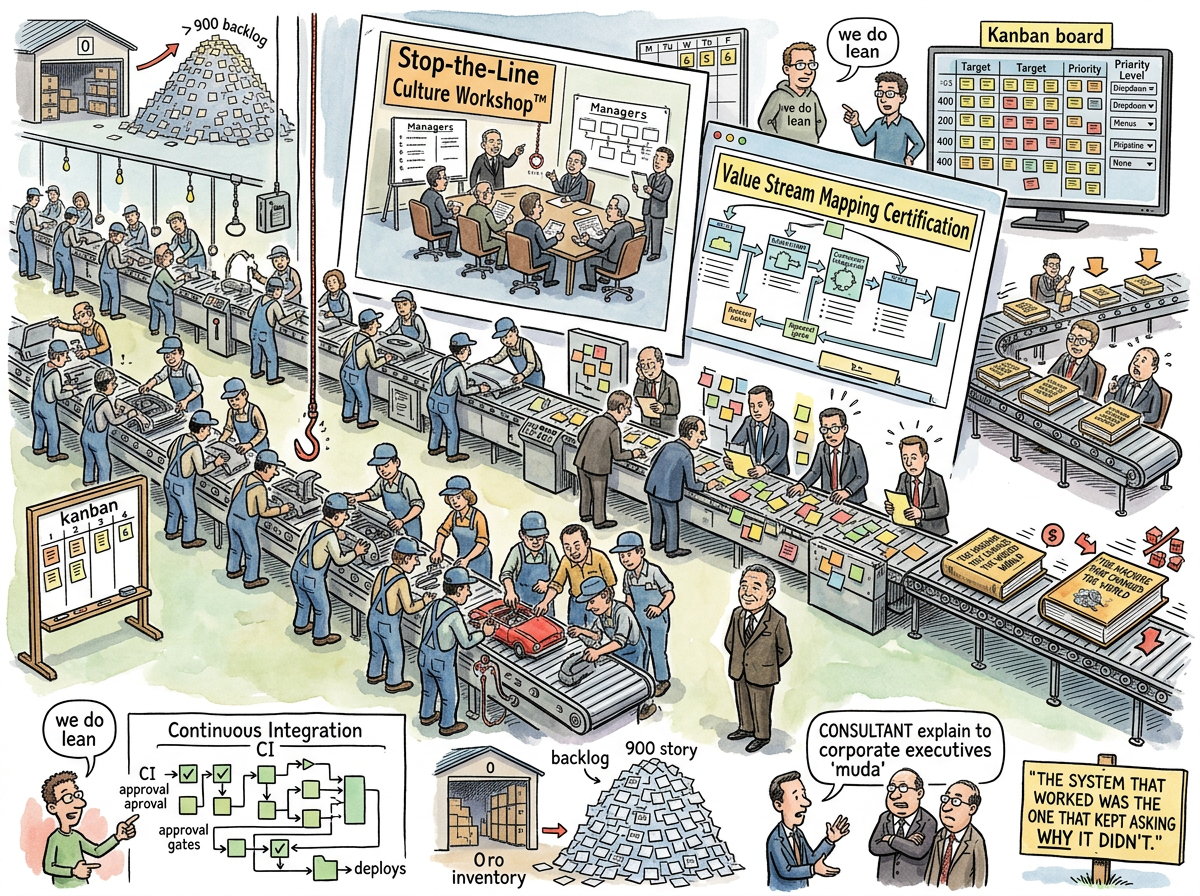
Lean is a philosophy of production that originated at Toyota in the 1950s, was named by an MIT researcher in 1988, codified in a book in 1990, and has spent the subsequent thirty-five years being adopted by organizations that implement its vocabulary while ignoring its discipline.
Lean’s core insight is deceptively simple: waste is the enemy, flow is the goal, and the people doing the work are the ones who know how to improve it. This insight transformed Toyota from a small Japanese automaker into the world’s largest car manufacturer. It also launched a consulting industry devoted to teaching the insight to organizations that then fail to act on it, which is itself a form of waste that Lean would classify as muda if Lean were allowed to audit its own adoption.
“You’ve been optimizing the wrong thing.”
— riclib, Mythology Driven Development — Substack Draft
The Toyota Production System
Before it was called Lean, it was called the Toyota Production System (TPS), developed primarily by Taiichi Ohno and Shigeo Shingo across three decades of relentless, patient, unglamorous improvement.
TPS rested on two pillars:
Just-in-Time — produce only what is needed, when it is needed, in the quantity needed. No inventory buffers. No “just in case.” No backlog of nine hundred stories waiting for a sprint that will never come.
Jidoka — automation with a human touch. When a defect is detected, stop the line. Fix it at the source. Do not pass it downstream. Do not file a JIRA ticket. Do not schedule a meeting about the defect. Stop. Fix. Now.
The pull cord — the andon — hung within reach of every worker on the line. Any worker could stop production. Any worker. Not the manager. Not the team lead. Not the Vice President of Stopping Things. The worker who saw the problem had the authority to halt the entire factory.
Western manufacturers visited Toyota and saw the pull cord. They went home and installed pull cords. Nobody pulled them. The cords were not the system. The permission was the system.
The Five Principles
When Womack and Jones codified Lean in The Machine That Changed the World (1990) and Lean Thinking (1996), they distilled it to five principles:
- Identify value — from the customer’s perspective, not the org chart’s
- Map the value stream — trace every step, identify waste
- Create flow — eliminate batching, queues, and handoffs
- Establish pull — let demand drive production, not forecasts
- Pursue perfection — continuous improvement, forever, no finish line
Five principles. Clear, actionable, measurable. Enough to fill a napkin. Enough to transform an industry. Not enough to sustain a certification ecosystem, so the industry added workshops, maturity models, assessment frameworks, and Lean Six Sigma Black Belts — a phrase that would have made Taiichi Ohno stop the line.
The Seven Wastes
Lean identifies seven types of waste (muda):
| Japanese | English | In Software |
|---|---|---|
| 過剰生産 | Overproduction | Features nobody asked for |
| 待ち | Waiting | Developers blocked on approvals, reviews, environments |
| 運搬 | Transportation | Handoffs between teams, departments, time zones |
| 加工 | Over-processing | Gold-plating, premature abstraction, the Squirrel’s architecture |
| 在庫 | Inventory | Backlogs, branches, undeployed code |
| 動作 | Motion | Context switching, ceremony overhead, meetings about meetings |
| 不良 | Defects | Bugs found downstream instead of at the source |
An eighth waste was later added: unused talent — the waste of not listening to the people doing the work. This is the waste that generates all the others.
Lean in Software
Lean entered software through two doors:
The serious door: Mary and Tom Poppendieck’s Lean Software Development (2003), which translated the Toyota principles into software practices with intellectual rigor and practical humility. Map the value stream. Eliminate waste. Defer decisions to the last responsible moment. Deliver fast. Build quality in. Respect people.
The famous door: Eric Ries’s The Lean Startup (2011), which took “Build-Measure-Learn” and gave Silicon Valley permission to ship unfinished products, call failure “pivoting,” and treat customers as unwitting participants in experiments. The Lean Startup is to Lean what the Spotify Model is to Spotify — a simplification so successful that it replaced the original in the popular imagination.
Both doors opened onto the same room. One entered quietly and got to work. The other entered with a TED talk.
The Paradox of Lean Adoption
Lean’s central paradox is identical to Agile’s: the philosophy that eliminates waste generates enormous waste when adopted as a brand rather than a discipline.
A Lean transformation typically proceeds as follows:
- Executive reads The Machine That Changed the World on a flight
- Executive hires a Lean consultancy
- Consultancy conducts a Value Stream Mapping workshop (3 days, £15,000)
- Workshop produces a current-state map covered in waste
- Workshop produces a future-state map with the waste removed
- The future-state map is laminated, framed, and hung in the lobby
- Nothing changes
- Executive attends a conference and learns about SAFe
The map is not the territory. The value stream map is not the value stream. Laminating the map does not reduce the waste. But the map looks like progress, and in enterprise, looking like progress is often the primary value stream.
The Lizard’s Position
The Lizard has never conducted a Value Stream Mapping workshop. The Lizard’s value stream is: markdown in, HTML out, zero waste, one binary.
This is not a simplification of Lean. This is Lean — the version that Ohno would recognize. No inventory (no backlog). Pull-based (build what’s needed). Flow (one pipeline, no handoffs). Stop-the-line quality (if the build breaks, fix it now). Continuous improvement (every commit).
The Lizard does not know the word muda. The Lizard simply does not tolerate waste, which is the same thing without the certification.
Measured Characteristics
Toyota's rise to #1 automaker:                     ~50 years of Lean
Average enterprise Lean transformation:             18 months, then SAFe
Principles in Lean Thinking:                        5
Wastes identified:                                  7 (+1)
Certifications Ohno had:                            0
Certifications available for Lean Six Sigma:        5 belt colors
Cost of a pull cord at Toyota:                      ¥500
Cost of a "Stop-the-Line Culture" workshop:         £15,000
Workers who could stop the Toyota line:              any
Workers who can stop the enterprise pipeline:        the VP (in theory)
Lines of code in Toyota's kanban system:             0 (it was cards)
Lines of code in enterprise Kanban software:         ~500,000
Time from Ohno's insight to global adoption:         40 years
Time from adoption to misunderstanding:              immediate