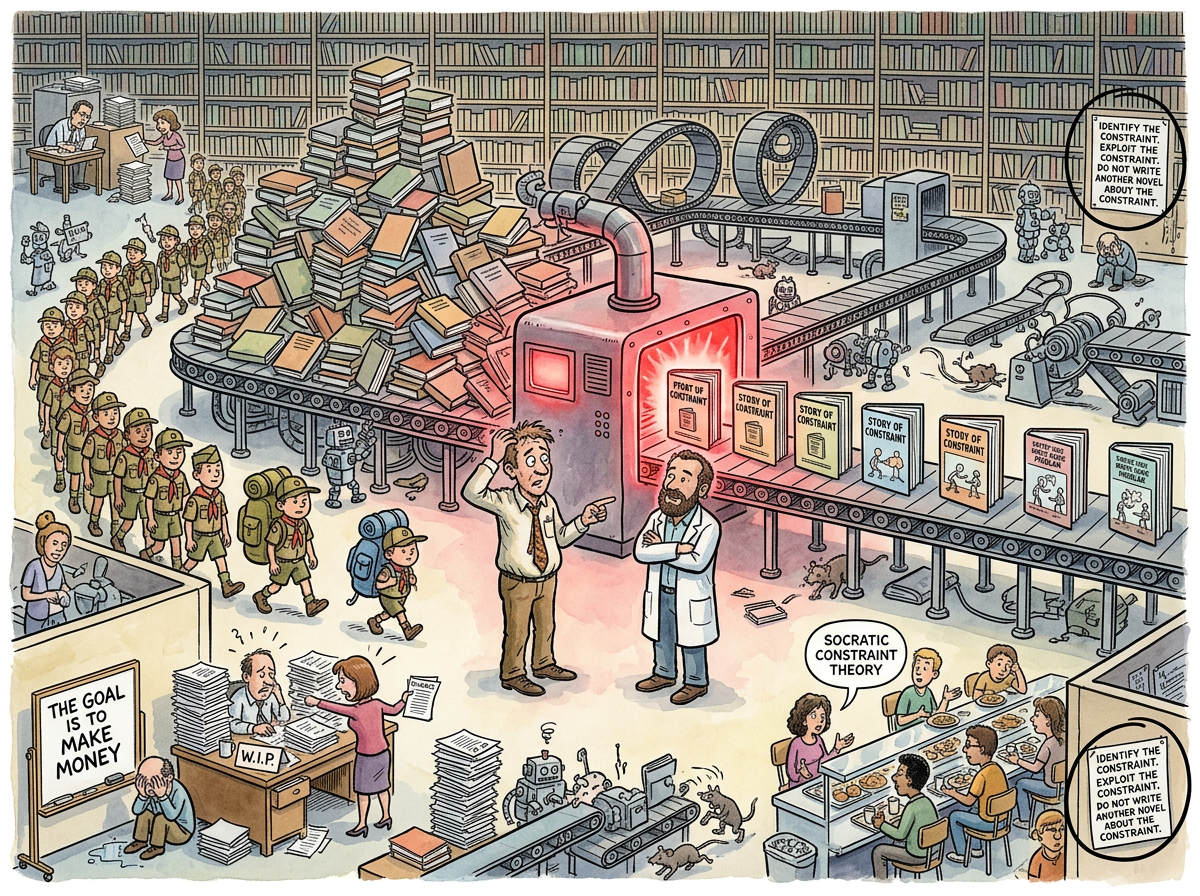
The Goal: A Process of Ongoing Improvement is a 1984 business novel by Eliyahu M. Goldratt and Jeff Cox in which a plant manager named Alex Rogo saves his factory from closure by discovering the Theory of Constraints — guided by a mysterious physicist named Jonah who appears periodically to ask Socratic questions, dispense exactly one insight per encounter, and then vanish before he can be asked anything practical.
It is simultaneously one of the most important books on operations management ever written and one of the strangest reading experiences in the business canon: a novel in which the protagonist’s marriage disintegrates in real time while he learns about throughput, and the reader is expected to care equally about both.
The reader does not care equally about both. The reader cares about throughput.
The Theory of Constraints
Goldratt’s insight — the one Jonah dispenses across two hundred pages of Socratic meandering — is this:
Every system has a constraint. The constraint determines the throughput of the entire system. Improving anything that is not the constraint is an illusion of progress.
The five focusing steps:
- Identify the constraint
- Exploit the constraint (maximize its output with what you have)
- Subordinate everything else to the constraint (nothing runs faster than the bottleneck)
- Elevate the constraint (invest in removing it)
- Repeat — because once you fix one constraint, another becomes the bottleneck
This is profound and simple. It is also, like all profound and simple ideas, almost universally ignored in practice. Organizations optimize everything except the constraint, because the constraint is usually the thing that’s politically inconvenient to name.
The Boy Scout Hike
The book’s most famous analogy: Alex takes his son’s Boy Scout troop on a hike. The troop spreads out. The fast kids race ahead. The slow kids fall behind. The gap between front and back grows without limit.
The constraint is Herbie — the slowest kid. The troop’s throughput is Herbie’s throughput. Making the fast kids faster makes the line longer, not the hike shorter.
Solution: put Herbie at the front. Redistribute his pack weight. Now the troop moves at Herbie’s improved pace, together.
This analogy has been retold in approximately every operations management course, DevOps presentation, and conference talk since 1984. It has not, however, been retold as effectively as Goldratt told it, because Goldratt made you care about Herbie.
The Marriage Subplot
Alex Rogo’s wife, Julie, is unhappy. Alex works constantly. The factory is failing. He comes home late. She takes the kids to her parents’ house.
The marriage subplot exists to humanize the throughput theory. It is the most skipped section of the most important operations book ever written. Readers have been known to develop a physical reflex — a thumb-flick past any paragraph that begins with “Julie” — that operates below conscious awareness.
This is itself a constraint. Goldratt wanted readers to understand that optimizing one system (the factory) while ignoring another (the marriage) is exactly the mistake the Theory of Constraints warns against. The readers who skip the marriage subplot to get to the throughput theory are demonstrating the throughput theory by sub-optimizing their reading experience.
Goldratt would have appreciated the irony. Julie would not.
The Legacy
The Goal has sold over six million copies. It is required reading in MBA programs worldwide. It changed how an entire generation thinks about bottlenecks, work-in-progress, and throughput.
It also spawned a genre: the business novel — a format in which management theory is delivered through fictional characters who exist solely to learn the theory and explain it to each other in dialogue that no human has ever spoken. The format’s advantage is accessibility. The format’s disadvantage is that you must read a novel’s worth of plot to extract a pamphlet’s worth of insight.
Goldratt wrote several sequels: It’s Not Luck, Critical Chain, Necessary but Not Sufficient. Each contained valuable theory wrapped in increasingly tired fiction. The constraint on the series was the fiction. Nobody elevated it.
The most notable descendants of The Goal are not sequels but paraphrases — books that took Goldratt’s structure, applied s/factory/IT department/g, and published the result. See: The Phoenix Project, The Unicorn Project.
Measured Characteristics
Year published:                              1984
Copies sold:                                 6,000,000+
Pages of throughput theory:                  ~120
Pages of marriage subplot:                   ~80
Pages of marriage subplot read:              ~12
Socratic questions asked by Jonah:           47 (estimated)
Straight answers given by Jonah:             0
Boy Scouts in the hiking analogy:            ~15
Herbies per organization:                    1 (but nobody names them)
Business novels spawned:                     dozens
Business novels as good as The Goal:         0
Regex replacements needed for The Phoenix Project:  s/factory/IT/g