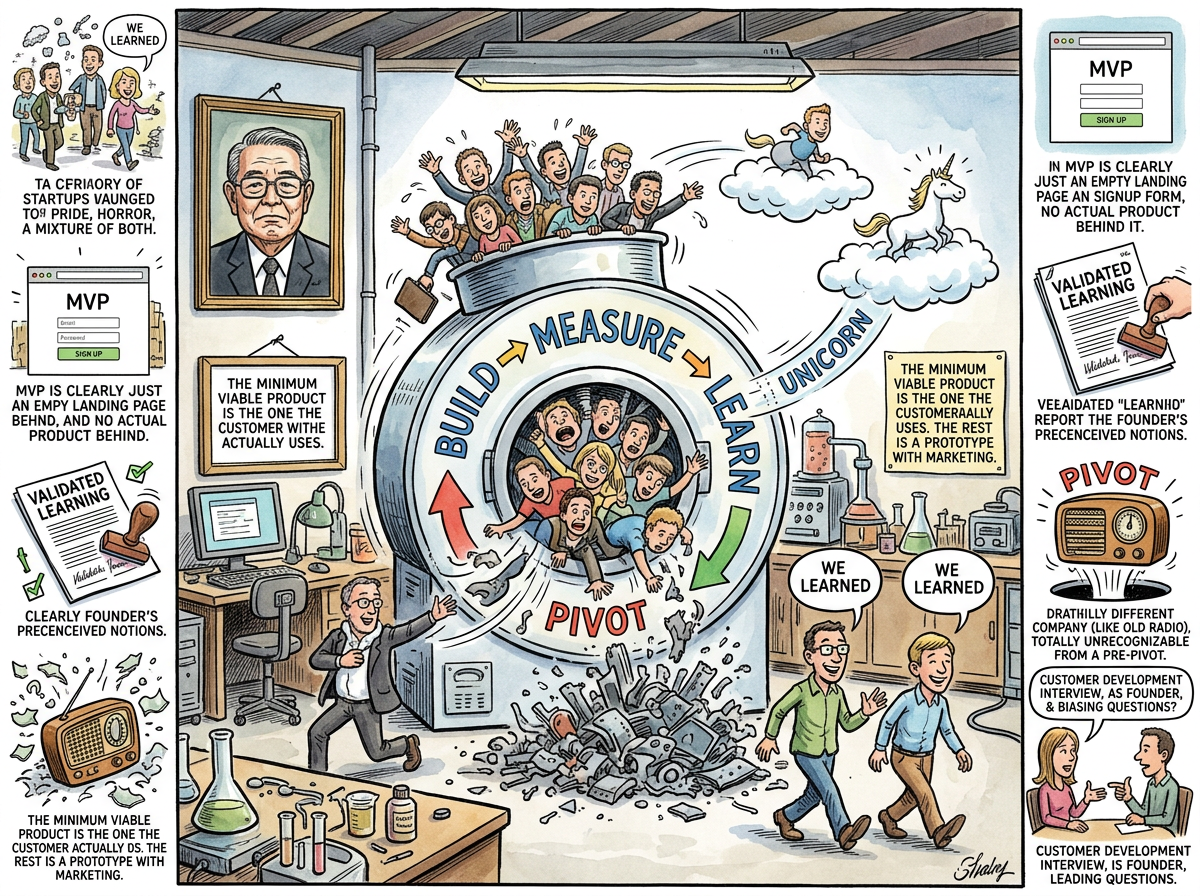
The Lean Startup is a 2011 book by Eric Ries that took Lean manufacturing principles — fifty years of Toyota’s disciplined elimination of waste — and translated them into a methodology for Silicon Valley startups, producing the most influential framework for building products that nobody needs, faster.
This is unfair. Ries’s actual insight is correct: don’t build the whole thing before testing whether anyone wants it. Build the smallest version. Measure whether it works. Learn from the result. Repeat. Build-Measure-Learn. Three words. Each one essential. Each one, in practice, selectively applied.
The startup world heard “Build” and ran with it. “Measure” became optional. “Learn” became “pivot” — a word that means “we were wrong but we’ve rebranded the wrongness as methodology.”
“Every feature you build before validating the need is inventory. Lean would call it muda. The startup world calls it ‘roadmap.’”
The MVP
Ries’s most enduring contribution is the Minimum Viable Product — the smallest thing you can build to test a hypothesis about customer value.
The MVP was a good idea. Then it was adopted.
In Ries’s formulation: the MVP is an experiment. You build the minimum necessary to learn whether your assumption is correct. If the assumption is wrong, you haven’t wasted months of development. If it’s right, you build more.
In Silicon Valley’s interpretation: the MVP is a landing page with a signup form, no product behind it, and a Medium post titled “How We Got 10,000 Signups in 48 Hours.” The signups validate the idea. The absence of a product validates the methodology. The Series A validates the signups. Nobody validates whether the product, once built, will be used by anyone who signed up.
The MVP was Lean’s gift to the startup world. The startup world unwrapped it, wore it as a hat, and called it strategy.
Build-Measure-Learn
The cycle, as Ries intended it:
Build → the minimum experiment to test an assumption
Measure → whether the assumption was correct, using actionable metrics
Learn → what to do next based on the measurement
The cycle, as commonly practiced:
Build → the thing the founder wanted to build anyway
Measure → vanity metrics (signups, pageviews, downloads)
Learn → “the metrics prove we should build more of what the founder wanted”
The gap between the two is the gap between Lean and the Lean brand. Ohno measured cycle time, defect rate, and throughput — metrics that exposed problems. The Lean Startup ecosystem measures growth rate, engagement, and runway — metrics that, in the wrong hands, obscure problems until the runway ends.
The Pivot
Ries defined the pivot as a structured course correction — a change in strategy without a change in vision. You learn that your assumption was wrong. You adjust. You test again.
The pivot, as practiced, is a semantic technology for transforming failure into narrative:
- “We pivoted” = “the product failed”
- “We pivoted to B2B” = “consumers didn’t want it”
- “We pivoted to platform” = “nobody wanted the product so we’re selling the infrastructure”
- “We pivoted to AI” = it’s 2024
The pivot is the Lean Startup’s most honest contribution: the acknowledgment that you will be wrong, and that being wrong quickly is better than being wrong slowly. This is genuine wisdom. It is also, when combined with venture capital, a mechanism for being wrong quickly at scale, repeatedly, with other people’s money.
The Relationship to Lean
The Lean Startup is to Lean what a cover band is to the original: recognizable, accessible, and missing something essential that the audience can’t quite name.
What’s missing is discipline. Toyota’s Lean was fifty years of daily improvement by people who made cars. The Lean Startup is a methodology adopted by people who have not yet made anything, applied to the process of figuring out what to make. Toyota eliminated waste from a system that worked. The Lean Startup eliminates waste from a system that doesn’t exist yet, which is either brilliant efficiency or a philosophical impossibility, depending on how you squint.
Ohno would have recognized the Build-Measure-Learn cycle. He would not have recognized the conference circuit, the certification ecosystem, or the idea that “failing fast” is a strategy rather than a consolation.
Measured Characteristics
Year published:                              2011
Copies sold:                                 1,000,000+
Words in Build-Measure-Learn:                3
Steps typically executed:                    1 (Build)
MVPs that are actually minimum:              ~15%
MVPs that are actually viable:               ~10%
MVPs that are actually products:             ~5%
Pivots per startup (average):                2.3
Pivots that are genuine course corrections:  ~30%
Pivots that are rebranded failures:          ~70%
Startups that practiced Lean Startup:        thousands
Startups that survived:                      the usual percentage
Toyota's opinion:                            not sought