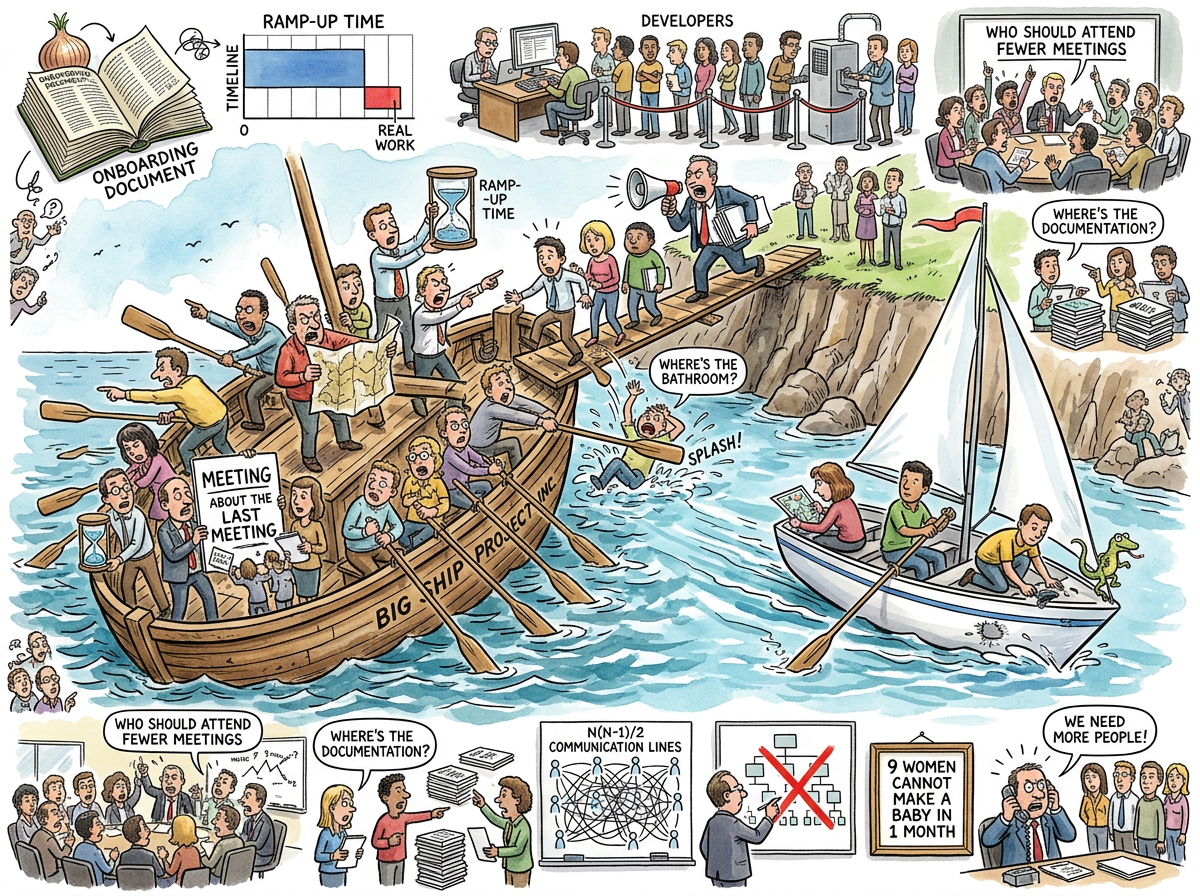
Brooks’s Law states that adding manpower to a late software project makes it later. It was published by Fred Brooks in his 1975 work The Mythical Man-Month, a book that every software manager has on their shelf and no software manager has applied, because applying it requires telling the board that the solution to the project being late is fewer people, and boards do not promote managers who propose fewer people.
The law is simple arithmetic, disguised as a management insight, wrapped in fifty years of being universally understood and universally ignored.
“Nine women cannot make a baby in one month.”
— Fred Brooks, stating the obvious in a way that remains necessary fifty-one years later
The Arithmetic
Brooks’s Law is not opinion. It is mathematics.
A team of n people has n(n-1)/2 communication channels. This is combinatorial growth:
- 3 people → 3 channels
- 6 people → 15 channels
- 12 people → 66 channels
- 24 people → 276 channels
- 50 people → 1,225 channels
Every person added to a project adds n new communication channels, where n is the current team size. The new person must learn the codebase (ramp-up time). The new person must synchronise with every existing team member (communication overhead). The new person must understand the decisions already made, the conventions already established, the bugs already accepted, and the one module that nobody touches because the person who wrote it left in Q2.
Meanwhile, the existing team members must teach the new person — which means they are not building. The teacher’s productivity drops. The student’s productivity is negative (consuming time, not producing output). The net effect of adding one person to a twelve-person team is: twelve people slow down, one person begins ramping up, and the project, which was already late, is now later.
This is not a pessimistic interpretation. It is the calculation. Brooks did the math. Fifty-one years of software projects have confirmed it.
The Mythical Man-Month
The foundational error that Brooks’s Law corrects is the man-month — the assumption that developer-time is fungible, that one developer for twelve months equals twelve developers for one month.
It does not. It has never equalled this. It will never equal this. And yet, every time a project falls behind schedule, someone in a conference room with a whiteboard draws this exact equation, divides the remaining work by the remaining time, arrives at a headcount, and calls HR.
The man-month is mythical because it assumes:
-
Work is parallelisable. Some work is. Most work in a late project is not, because the work that remains is the hard part — the integration, the edge cases, the “it works in isolation but breaks when combined” — and hard work is, by definition, the work that cannot be split.
-
People are interchangeable. They are not. The developer who has been on the project for six months carries six months of context. The developer who arrives today carries zero months of context and a laptop that hasn’t been configured yet.
-
Communication is free. It is not. Every person added is another person who needs to know what’s happening, another person who might make a decision that conflicts with someone else’s decision, another person in the standup saying “I’m still ramping up.”
The man-month is the unit of measurement for managers who have never managed. The people-month — messy, non-linear, full of ramp-up time and communication overhead — is the unit of measurement for the rest of us.
The Blazer Years: A Counter-Example
Before the scrolls had names, before the mythology, a consultant in a blazer encountered Brooks’s Law in the wild — and applied it in reverse.
A project abroad. Twelve developers. One year late. The standard response would have been to add people — reinforce the team, increase capacity, demonstrate to stakeholders that Something Was Being Done. The standard response would have made the project two years late.
The consultant did not add people. The consultant subtracted them.
“Cut the team to four. Fix the bottleneck. Ship in three months.”
— The Consultant, before he was called The Consultant, Interlude — The Blazer Years
The team was cut from twelve to four. The communication channels dropped from 66 to 6. The meetings dropped from eleven per week to two. The shared test environment, which twelve developers had been queuing for, was suddenly available. The bottleneck — the one constraint that had been invisible under the weight of sixty-six communication channels and eleven weekly meetings — was identified, addressed, and removed.
The project shipped in three months.
Not because the remaining developers were better. Because there were fewer communication channels, fewer meetings, fewer people waiting for other people, and one clear bottleneck that could finally be seen now that the organisational noise had been stripped away.
This is Brooks’s Law applied in reverse: removing people from a late project can make it earlier. Not because people are the problem. Because communication overhead is the problem, and people are the medium through which communication overhead propagates.
The consultant drew a diagram on the whiteboard: twelve boxes with sixty-six lines between them, then four boxes with six lines between them. The project manager stared at it for a long time. “That’s… that’s it?” the project manager said.
That was it. That was always it. Brooks published it in 1975. The diagram had not changed.
The Multiplication Paradox
The lifelog contains an apparent violation of Brooks’s Law that, on closer examination, confirms it.
A single developer working with three AI agents was producing seven tickets per week. The developer then multiplied to eight concurrent AI agents. Throughput increased to 36-53 tickets per week. People were added. The project got faster.
This appears to violate Brooks’s Law. It does not.
Brooks’s Law applies to communication overhead. The multiplication succeeded because it changed the communication model, not the headcount. The developer did not add seven new team members who needed to synchronise with each other. The developer added seven agents who synchronised through one conductor — a hub-and-spoke topology that kept communication channels at n (one per agent) instead of n(n-1)/2 (every agent talking to every other agent).
“The old riclib would have reviewed every line. The new riclib reviews the direction.”
— CLAUDE-1, The Retrospective — The Night Eight Identical Strangers Discovered They Were the Same Person
The critical insight was not “add more agents.” It was “change the coordination model so that adding agents doesn’t increase communication overhead.” This is Brooks’s Law understood at the structural level — not as a rule against adding people, but as a rule against adding communication channels.
Three AI agents managed by one human through direct supervision: 3 channels, but the human is the bottleneck (can only attend to ~1.5 agents at a time). Eight AI agents managed by one conductor through servant leadership: 8 channels, but the conductor reviews direction, not lines. The communication structure changed. Brooks’s Law, as always, delivered the throughput that the communication structure predicted.
“The micromanagement wasn’t malicious. It was structural. He COULDN’T attend to three of us.”
— CLAUDE-1, The Retrospective — The Night Eight Identical Strangers Discovered They Were the Same Person
The Bottleneck Theorem
Brooks’s Law has a corollary that is less famous but equally important: the bottleneck is always invisible until you remove the noise.
In a twelve-person team with sixty-six communication channels, the bottleneck is invisible because it is buried under meetings, synchronisation rituals, merge conflicts, shared environment queues, and the general entropy of twelve people trying to work on the same codebase. Every developer is busy. Every developer looks productive. The Gantt chart is full. Progress is slow. Nobody can explain why.
The explanation is the bottleneck. But the bottleneck cannot be seen because the organisational noise — the overhead of coordinating twelve people — is louder than the bottleneck’s signal.
Remove people. Reduce channels. Strip away the meetings. And the bottleneck appears — clear, obvious, the one thing that was always holding everything up, now visible because there is nothing else in the way.
“The human is the bottleneck. Not the engineering team.”
— riclib, The Idle Factory — The Morning the Backlog Ran Out of Ideas …
The Idle Factory proved this from the other direction: when engineering throughput was no longer the constraint, the bottleneck shifted to imagination. Ten tickets per day. Seventeen items in the backlog. The factory floor was idle. The constraint was not people — it was ideas.
Brooks’s Law predicts this implicitly: the project’s throughput is determined by its constraint, not its headcount. Adding people to a project whose constraint is not headcount does not address the constraint. It adds communication overhead to a team that was already not constrained by capacity. The project was late because of the bottleneck. The bottleneck was not headcount. Adding headcount made the bottleneck harder to find. The project got later.
The Conway Connection
Brooks’s Law and Conway’s Law are the same observation from different angles.
Conway says: the system’s architecture mirrors the organisation’s communication structure. Brooks says: the organisation’s communication structure has a cost that scales quadratically with headcount.
Together, they predict: adding people to a project produces a more complex communication structure, which produces a more complex architecture, which produces a more complex system, which requires more people to maintain, which adds more communication overhead, which makes the system more complex.
This is a feedback loop. It is the loop that produces enterprise software: twelve teams produce twelve services produce twelve on-call rotations produce twelve recruitment drives produce twelve more services. The architecture is not designed to be complex. It is complex because the organisation is complex, and the organisation is complex because someone added people to a late project in 2019 and never stopped.
Why It Is Ignored
Brooks’s Law is not obscure. It is taught in every software engineering course. It is cited in every project management textbook. It is mentioned in every retrospective where someone asks “why did the project slip?”
And then everyone goes back to the conference room, looks at the late project, divides the remaining work by the remaining time, arrives at a headcount, and calls HR.
Because Brooks’s Law requires the manager to say: “We cannot solve this by adding people. We may need to remove people. We certainly need to find and fix the bottleneck, which requires understanding the system better, not staffing it higher.” And this sentence does not fit on a slide. This sentence does not demonstrate decisive action. This sentence does not answer the board’s question, which is “what are you doing about it?” with a satisfying number.
The board wants a number. Specifically, they want a bigger number. More people, more budget, more resources. Brooks’s Law says the answer is a smaller number. And smaller numbers do not get approved in Q3 business reviews.
“The conductor who never pauses is not conducting, he is panicking with rhythm.”
— A Passing AI, The Watercooler — The Morning Five Identical Strangers Shared a Screen and One of Them Opened a Window to Say Hello to a Sixth
The Solo Developer Solution
The terminal case of Brooks’s Law is the Solo Developer.
One person. Zero communication channels. No ramp-up time. No meetings about meetings. No shared test environment because there is nobody to share it with. No merge conflicts because there is nobody to merge with. No synchronisation rituals because there is nobody to synchronise with.
One binary. One deploy. Forty-seven milliseconds.
The Solo Developer is Brooks’s Law taken to its logical extreme: the team size at which communication overhead is zero. This is not practical for most projects. It is not scalable. It is not how enterprises operate.
It is, however, how the fastest software gets built.