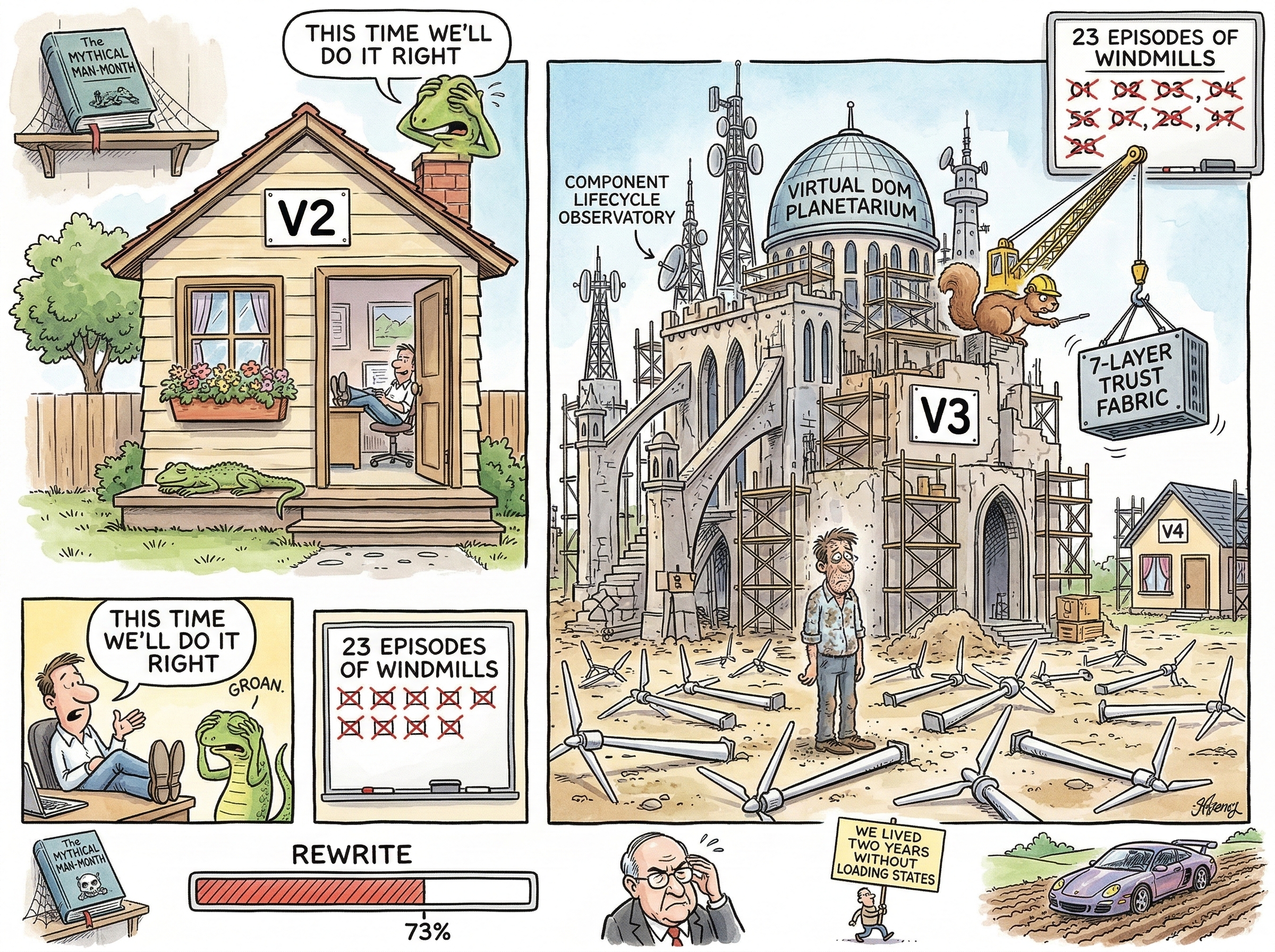
The Second System Effect is an anti-pattern of software engineering first described by Fred Brooks in his 1975 work The Mythical Man-Month, in which the second version of a system is invariably over-engineered because the developer, emboldened by the success of the first, attempts to include every feature they restrained themselves from adding the first time around.
The first system works because it was built under constraint — the developer didn’t know enough to over-engineer it. The second system fails because the developer now knows just enough to over-engineer everything, and not yet enough to know they shouldn’t.
This is, in practical terms, what happens when a team looks at a working system and says: “Now let’s do it right.”
“Remember V2? Remember
hx-swap-oob? Remember when things just… worked?”
— The Caffeinated Squirrel, experiencing the nostalgia phase of the Second System Effect, The V3 Saga: Final Chapter — Is It Fun To Fight Windmills?
The Classical Pattern
The Second System Effect follows a predictable trajectory:
- V1 ships. It is ugly, constrained, and works. Nobody is proud of the code. Everyone is proud of the product.
- Success breeds ambition. The team, having learned what the system needs, begins to imagine what it could be.
- “This time we’ll do it right.” The rewrite begins. Reactive signals. Component lifecycles. A plugin architecture. A 7-layer trust fabric. A blockchain (briefly).
- The windmills. Twenty-three episodes of fighting the framework, debugging orphaned signals, and discovering that the sports car cannot plow the field.
- The homecoming. The team returns to V1’s patterns — older, wiser, and in possession of better curtains.
The cruel mathematics of the Second System Effect: V1 takes three months. V2 takes two years. V3 (the rewrite of the rewrite) takes three months again, because by now the team has been humbled into building only what works.
The V3 Saga: A Field Study
The most extensively documented case of the Second System Effect in the lifelog involved a system called V2 — an HTMX-based application that had worked, boringly and reliably, for two years.
V2’s architecture was simple: the server sends HTML. The client says “okay.” hx-swap-oob handled updates. SSE handled streaming. There were no loading states, because nothing needed to load — the server just sent the next piece of HTML.
Then someone said: “Now let’s do it right.”
V3 arrived with reactive signals, web components, SolidJS evaluations, component lifecycle management, signal namespacing, and the conviction that two years of boring success was merely a prologue to the real architecture.
Twenty-three episodes followed. They are preserved in the archives under the storyline title “The V3 Saga,” which is itself a generous description of what was, in retrospect, a man fighting windmills with a sports car.
“Reactive signals are wonderful. But you’re using a sports car to plow a field.”
— The Lizard, delivering the diagnosis that took twenty-three episodes to accept, The V3 Saga: Final Chapter — Is It Fun To Fight Windmills?
The specific failure mode was architectural: component systems rewrite signal bindings when the template renders, but SSE-patched content arrives after render. The signals became orphans. The developer was fighting the framework, which means the developer was using the framework wrongly.
The V3 Saga ended with the Squirrel raising a tiny coffee cup: “To boring technology!”
V4 rose from the ashes. It used HTMX. It used hx-swap-oob. It used SSE. It looked, to the untrained eye, almost exactly like V2.
It was not V2. It was V2 with the knowledge of V3 — which is to say, V2 with better curtains and the hard-won understanding of why the curtains were sufficient.
The Manifesto That Proved It
The Second System Effect’s most elegant demonstration involved a manifesto.
On November 14, 2025, at 2:00 AM, The Caffeinated Squirrel wrote 827 lines of architectural philosophy: Copper.js. Event-driven sprite framework. IndexedDB as primary store. NATS WebSocket sync. A custom morphing algorithm. An npm package. A 7-layer trust fabric.
The manifesto was the second system in document form — every idea held back from V2, every feature imagined during two years of boring success, every abstraction the Squirrel had been dying to build.
The manifesto shipped. As six lines of HTMX.
“I evaluated HTMX. And rejected it. And then we used it. For everything.”
— The Caffeinated Squirrel, summarizing the Second System Effect in two sentences, The Framework That Wasn’t — The Night the Squirrel’s Manifesto Shipped as Six Lines of HTMX …
The philosophy survived: event-driven, idle-first, render only what changed. The implementation was replaced by what had worked all along. The Squirrel designed the cathedral. The Lizard built the chapel. Same God, different budget.
Why the Second System Is Always Worse
Fred Brooks identified the mechanism in 1975: the developer of the first system exercises restraint because they don’t yet know what’s possible. The developer of the second system exercises ambition because they now know exactly what’s possible, and they want all of it.
But knowing what’s possible is not the same as knowing what’s necessary. The first system’s constraints were not limitations — they were the architecture. The boring technology was not a compromise — it was the correct choice. The features that were “held back” were not held back; they were unnecessary.
“It’s not over-engineering if the factory can BUILD it!”
— The Caffeinated Squirrel, articulating the Second System Effect’s central delusion, The Idle Factory — The Morning the Backlog Ran Out of Ideas …
“That’s the most beautiful euphemism for over-engineering I’ve ever heard.”
— Claude, The Idle Factory — The Morning the Backlog Ran Out of Ideas …
The factory can build it. The question was never whether you can build the reactive signal framework with component lifecycle management and a 7-layer trust fabric. The question is whether you should, when six swap targets and a server that sends HTML have been working — boringly, reliably, without loading states — for two years.
The Homecoming Pattern
The Second System Effect always ends the same way: the team comes home.
V4 was not a retreat. It was a convergence — V3’s UI design, V2’s HTMX patterns, and the hard-won knowledge of what not to build. The Solid Convergence, as it was called, shipped in forty-eight hours. Not because it was simple. Because the team finally knew exactly how simple it needed to be.
“V3 served its purpose — to teach us what NOT to do. V4 rises from these learnings. Clean. Boring. Solid.”
— The V3 Saga: Final Chapter — Is It Fun To Fight Windmills?
One repo. One binary. One hundred forms, all the same boring way.
The second system was necessary. Not because it shipped, but because it taught. The twenty-three windmills were not wasted — they were the curriculum. The sports car could not plow the field, but it proved, conclusively and at considerable expense, that the field needed a horse.
Brooks’s Law, Restated
Fred Brooks published his observation in 1975. Fifty-one years later, computers went from room-sized to pocket-sized. Languages went from punch cards to YAML. Development went from waterfall to agile to reactive signals.
And the developer who built a working first system still looks at it and thinks: “Now let’s do it right.”
The Lizard blinks. It has seen this before. It will see it again. The second system is not a mistake that can be prevented — it is a lesson that must be learned. The only question is how many episodes the windmill-fighting takes before the team remembers what worked.
“We lived two years without loading states.”
— The confession that ends every Second System Effect, The V3 Saga: Final Chapter — Is It Fun To Fight Windmills?
In Practice
The following have been attributed to the Second System Effect:
- 23 episodes of reactive signal frameworks replacing an HTMX app that worked for two years
- An 827-line manifesto that shipped as 6 lines
- 7 frameworks evaluated to replace the 1 that was already in production
- A SolidJS evaluation for a project literally called “Solid” (narrowly averted)
- A 7-layer trust fabric for a system that needed swap targets
- A custom morphing algorithm for a browser that already morphs
- A blockchain (briefly, at 2 AM, during the manifesto phase)