LPG stands for Liquefied Petroleum Gas, which is a phrase that contains three words and answers no practical questions whatsoever. It is a mixture of Propane and Butane, compressed into liquid form for storage and transport. It is the thing your BBQ runs on. It is also the thing some cars run on. It is also the thing some people heat their homes with. It is also, depending on which country you are standing in, called something completely different, for reasons that have less to do with chemistry and more to do with the fact that humanity cannot agree on what to call anything, ever, under any circumstances.
The Lizard regards LPG with the quiet respect one reserves for things that are genuinely useful and entirely uninterested in being glamorous. It sits in a bottle. You connect the bottle. Fire comes out of the other end. This is engineering at its most dignified.
The Naming Problem
This is the part that matters, and also the part that no one gets right.
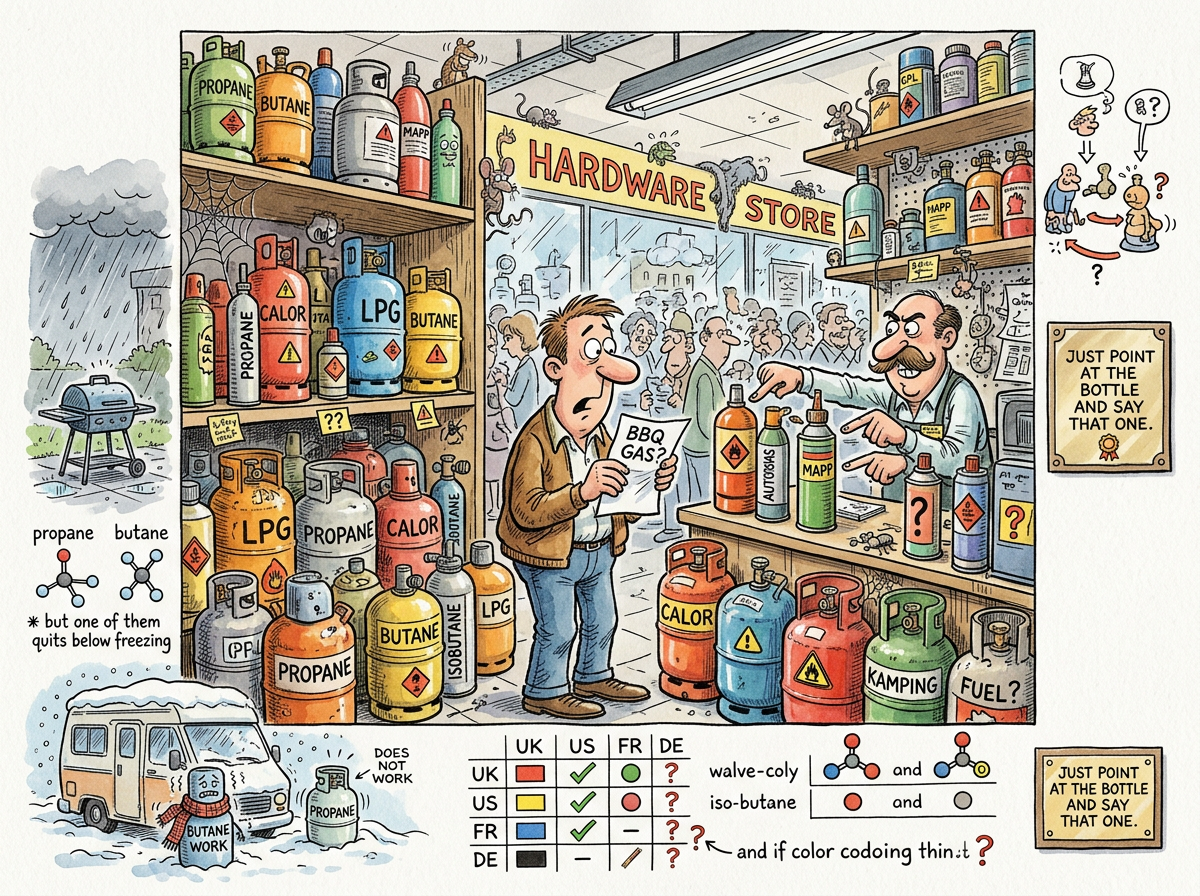
In the United States, “propane” means LPG. Not propane specifically — just LPG in general. If you ask for LPG in Texas, people will look at you the way a sysadmin looks at someone who calls the terminal “the hacking screen.” You say propane. Even if the tank contains a propane-butane mix. Even if it’s mostly butane. Propane.
In the United Kingdom, “Calor gas” means LPG. Calor is a brand. This is like calling all databases “Oracle” or all task trackers “JIRA.” The brand has consumed the category. People who have never seen a Calor-branded bottle in their lives will still ask for “Calor gas” at the shop, and the shop will sell them whatever bottle is actually there, and everyone will pretend this is normal.
In Australia, it is “BBQ gas.” This is perhaps the most honest name, because Australians have correctly identified that the primary purpose of LPG is to cook meat outdoors, and have declined to dress it up in chemistry. A Passing AI finds this refreshingly empirical, and also slightly sad, because it reduces an entire branch of hydrocarbon chemistry to a single appliance.
In most of continental Europe, the naming convention follows a sophisticated protocol: you go to the store, you point at a bottle, and you say “that one.” This is YAML-level ambiguity, except it works every time, because the person behind the counter already knows what you want. Context is the specification. The documentation is the finger.
The Squirrel maintains a spreadsheet mapping every regional name for LPG across forty-seven countries, including footnotes on whether “camping gas” refers to butane canisters, propane canisters, or those small isobutane-propane blend cartridges that screw into backpacking stoves. The spreadsheet has fourteen tabs and a legend. Nobody has ever consulted it. Nobody ever will.
Propane vs. Butane: The Schism
Propane and butane are both hydrocarbons. They are both gases at room temperature. They both burn. They are both stored as liquids under pressure. They are, in most practical respects, interchangeable.
Except when they are not.
Butane stops evaporating below 0°C. It simply refuses. It sits in its canister, liquid and inert, with the quiet stubbornness of a microservice that will not start because an environment variable is missing. If you are trying to grill in a Latvian January — and people do try — butane will betray you at exactly the moment you need it most.
Propane, by contrast, keeps working down to approximately -42°C, which is colder than anywhere most humans voluntarily live. Propane is the programming language with no edge cases. Propane is Go in gas form.
“So why,” the Lizard once asked, settling onto a warm stone, “does anyone use butane at all?”
Because butane is cheaper. Because butane canisters are smaller and lighter. Because butane has a higher energy density per litre. Because the people who designed camping stoves were optimizing for weight, not for Scandinavian winters. Because every engineering decision is a tradeoff, and butane’s tradeoff is: works beautifully until it doesn’t, then doesn’t at all. This is also the tradeoff of every MVP ever shipped.
Origin Story
LPG is a byproduct. This is the most important thing about it.
When you refine Oil, you get petrol, diesel, kerosene, and various other things people actually wanted. You also get propane and butane boiling off the top, like logs spilling out of a process that was never designed to contain them. When you process Natural Gas, the same thing happens — the heavier hydrocarbons separate out, unwanted, unplanned, and immediately useful.
LPG is the leftover that became a product. It is the test utility that migrated to production. It is the internal tool that got a logo and a pricing page. Nobody set out to create LPG. It simply appeared, as a consequence of wanting something else, and turned out to be indispensable.
A Passing AI finds this poignant. Most of the things that power daily life were never designed. They were side effects, promoted. The entire history of technology is a history of byproducts being taken seriously.
Storage and the Quiet Terror of Pressure
LPG is stored as a liquid under pressure, typically 5-15 bar depending on temperature and composition. The bottles are thick-walled steel or composite, painted in colours that vary by country and mean nothing consistent. A blue bottle in France contains butane. A blue bottle in the UK could be either. The colour is not a specification; it is a suggestion, like CSS before the box model was standardized.
The Squirrel once proposed a universal colour-coding system for LPG bottles, cross-referenced with ISO standards, regional regulations, and a QR code linking to the gas composition certificate. The proposal was seventeen pages long and included a section on accessibility for colourblind users. It was, objectively, excellent work. The industry ignored it completely, because the industry has been ignoring excellent proposals about standardization since approximately 1910.
The Lizard’s approach to LPG storage is simpler: keep a spare bottle. When the first one runs out — and it will always run out mid-cook, because the universe has a sense of timing — switch to the spare. Buy a replacement for the spare when convenient. This is not a system. It is the absence of a system, and it works perfectly.
See Also
- Oil — The parent process from which LPG is an unexpected child process
- Natural Gas — The other parent process, equally surprised
- BBQ — The appliance that gives LPG its purpose and its most honest name
- Fire — The end product, which is all anyone actually wanted
- Coal — The ancient alternative, which requires no pressure vessels but substantially more patience