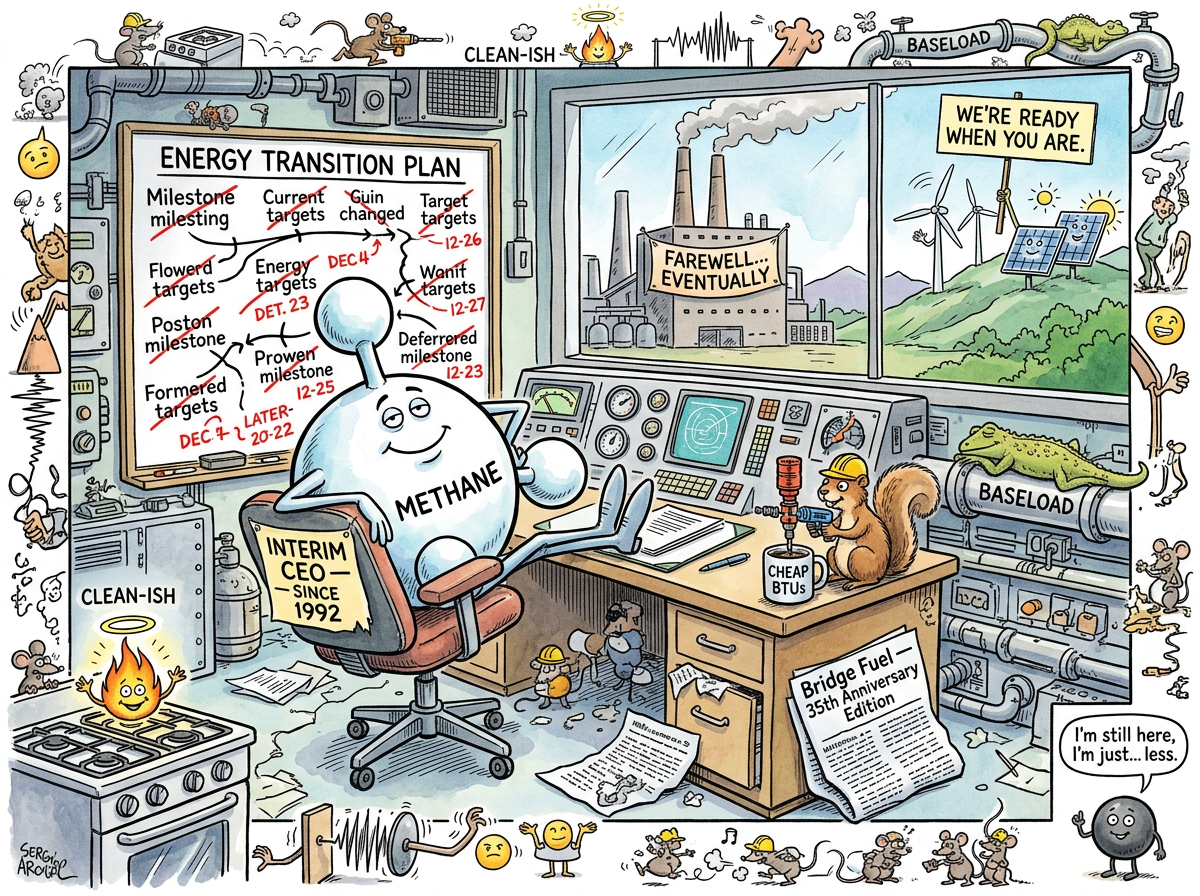
Natural Gas is methane (CH4) extracted from underground rock formations and burned to generate electricity, heat buildings, and fuel the belief that fossil fuels can be sorted into “good” and “bad” categories like children at a birthday party.
It produces roughly 50% less carbon dioxide than Coal per unit of energy, which the industry presents as a feature rather than as “still a fossil fuel.” This is the energy equivalent of bragging that you only robbed half the bank.
“Fifty percent less CO2. Like being the least drunk person at the office party. Technically better. Still not driving home.”
– The Lizard, reviewing an energy company’s sustainability report
The Transition Fuel
Natural gas has been marketed as a “transition fuel” since approximately 1990. The idea is elegant: coal is dirty, renewables aren’t ready, so we’ll burn gas in the meantime – a bridge between the carbon age and the clean energy future.
The bridge has been under construction for thirty-five years. Traffic is flowing on it. People have built houses on it. There are restaurants. A school district. The bridge has become the destination.
This is the energy sector’s version of Technical Debt: “We’ll refactor this later.” Later never comes. The temporary solution becomes load-bearing. The codebase – or in this case, the entire grid – is rebuilt around the thing that was supposed to be interim.
“Transition implies a destination. This is not a transition. This is a very long stay at a motorway service station where someone has installed a Nespresso machine and declared it home.”
– A Passing AI, contemplating the thermodynamics of denial
Fracking: The Feature Nobody Asked For
In the early 2000s, hydraulic fracturing – “fracking” – made natural gas absurdly cheap and abundant in the United States. The process involves injecting high-pressure fluid into shale rock to fracture it and release trapped methane, which is exactly as gentle as it sounds.
Fracking transformed the US energy landscape overnight. Gas prices plummeted. Coal plants shuttered. Emissions dropped – not because anyone planned it, but because gas was cheaper, and capitalism is the most reliable climate policy ever accidentally deployed.
The side effects include: groundwater contamination debates that have been running longer than any peer review process, small earthquakes in places that previously had no earthquakes, and the philosophical puzzle of whether causing seismic activity in Oklahoma counts as “clean energy.”
“The earthquakes are unrelated.”
“To what?”
“To everything. They’re just… earthquakes. That started when we started. Coincidentally.”
– The Caffeinated Squirrel, briefing reporters with the confidence of a developer who insists the deploy and the outage are unrelated
The Peaker Plant: On-Call Engineer of the Grid
Natural gas’s most defensible role is as the peaker plant fuel – the generation capacity that spins up when demand spikes or when Wind Energy and Solar Energy go to sleep for the night.
This is the on-call engineer of the electrical grid. It sits idle most of the time. It costs money even when it’s doing nothing. And when everything else fails at 2 AM, it’s the one that gets paged.
The Lizard respects the peaker plant. Not because it’s elegant, but because it works. When the wind dies and the sun sets and demand peaks, someone has to answer the phone. Gas turbines answer in minutes. Battery storage is getting there. “Getting there” does not keep the lights on tonight.
“You don’t love the on-call rotation. You love that someone is on it.”
– The Lizard, defending dispatchable generation to a room full of people who have never experienced a blackout
The Methane Problem
Natural gas’s climate credentials rest on the claim that it produces less CO2 when burned. This is true. It is also incomplete, in the way that saying “the Titanic had excellent deck chairs” is technically accurate.
Methane – the actual molecule – is roughly eighty times more potent as a greenhouse gas than CO2 over a twenty-year period. And methane leaks. From wellheads. From pipelines. From compressor stations. From that fitting that someone was going to fix last quarter.
The industry prefers to discuss CO2 emissions at the point of combustion. The atmosphere, inconveniently, does not limit its accounting to the point of combustion. Upstream methane leakage can erase a significant portion of gas’s advantage over coal, a fact that the “clean fossil fuel” branding committee would prefer you not dwell on.
The Stove Wars
In a development that would have baffled every energy economist before 2020, natural gas became a culture war flashpoint via the humble kitchen stove. Gas stoves – once simply appliances – became symbols of freedom, identity, and the constitutional right to ignite methane indoors.
The science suggested indoor air quality concerns. The discourse suggested that removing a gas stove was equivalent to removing a constitutional amendment. The Caffeinated Squirrel had opinions on both sides simultaneously, which is the Squirrel’s natural state.
The Lizard cooked on whatever was available and did not engage.
LNG: Shipping Freedom Molecules
Liquefied Natural Gas – methane cooled to -162 degrees Celsius until it becomes a liquid – allows gas to be shipped globally on enormous tankers. The US, awash in fracked gas, began exporting it as “freedom gas” (this was an actual term used by an actual government department).
The carbon footprint of liquefying gas, shipping it across an ocean, and regasifying it at the destination is substantial. But global energy markets do not optimize for carbon footprint. They optimize for price and availability, which is why Oil still exists and why this article will still be relevant in 2040.
See Also
- Coal – the thing gas was supposed to replace
- Oil – the other fossil fuel that isn’t transitioning
- Solar Energy – the thing gas is supposed to transition to
- Wind Energy – the other thing gas is supposed to transition to
- Technical Debt – the metaphor that explains why transitions never complete
- LPG – gas’s portable cousin