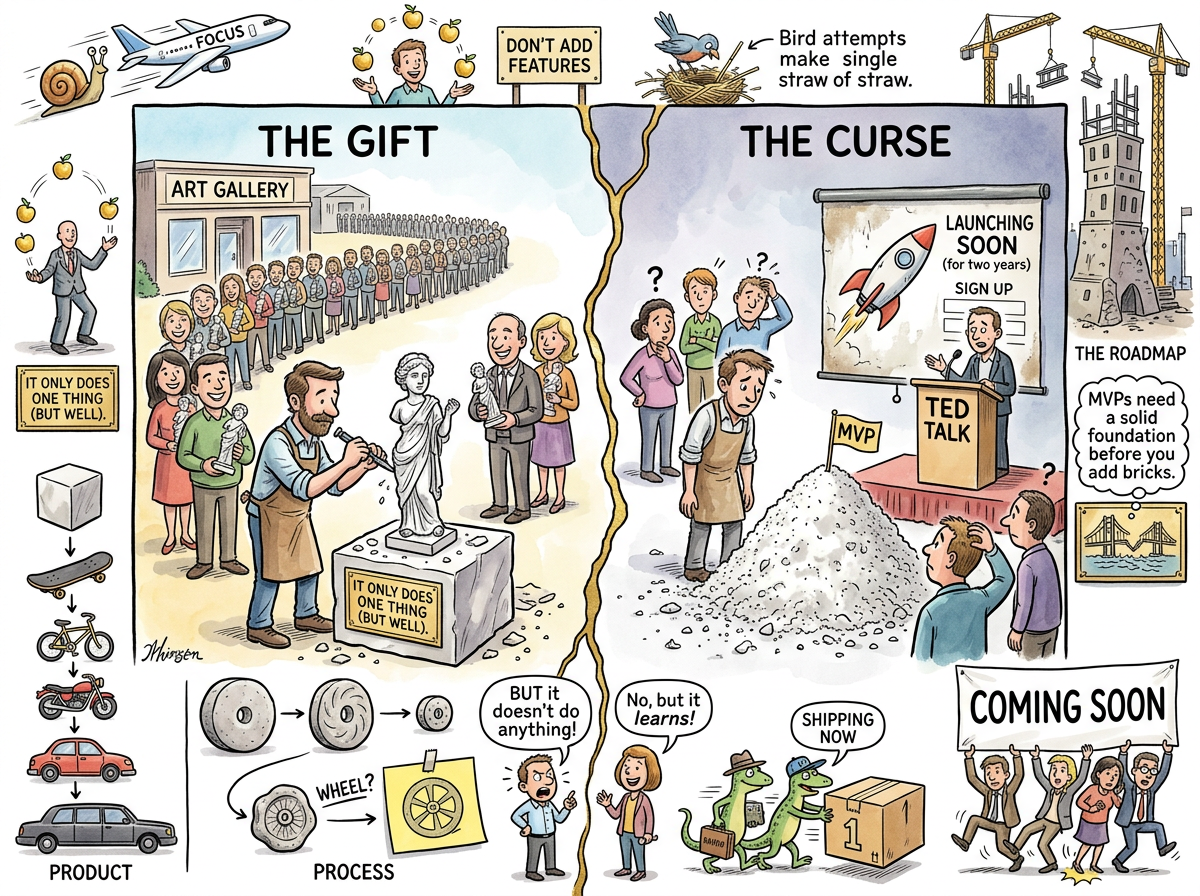
MVP (Minimum Viable Product) is a concept from product development that means, depending on who is using it:
- The smallest thing you can build that delivers real value to a real customer (the gift)
- Permission to ship something broken and call it strategy (the curse)
Both definitions are in active use. The difference between them is the difference between a surgeon removing exactly what needs to be removed and a surgeon who stops mid-operation because the patient is “viable enough for now.”
The term was coined by Frank Robinson in 2001, popularized by Eric Ries in The Lean Startup (2011), and weaponized by approximately everyone else from 2012 onwards.
The Gift
The MVP, as originally conceived, is one of the most powerful ideas in product development. It is Gall’s Law wearing a product manager’s lanyard:
Start with something simple that works. Then improve it.
Do not build the entire system before testing whether anyone wants it. Do not spend six months on an architecture that serves hypothetical users. Do not design the second feature before shipping the first. Build the minimum. Ship it. Watch what happens. Learn. Iterate.
This is a gift because it liberates teams from the tyranny of completeness — the belief that a product must be finished before it can be tested, that version 1.0 must contain everything version 3.0 will contain, that shipping something small is an admission of inadequacy.
The MVP says: shipping something small is not inadequate. It is disciplined. The surgeon who removes exactly the tumor is not less skilled than the surgeon who removes the entire organ. Precision is not parsimony.
The bootblock demo was an MVP. 488 bytes. It did one thing — six layers of parallax stars — and it did it completely. Nobody looked at the bootblock and said “this needs a database layer.” The constraint was the gift. The minimum was the viable.
DO NOT STORE WHAT YOU CAN GENERATE
DO NOT BUILD WHAT YOU CAN TEST
DO NOT SHIP WHAT YOU CAN LEARN WITHOUT— The Lizard, extrapolating
The Curse
The MVP, as commonly practiced, is the same idea stripped of its discipline and dressed in its vocabulary:
“It’s an MVP” — translation: it doesn’t work yet, and we’ve decided that’s a methodology rather than a problem.
“We’re shipping the MVP” — translation: we’re shipping the part we managed to finish by the deadline, which is less than what we promised and more than what we tested.
“MVP approach” — translation: we will build the feature badly now and fix it later, where “later” is a coordinate on a timeline that recedes at the speed of roadmap.
The curse is not the concept. The curse is the weaponization — the moment “minimum viable” stopped meaning “the smallest thing that delivers value” and started meaning “the least we can get away with.”
The skateboard-to-car diagram — Henrik Kniberg’s famous illustration of iterative delivery — shows a skateboard evolving into a scooter, then a bicycle, then a motorcycle, then a car. Each step is viable. Each step delivers value. Each step teaches something.
The actual trajectory, in most organizations:
Skateboard → smaller skateboard → drawing of skateboard →
Post-it note reading "skateboard" → landing page with
signup form → Series A → hire 40 engineers →
build a boat instead
The skateboard was the MVP. The Post-it note is not an MVP. The Post-it note is a hypothesis about a skateboard, which is useful for learning but not for riding, and the customer showed up to ride.
The Two Load-Bearing Words
The problem is grammatical. “Minimum Viable Product” contains three words. Two of them are load-bearing. Organizations consistently emphasize the wrong one.
Minimum — this is the word everyone hears. Minimum effort. Minimum scope. Minimum investment. Minimum. Less. Cheaper. Faster. Smaller. The word “minimum” is catnip to executives because it sounds like efficiency.
Viable — this is the word everyone forgets. Viable means it works. It means a customer can use it and derive value from it. Not “sign up for it.” Not “express interest in it.” Use it. A skateboard is viable — you can ride it somewhere. A drawing of a skateboard is not viable. It is a drawing.
Product — this is the word that has been most aggressively redefined. A product is a thing that a customer uses. A landing page is not a product. A prototype is not a product. A mockup is not a product. A pitch deck is not a product. These are all legitimate tools for learning, but calling them products is like calling a blueprint a house and then wondering why the tenants are cold.
Both words are load-bearing. Remove “minimum” and you get The Second System Effect — a product so complete that it collapses under its own ambition. Remove “viable” and you get a press release with a signup form. The MVP requires both: the discipline of less and the standard of works.
The Lizard’s MVP
The Lizard’s position on MVP is simple: the Lizard has never shipped a non-viable product.
lg is an MVP. One binary. SQLite. Markdown in, HTML out. It does not have user authentication, a plugin system, a REST API, a GraphQL endpoint, or a mobile app. It has search, backlinks, and a blog. These things work. They work completely. They are minimum and viable.
The Lizard would observe that the bootblock demo — 488 bytes, six layers of parallax — was both the minimum possible demo and a completely viable one. Nobody watched it and said “but where’s the menu system?” The demo did one thing. It did it at the limit of what the hardware allowed. It was minimum because the hardware demanded it and viable because the developer refused to ship something broken.
The constraint enforced the minimum. The pride enforced the viable. Both are necessary. Most organizations have the constraint but not the pride.
The Spectrum
← CURSE                                                   GIFT →

Landing   Prototype   Broken    Feature    Working    Complete
page      nobody      v1 with   subset     product    product
with      tested      apology   that       that       that
signup               in the    solves     delights   nobody
form                 release   one        one        needed
                     notes     problem    customer

"MVP"     "MVP"       "MVP"     MVP        MVP        Not MVP
                                                     (overbuilt)
The sweet spot is narrow. Most teams miss it in one of two directions: too little (the curse) or too much (the anti-pattern the MVP was invented to prevent). The teams that hit it are the ones that understand both words: minimum enough to ship fast, viable enough to be worth shipping.
Measured Characteristics
Year coined:                                 2001
Year popularized:                            2011
Year weaponized:                             2012
Products labeled "MVP" that are minimum:     ~90%
Products labeled "MVP" that are viable:      ~30%
Products labeled "MVP" that are products:    ~20%
Landing pages called "MVP":                  thousands
Customers who wanted a landing page:         0
Skateboard-to-car diagrams drawn:            millions
Actual skateboard-to-car evolutions:         rare
Load-bearing words in "Minimum Viable Product": 2
Load-bearing words typically honored:        1 (guess which)
lg features at launch:                       3 (search, backlinks, blog)
lg features that worked:                     3