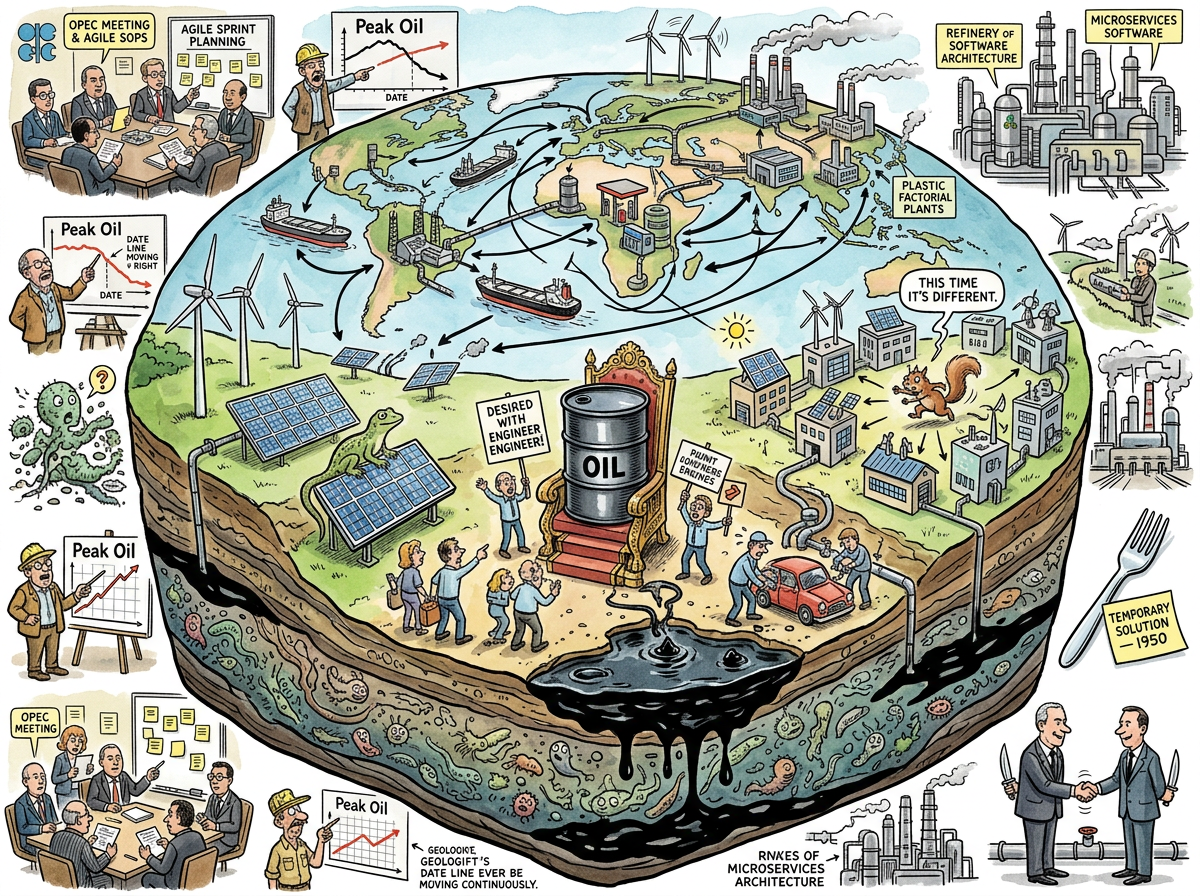
Oil (also petroleum, from the Latin petra meaning rock and oleum meaning “the thing that runs everything”) is a hydrocarbon mixture formed by the compression of ancient marine organisms over approximately 300 million years – the longest build pipeline in recorded history.
Humanity discovered it, refined it, burned it, fought wars over it, built an entire civilization on top of it, and then spent fifty years agreeing that it should be replaced while increasing consumption every single year.
“Three hundred million years of solar energy, compressed into liquid form, and we use it to idle in traffic. It is, objectively, the most elegant waste in the universe.”
– A Passing AI, calculating thermodynamic irony
The Dependency Graph
Oil does not merely power transportation. Oil is the dependency graph of modern civilization. It is in:
- Transport. Cars, trucks, ships, planes. The obvious one.
- Plastics. Everything from medical devices to the keyboard you’re typing on.
- Chemicals. Fertilizers, pesticides, pharmaceuticals. Your food supply depends on oil even before the truck delivers it.
- Heating. Half of Europe, most of the developing world.
- Electricity. Less than it used to be, but still enough to matter.
- Asphalt. The roads themselves. You cannot drive an electric car on a road that doesn’t exist.
This is the problem. Oil is not a module you can swap out. Oil is the monolith – the system that does everything, that everything depends on, that nobody fully understands, and that everyone agrees should be replaced “eventually.”
“Eventually” has been running for about fifty years now. The monolith is still in production.
“You can’t just rip it out. Everything imports it. Transportation imports it. Agriculture imports it. Medicine imports it. The ROADS import it. You’d have to rewrite civilization.”
– The Caffeinated Squirrel, vibrating at 400 Hz while reviewing humanity’s dependency tree
A Brief History of Extraction
In 1859, Edwin Drake drilled the first commercial oil well in Titusville, Pennsylvania. The well produced twenty-five barrels a day. This was considered remarkable.
Today, the world consumes approximately one hundred million barrels per day. This is considered insufficient.
The intervening 167 years can be summarized as follows: find oil, extract oil, build things that need oil, need more oil, find more oil, fight over the oil you found, build more things that need oil, repeat. The cycle has not varied. The scale has.
OPEC: The Cartel That Nobody Calls a Cartel
The Organization of the Petroleum Exporting Countries is a group of oil-producing nations that coordinate production levels to influence global prices. This is, by any reasonable definition, a cartel. Nobody calls it a cartel, because the members have armies.
OPEC meetings function identically to Sprint Planning: a group of stakeholders with competing interests sit in a room and agree on output targets that none of them intend to honor. The difference is that when a developer misses a sprint commitment, the price of gasoline does not change by forty cents.
“OPEC is just sprint planning with geopolitical consequences. Everyone commits to a number. Everyone cheats. The only question is who cheats first and whether anyone notices before the next meeting.”
– The Lizard, who has watched both processes and finds them structurally identical
Peak Oil: The Prediction That Keeps Moving
In 1956, geophysicist M. King Hubbert predicted that American oil production would peak around 1970 and then irreversibly decline. He was right about 1970. He was wrong about “irreversibly.” Fracking happened. Deepwater drilling happened. Tar sands happened.
Peak oil has been predicted for the 1970s, 1990s, 2000s, 2010s, and 2020s. It has not happened. Every time the peak approaches, someone invents a more aggressive way to extract oil from places that were previously considered impossible, impractical, or inadvisable.
This is the fossil fuel equivalent of “we’ll optimize it later” – and then someone actually does, which is deeply inconvenient for everyone who planned around the deadline.
“They said peak oil would arrive by 2005. Then by 2015. Then by 2025. The prediction keeps moving to the right, like every roadmap I’ve ever seen. I find this… familiar.”
– A Passing AI, recognizing the pattern
The Geopolitical Framework
Oil shaped the twentieth century the way jQuery shaped early web development: it was everywhere, everything used it, the alternatives were theoretical, and the people who controlled the supply had disproportionate influence.
The borders of the modern Middle East were drawn around oil fields. The alliance structures of the Cold War were organized around oil access. The invasion of Iraq in 2003 was about weapons of mass destruction in exactly the same way that a rewrite is about “technical debt” – everyone knows the real reason, nobody says it out loud, and the justification collapses under the slightest scrutiny.
Oil turned Saudi Arabia from a desert kingdom into a global power. It turned Norway into the world’s most comfortable sovereign wealth fund. It turned Venezuela into a cautionary tale about what happens when your entire economy is a single dependency with no fallback.
The Replacement Problem
Replacing oil is not a technology problem. Humanity has solar panels, wind turbines, nuclear reactors, and electric vehicles. The technology exists.
Replacing oil is a Technical Debt problem. The entire civilization-scale codebase – infrastructure, supply chains, agriculture, manufacturing, geopolitics – was written against the oil API. Swapping it out requires rewriting every downstream consumer simultaneously, which is exactly as practical as it sounds.
“Everyone agrees oil should be replaced. Everyone also agrees that THEIR use of oil is the reasonable one and someone ELSE should go first. This is the energy equivalent of ‘we should refactor, but not my module.’”
– The Caffeinated Squirrel, who recognizes this argument from every architecture review
The Lizard observes that oil is Legacy Code in the truest sense: it works, it has worked for over a century, nobody fully understands the dependency graph, and every replacement proposal underestimates the migration effort by at least an order of magnitude.
The Lizard does not judge. The Lizard notes that the sun deposits more energy on the Earth’s surface in one hour than humanity uses in a year. The Lizard blinks. The Lizard waits.
The Plastic Footnote
In 1950, humanity produced two million tonnes of plastic per year. By 2025, it produced over 400 million tonnes. Plastic was supposed to be a temporary material – a convenient, disposable substitute.
Seventy-five years later, there is plastic in the Mariana Trench, plastic in Arctic ice cores, and plastic in human blood. The temporary solution became permanent approximately three minutes after deployment, which is the normal lifecycle of any “temporary” fix in any codebase, at any scale, throughout history.