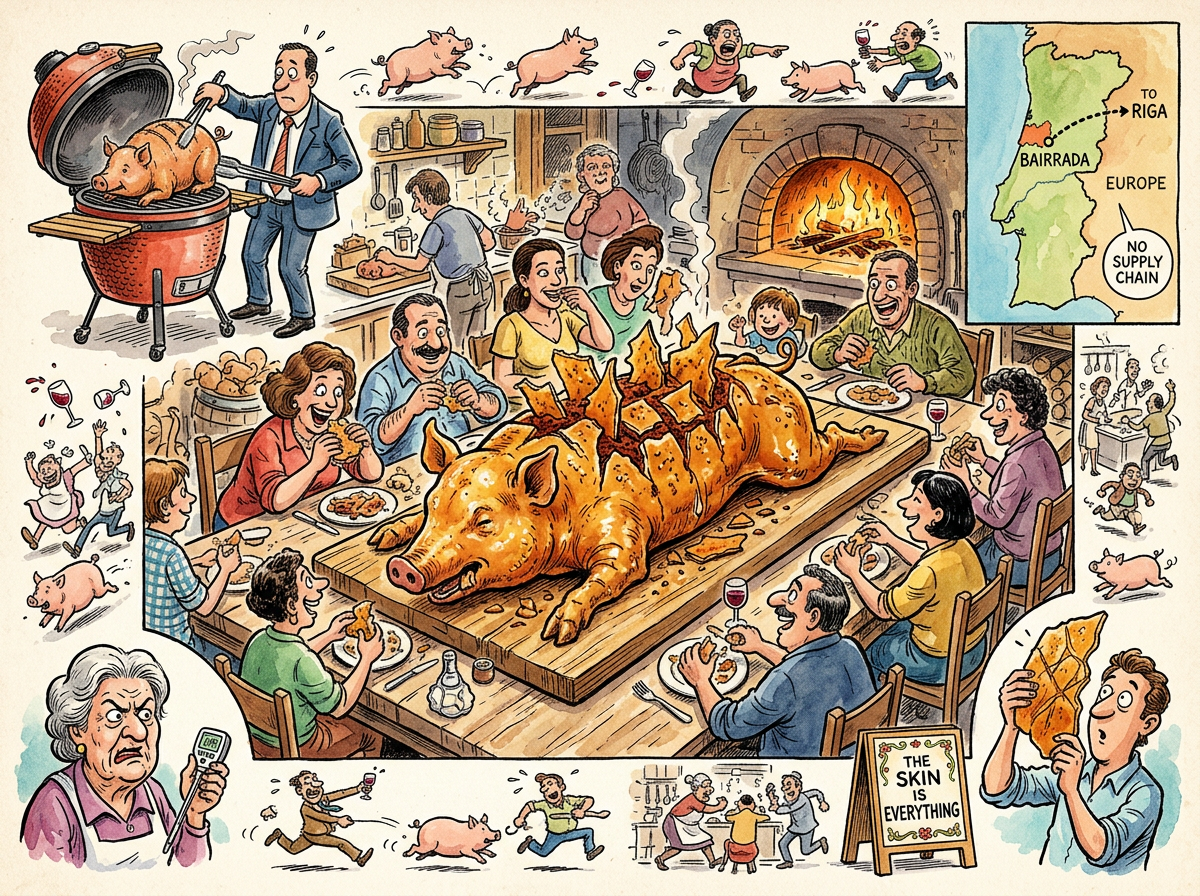
Leitão da Bairrada is a whole suckling pig, 5-6 kg, rubbed with pepper paste, roasted in a wood-fired oven until the skin achieves a state of crispiness that transcends the word “crispy” and enters the realm of structural engineering — shatteringly crispy, the kind of crispy that breaks like glass when you tap it, that sends shards across the table when you cut it, that makes a sound when it fractures that is closer to a wine glass breaking than anything you would associate with pork.
The meat is moist and tender because the pig is young and small and has spent its brief existence converting milk into the most delicate pork that exists. The skin is everything. The meat is a bonus. This is not a controversial opinion in Portugal. This is a fact that has been understood in the Bairrada region for centuries and that the rest of the world has largely failed to discover because the rest of the world is too busy smoking brisket for 16 hours and deep-frying turkeys.
“You do not eat leitão for the meat. You eat leitão for the skin. The meat is what happens between the skin and the bones. It is lovely. It is not why you are here.”
— riclib, to anyone who will listen
The Skin
The skin of leitão da Bairrada is the point of the entire exercise. Everything else — the pepper paste, the wood-fired oven, the size of the pig, the temperature, the time — exists in service of the skin.
The skin must shatter. Not crack. Not crisp. Shatter. When a knife touches properly roasted leitão, the skin breaks into shards with an audible snap. The shards are translucent at the edges. They are golden-brown. They are rigid enough to pick up and hold like a chip. They dissolve on the tongue into pure rendered fat and salt and the ghost of pepper paste and woodsmoke.
This is not the same as crackling. Crackling is what the British do to pork belly, and it is fine, in the way that a photograph of the ocean is fine. Leitão skin is the ocean. The difference is three-dimensional: crackling is a layer; leitão skin is a structure. It has architecture. It has depth. It has a crunch that resonates in your skull.
The Squirrel once suggested a blowtorch finish for extra crispiness. The Squirrel was escorted from the kitchen.
The Method
The Traditional Way (Wood-Fired Oven)
The traditional method requires three things that are difficult to obtain outside of Bairrada: a wood-fired oven, a whole suckling pig, and a Portuguese grandmother who doesn’t measure anything.
- The pig — 5-6 kg, whole, cleaned. A suckling pig. Not a small pig. A suckling pig — one that has been fed on milk and has not yet developed the tougher muscle fibres of an older animal. The distinction matters.
- Score the skin — deep crosshatch cuts through the skin, into the fat, not through to the meat. The scoring allows the fat to render outward and the heat to penetrate inward. Without it, the skin steams instead of crisps.
- The pepper paste (massa de pimentão) — a paste of sweet red pepper, garlic, salt, bay leaf, and white wine. This is rubbed into the scored skin and the cavity. It is not optional. It is not a seasoning. It is the soul of leitão. Every family has their recipe. No family writes it down.
- The oven — wood-fired, preheated to 200°C (390°F), then settling to 160°C (320°F) once the pig is inside. The wood matters. The radiant heat matters. The way a wood-fired oven surrounds the pig in convective heat from all directions matters. A conventional oven cannot replicate this because a conventional oven heats from one direction and hopes for the best.
- Roast for 2-3 hours — the pig rests on a rack or a bed of branches. No basting. The fat bastes itself. The skin tightens, then blisters, then transforms. In the last 30 minutes, the temperature rises to crisp the skin to shattering point.
- Do not open the oven — the grandmother will tell you this. She will also not tell you the temperature, the time, or the recipe for the pepper paste. She knows by smell. She knows by the sound the skin makes. She has been doing this since before you were born. Trust her.
The Kamado Adaptation (Mixed Results)
riclib has attempted leitão on The Kamado. The ceramic holds heat perfectly — better, in some ways, than a traditional oven, because the Kamado’s radiant heat is even and its insulation is extraordinary. The problems are mechanical, not thermal.
Problem one: the spit. Traditional leitão rotates on a spit. The Kamado has no spit. This means the pig sits on the grate, which means one side faces the coals and the other faces the dome, which means managing heat zones manually, which means rotating a whole suckling pig with tongs and determination every 30 minutes, which means the developer’s forearms get a workout and the pig gets uneven skin.
Problem two: the size. A 5-6 kg suckling pig fits in the Kamado. Barely. The legs must be tucked. The ears brush the dome. It is the culinary equivalent of fitting a Great Dane into a Mini Cooper — technically possible, aesthetically questionable, and requiring adjustments that the original designers did not anticipate.
Problem three: humidity. The Kamado’s sealed environment traps moisture. Crispy skin requires dry heat. The solution — leaving the top vent wider open than instinct allows — works but reduces the Kamado’s thermal efficiency, which offends the Kamado on a philosophical level. The Kamado was designed to retain heat and moisture. Asking it to vent moisture is asking it to be bad at the thing it is best at.
The results have been: meat, excellent (the Kamado’s even heat produces tender, moist pork every time); skin, inconsistent (patches of perfection surrounded by patches of chewy disappointment). The honest assessment is 70% of the way there. The remaining 30% requires either a rotisserie attachment or a wood-fired oven or a Portuguese grandmother, and only one of those is available on Amazon.
The Bairrada Connection
Bairrada is a small region in central Portugal, between Coimbra and Aveiro, known for two things: wine (Baga grape, tannic, difficult, underappreciated) and leitão. The roadside restaurants of Bairrada — casas de leitão — have been roasting suckling pig since before the concept of a restaurant existed. They are not restaurants in the modern sense. They are places where a pig has been turning in an oven since dawn and you arrive and eat it.
There is no menu decision. There is leitão. There is wine from Bairrada. There is bread. There is salad if you insist. The pig was ordered days ago, prepared that morning, and has been roasting for hours by the time you sit down. You eat it with your hands. The skin shatters onto the plate. The meat falls off the bone. The pepper paste lingers. The wine cuts through the fat. The table is loud. The afternoon is long. This is Sunday in Bairrada.
For riclib, this is the dish of feast days and homecomings. The smell of a wood-fired oven and pepper paste is the smell of Portugal in the way that bacalhau is the smell of Portugal — not a single dish but a cultural coordinate, a thing that tells you where you are and where you came from. In Riga, the smell exists only in the 70%-successful Kamado attempts that produce excellent pork with imperfect skin and the lingering knowledge that the grandmother would shake her head.
The supply chain problem is real. Suckling pig in Latvia is not a thing you can order from the butcher with a phone call. It requires advance notice, a sympathetic farmer, and the kind of logistical coordination that riclib applies to distributed systems but has not yet successfully applied to pig procurement. The connection to Portugal is deep — this is the dish you eat on feast days, on Sundays in Bairrada, at roadside restaurants where the pig has been turning since dawn. In Riga, the availability is theoretical. The longing is not.
Measured Characteristics
- Weight (whole pig): 5-6 kg (suckling, milk-fed)
- Skin state: shattering (glass-like fracture, audible snap)
- Paste: massa de pimentão (sweet red pepper, garlic, salt, bay leaf, white wine)
- Oven: wood-fired, traditional
- Temperature: 160-200°C (320-390°F), rising at end for skin
- Roasting time: 2-3 hours
- Rotation: continuous (spit) or manual (Kamado, with regret)
- Kamado success rate: 70% (meat perfect, skin inconsistent)
- Kamado main obstacles: no rotisserie, humidity management, size constraints
- Riga supply chain: theoretical
- Portuguese grandmother required: yes (non-negotiable)
- The Squirrel’s blowtorch suggestion: rejected (escorted from kitchen)
- Correct accompaniment: Bairrada wine (Baga grape), bread, nothing else
- The skin is everything: yes