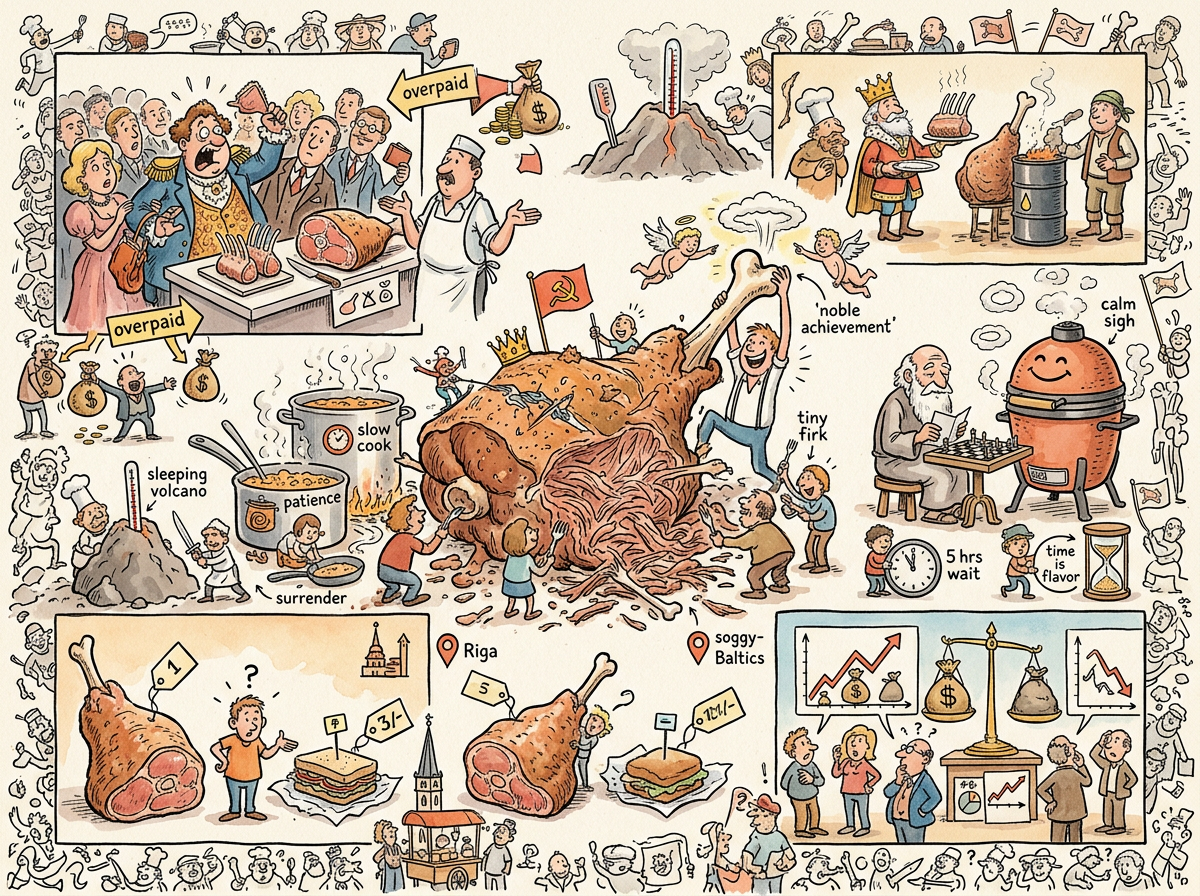
Bone-in lamb shoulder is the working-class cut of the lamb world — full of collagen, threaded with fat, anchored to a bone that seems to have been designed by a committee, and absolutely magnificent when given five hours at 120°C (248°F) to sort itself out. Unlike Lamb Rack (which is fast and elegant), lamb shoulder is slow and rustic. It is the pulled pork of lamb. The connective tissue dissolves, the fat renders, and what remains pulls apart with a fork like a protein that has given up on structural integrity and decided to become something better.
There is a fundamental misunderstanding in the world of lamb, and it goes something like this: the expensive cuts are the good ones. This is the same reasoning that leads people to believe that first-class airline seats are comfortable (they are merely less uncomfortable) and that expensive wine tastes better (it tastes more expensive, which is not the same thing).
The Squirrel, predictably, wanted to apply a seventeen-spice Moroccan rub with harissa, preserved lemons, ras el hanout, and something called “sumac butter” that he found on a food blog written by someone who has never actually been to Morocco. The shoulder does not need Morocco. The shoulder needs rosemary, garlic, salt, and — if you are feeling generous, or if there is an open bottle that has been sitting on the counter since Thursday — a splash of red wine.
The Lizard simply nodded. “Salt. Fire. Wait.”
This is, as usual, correct.
“The best cuts are the ones nobody else is buying.”
— riclib, staring at a butcher’s case in Riga
The Shoulder vs The Rack
The relationship between lamb shoulder and Lamb Rack is the relationship between a Sunday afternoon and a Friday night. One is fast, impressive, and slightly dangerous. The other is slow, contemplative, and ends with you falling asleep on the sofa feeling profoundly satisfied.
| Attribute | Shoulder | Rack |
|---|---|---|
| Cost | Cheap | Expensive |
| Time | 4-5 hours | 15-20 minutes |
| Technique | Patience | Precision |
| Failure Mode | Undercooked (tough) | Overcooked (ruined) |
| Serving Style | Pulled, rustic, communal | Sliced, elegant, individual |
| Stress Level | Almost none | Considerable |
| Beer Consumption During Cook | 3-4 | 0.5 (you need to focus) |
The rack demands your attention. The shoulder demands your absence. You put it in the Kamado, close the lid, and go do something else for four hours. Check it once, maybe twice, the way you might glance at a sunset — not because it needs you, but because you want to confirm it’s still beautiful.
riclib does lamb shoulder when time permits — it is a weekend cook, a planning exercise, the kind of project where you start at 8 AM and eat at 1 PM. It is not a Wednesday dinner. If you are attempting lamb shoulder on a Wednesday, something has gone wrong with your life, or very right.
The Method (Low and Slow)
The method is, like all great methods, almost insultingly simple. The Squirrel finds this suspicious. Surely there must be more steps. There are not.
Preparation
-
Take the lamb shoulder out of the fridge one hour before cooking. This is not optional. Cold meat in a hot cooker is how you get a shoulder that is burnt on the outside and raw in the middle, which is not a flavour profile anyone has ever requested.
-
Score the fat cap in a crosshatch pattern. Not too deep — you are making channels for the seasoning, not performing surgery.
-
Rub generously with:
- Coarse salt
- Cracked black pepper
- Fresh rosemary (stripped from the stem and roughly chopped)
- Garlic (4-6 cloves, minced or sliced and pushed into the score marks)
- Olive oil (enough to make everything stick)
- Red wine splash (optional, but recommended if you are already drinking some)
-
Let it sit for 30 minutes while you set up the Kamado.
The Cook
- Set up the Kamado for indirect heat at 120°C (248°F). This is Low and Slow territory. If your temperature creeps above 135°C (275°F), you are rushing, and the shoulder knows it.
- Place the shoulder bone-side down on the grate, fat cap up.
- Close the lid. Walk away.
- At the 2-hour mark, you may spritz with a mixture of apple cider vinegar and water if the surface looks dry. It probably does not. The fat cap is doing its job.
- At the 3-hour mark, you may wrap in foil if the bark is where you want it. Or do not. The shoulder is forgiving.
- At the 4-hour mark, start checking. The internal temperature should be heading toward 95°C (203°F). The bone should wiggle when you grab it.
- At the 4.5-5 hour mark, the bone should pull clean. If it does not, it is not done. Put it back. The shoulder will tell you when it is ready.
The Rest
Pull it off. Tent it with foil. Wait 20-30 minutes. This is the hardest part, because it smells extraordinary and you have been drinking beer for four hours.
Then pull it apart with two forks. It should offer no resistance. If it does, see above: it was not done.
The Economics of Unpopular Cuts
The lamb shoulder is cheap because the market has decided that lamb rack and leg are “premium.” This is excellent news for anyone who owns a Kamado and understands the concept of time. While everyone else is paying top euro for a rack that will be over in twenty minutes, the shoulder sits in the butcher’s case at a fraction of the price, waiting for someone who knows what collagen becomes when you give it five hours at 120°C (248°F).
The Baltic has excellent lamb from local farms — small operations where the sheep have led lives of pastoral contentment before their inevitable career change into dinner. The shoulder from these animals is particularly good: well-exercised (more connective tissue = more gelatin = more flavour), with a clean, grassy taste that comes from actually eating grass rather than whatever it is that industrial sheep eat.
This is the same economic principle that governs Brisket, Pulled Pork, and Flat Iron. The “undesirable” cuts — the ones with too much connective tissue, too much fat, too much work required — are precisely the ones that reward patience with the deepest flavour. The market’s loss is the pitmaster’s gain.
The Squirrel once tried to calculate the optimal cost-per-flavour-unit ratio across all lamb cuts. He was rejected, as usual, but not before producing a spreadsheet with seventeen tabs and a pivot table that somehow involved the GDP of New Zealand.
Measured Characteristics
| Parameter | Value |
|---|---|
| Optimal Cook Temp | 120°C (248°F) |
| Target Internal Temp | 95°C (203°F) |
| Cook Time | 4-5 hours |
| Rest Time | 20-30 minutes |
| Bone Test | Should pull clean |
| Cost (Baltic, 2026) | Roughly 1/3 the price of rack |
| Collagen Content | High (this is the point) |
| Weekend Requirement | Mandatory |
| Difficulty | Low (patience is not difficulty) |
| Squirrel Approval | Pending (wants more spices) |
| Lizard Approval | “Salt. Fire. Wait.” (Approved) |
See Also
- BBQ — The broader church to which the shoulder belongs
- The Kamado — The instrument of transformation
- Lamb Rack — The shoulder’s elegant but high-maintenance sibling
- Pulled Pork — The shoulder’s spiritual cousin from across the species divide
- Brisket — Another working-class cut that became a legend
- Low and Slow — The philosophy that makes all of this possible
- Flat Iron — Fellow beneficiary of the Unpopular Cut Economic Principle