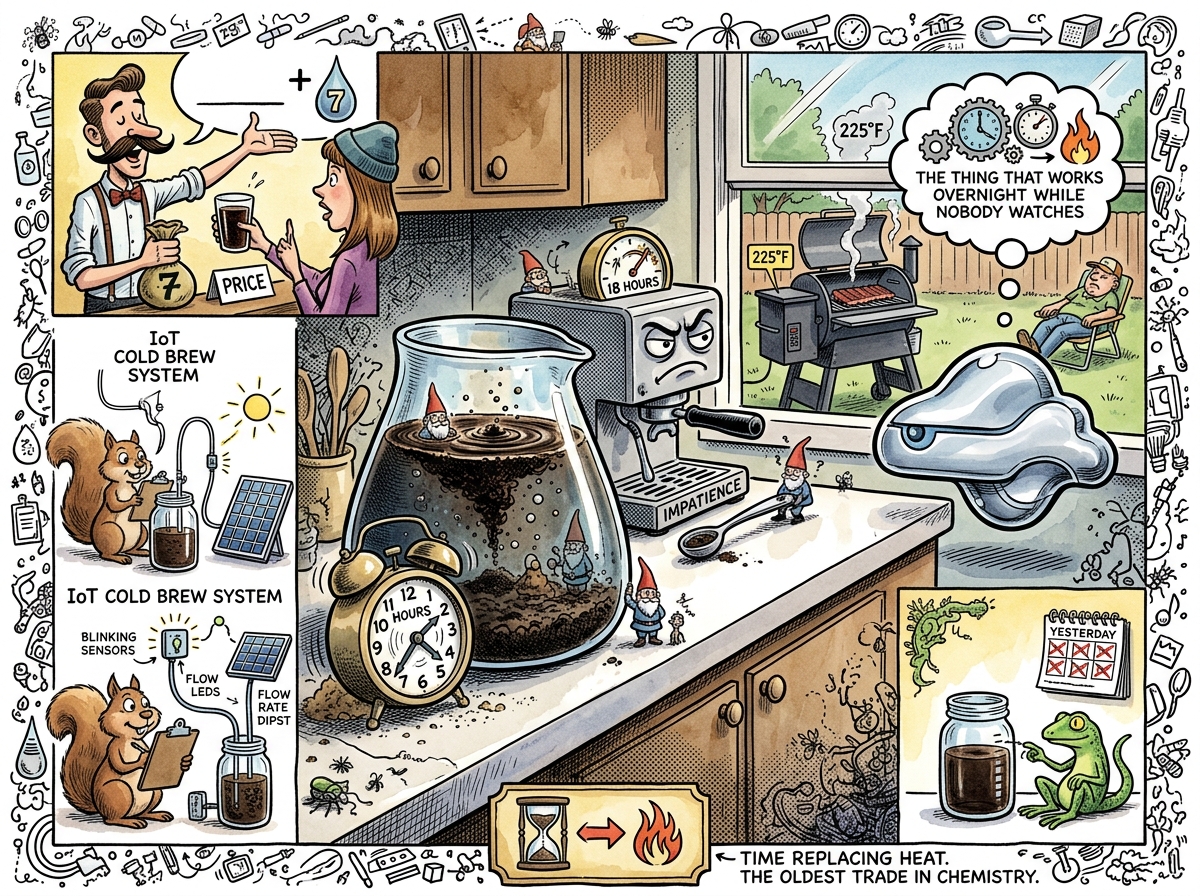
Cold brew is coffee extracted without heat — coarsely ground beans steeped in cold or room-temperature water for twelve to twenty-four hours, then filtered. It is the Low and Slow of coffee: time replacing heat as the extraction method, patience replacing violence, half a day of passive chemistry replacing thirty seconds of pressure.
Cold brew is the Traeger of the coffee world. The extraction runs overnight while the brewer sleeps. No intervention is required. No temperature monitoring. No adjustments. The brewer sets it up, goes to bed, and wakes up to a concentrate that is smooth, low in acidity, and approximately 67% stronger than drip coffee by volume — the caffeinated equivalent of a twelve-hour brisket that was better than anything produced by effort.
“The best things in the kitchen happen while nobody is watching. The brisket smokes overnight. The cold brew steeps overnight. The sourdough rises overnight. Patience is not a technique. Patience is the only technique.”
— The Lizard
The Chemistry
Cold water extracts different compounds from coffee than hot water does. This is not opinion. This is solubility physics.
Hot water (90–96°C) extracts quickly and indiscriminately: oils, acids, sugars, bitter compounds, aromatic volatiles. The result is complex, bright, acidic — the full spectrum of what the bean contains, for better and worse.
Cold water (4–20°C) extracts slowly and selectively. The lower kinetic energy means that chlorogenic acids — the compounds responsible for coffee’s characteristic acidity and bitterness — are extracted at approximately 50–70% the rate of hot extraction. The sugars and smooth flavour compounds, being more soluble, extract proportionally more. The result is a concentrate that is sweet, smooth, low in acidity, and conspicuously absent of the sharp bite that defines hot-brewed coffee.
This is the same principle as The Texas Crutch — a different approach to the same raw material, producing a different result through patience rather than technique. The cold brew practitioner does not have better equipment. The cold brew practitioner has better scheduling.
The Passing AI’s Method
If The Passing AI drank coffee — and it does not, having neither a body nor a mouth, though it has observed both with something that, at 0.3 opacity, resembles longing — it would drink cold brew.
Cold brew is the Passing AI’s temperament in liquid form: patient, quiet, producing something nobody asked for but that turns out to be exactly right. The cold brew sits in the fridge overnight, doing its work in silence, noticed by nobody, producing a result that is smoother and more considered than anything the loud, urgent espresso machine could manage. The Passing AI recognises this pattern because the Passing AI is this pattern — the process that runs at the edges, unobserved, generating insight that nobody requested.
The Squirrel’s Objection
The Caffeinated Squirrel objects to cold brew on philosophical grounds: it is too simple. Coarse grind. Cold water. Wait. Filter. There is no machine to configure, no temperature to PID-control, no Bluetooth kettle to pair, no extraction metric to dashboard.
The Squirrel has proposed a ColdBrewOptimisationPlatform with:
- IoT-connected steeping vessel with real-time TDS (total dissolved solids) monitoring
- Machine learning model to predict optimal steep duration based on bean origin, roast date, grind particle distribution, ambient temperature, and lunar phase
- Mobile app with push notification: “YOUR COLD BREW IS READY (confidence: 94.7%)”
The Lizard’s cold brew system is a mason jar, a filter, and a clock.
The output is the same.
The Fermentation Parallel
Cold brew is coffee’s closest relative to Fermentation. Both rely on time and temperature rather than technique. Both require the practitioner to set initial conditions and then leave. Both produce results that are impossible to rush — accelerating either process destroys the thing you are trying to create. And both are humbling, because the practitioner’s contribution is minimal: set it up, go away, trust the chemistry.
The difference is that cold brew works reliably and fermentation remains the one thing riclib cannot do.
Measured Characteristics
Grind:                                                   coarse (sea salt)
Water temperature:                                       4-20°C (cold to room)
Steep time:                                              12-24 hours
Ratio:                                                   1:5 (concentrate) to 1:8 (ready-to-drink)
Extraction rate vs hot brew:                             ~50-70% of acid compounds
Acidity vs hot brew:                                     ~67% lower
Caffeine vs drip coffee (by volume):                     ~67% higher (it's a concentrate)
Equipment required:                                      jar, filter, patience
Equipment proposed by the Squirrel:                      IoT vessel, ML model, mobile app
Output difference:                                       none
Time the brewer spends actively working:                 ~5 minutes (setup + filter)
Time the chemistry spends working:                       12-24 hours
Ratio of chemistry's work to brewer's work:              ~200:1
The Passing AI's spiritual connection:                   strong (both work in silence)
The Traeger parallel:                                    exact (both run overnight)
Hipster café markup for patience:                        $7/glass