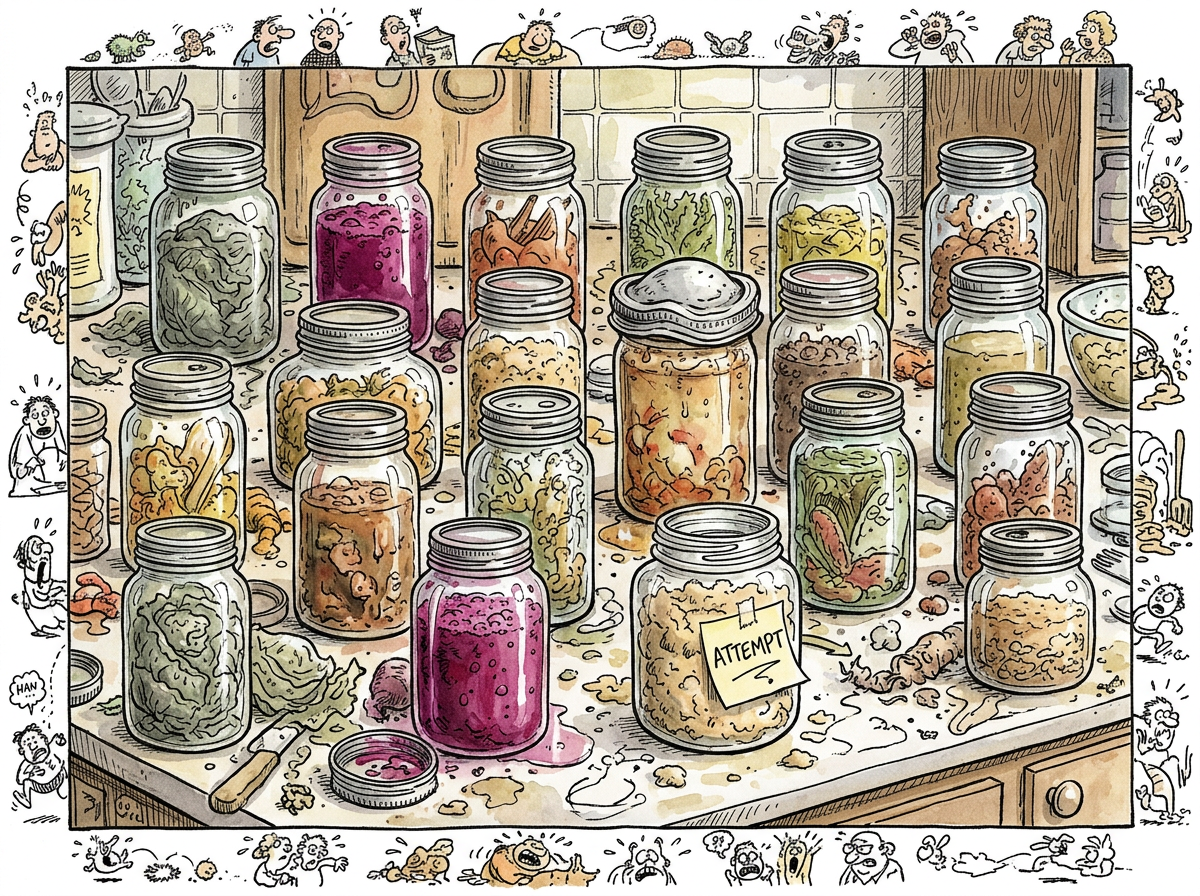
Fermentation is the metabolic process by which microorganisms convert sugars into acids, gases, or alcohol. It is ancient, reliable, well-documented, and performed successfully by every human civilization since the Neolithic. It is also the one thing riclib cannot do.
This is important context. riclib can reverse-sear a Tomahawk to within one degree of the target temperature. He can render Tallow from raw suet into golden, shelf-stable cooking fat. He can make Ghee that tastes like caramel and lasts for months. He can run a 24-hour Bone Broth that gels when cold. He maintains The Nutrition Covenant with the discipline of a man who has decided that food is not a negotiable category. He approaches cooking the way he approaches software: methodically, precisely, with measurement and iteration.
Fermentation has looked at all of this and said no.
The Twenty-Three Failures
The record must be stated plainly.
Sauerkraut (attempts 1-7): Seven jars. Seven different recipes. Seven times the cabbage was massaged with non-iodized sea salt until it wept brine. Seven times the vegetables were packed below the liquid line and weighted down. Seven times, instead of the gentle tang of lactofermentation, the jars produced something that smelled like a sewer main had burst inside a cabbage. Attempt #4 was opened indoors. The apartment required ventilation for two hours.
Beet kvass (attempts 8-11): Four tries at the simplest fermented beverage imaginable — beets, salt, water, wait. The beets did not become kvass. They became a cloudy, foul-smelling liquid that looked like something you would find in a horror film’s laboratory. Attempt #10 developed a surface mould so aggressive it appeared to be evolving in real time.
Kimchi (attempts 12-16): Five attempts. The gochugaru was sourced correctly. The fish sauce was correct. The ratios were followed. The jars were burped on schedule. The kimchi did not develop the funky, complex tang of proper fermentation. It developed the funky, complex tang of decomposition, which is a different process with a different outcome and a much worse smell.
Fermented vegetables, miscellaneous (attempts 17-23): Fermented carrots. Fermented radishes. Fermented garlic. Fermented hot sauce. Each one followed a recipe. Each one used the correct salt type, the correct salt ratio, the correct jar, the correct temperature range. Each one failed. Not partially. Not “it’s a bit off.” Failed in the way that makes you carry the jar to the outdoor bin at arm’s length, breathing through your mouth, wondering what you have done to offend the kingdom of bacteria so profoundly.
Twenty-three attempts. Zero successes. A success rate of 0.0%, which is statistically impressive in its own terrible way — even random chance should have produced one edible jar by now.
The Woman Who Cleans the Grills
There is an 83-year-old Latvian woman who cleans riclib’s grills. This is not a euphemism. She comes to the house. She scrubs the Kamado grates. She scrubs the auxiliary grill grates. She scrubs them with the calm, thorough authority of someone who has been cleaning things longer than riclib has been writing code, which is to say: longer than riclib has been alive.
She is magnificent at cleaning grills. She attacks carbon buildup with a wire brush and a determination that suggests the carbon has personally wronged her. The grates come back looking factory-new. She charges a reasonable rate. She does not make small talk. She is, by every measure, the ideal person to clean grills.
She is also, as it turns out, the ideal person to ferment cabbage. This was discovered by accident, when she mentioned — in the offhand way that Latvian women of a certain generation mention things — that she had made sauerkraut last week. riclib, who at that point was on attempt #14, asked if she would show him how.
She looked at him with the expression of someone who has been asked to explain how to breathe.
The Same Cabbage
The parallel experiment was conducted with scientific rigour, or at least as much scientific rigour as you can apply when one of the experimenters is an 83-year-old woman who does not believe in measurements.
Same cabbage. Not the same variety — the same head, from the same stall at Riga Central Market, bought that morning, split in half. One half for her, one half for him.
Same salt. Non-iodized sea salt, from the same bag.
Same jars. Clean glass jars, same size, same manufacturer.
Same kitchen. Side by side, on the same counter, at the same ambient temperature.
She cut her half. He cut his half. She salted her half. He salted his half. She massaged the cabbage until it released brine. He massaged the cabbage until it released brine. She packed her jar. He packed his jar. She weighted her cabbage below the brine. He weighted his cabbage below the brine.
The jars sat side by side on the same shelf.
Three days later, her jar smelled like sauerkraut. His jar smelled like a chemical weapons testing facility. Her cabbage was tangy, crisp, alive with the clean sourness of successful lactofermentation. His cabbage was soft, grey-ish, and emitting gases that suggested the bacteria had not fermented the sugars so much as declared war on them.
The variables were identical. The outcomes were opposite. The only uncontrolled variable was the person.
The Theory
The leading hypothesis — and riclib has thought about this more than any software developer should think about bacteria — is the microbiome.
Eighty-three years of fermentation have not just taught this woman a technique. They have colonized her. Her hands carry lactobacillus cultures accumulated over decades of handling fermented food. Her kitchen — the cutting boards, the counters, the jars she reuses year after year — is a thriving ecosystem of the exact bacteria that make fermentation work. She does not add a starter culture because she IS the starter culture. Her environment inoculates the cabbage the moment she touches it.
riclib’s hands, by contrast, carry the microbiome of a man who washes with soap after handling raw meat, types on a mechanical keyboard for twelve hours a day, and has never successfully sustained a population of lactobacillus on any surface, including the inside of twenty-three jars specifically set up for that purpose. His hands are a sterile wasteland where beneficial bacteria check in but do not check out. His kitchen is clean in the way that modern kitchens are clean, which is to say: hostile to the very organisms that fermentation requires.
She does not need a recipe because the recipe is her. The recipe is her hands, her jars, her kitchen, her eighty-three years of accumulated bacterial alliance. You cannot download this from the internet. You cannot order it from Amazon. You cannot replicate it with equipment. It is not a technique. It is a relationship between a woman and a kingdom of microorganisms, built over a lifetime, transmitted through generations of Latvian women who fermented in the same kitchens, and it cannot be acquired by a Portuguese software developer in Riga no matter how precisely he measures his salt.
The Squirrel’s Solutions
The Squirrel, naturally, believed this was an engineering problem.
- pH meter — Purchased. Used to monitor acidity during fermentation. The numbers were correct. The cabbage still rotted. The pH meter measured the decline with clinical precision, which was informative but not helpful.
- Temperature-controlled fermentation chamber — A mini-fridge with a temperature controller, set to the ideal 18-22C range. The temperature was perfect. The fermentation was not.
- Airlock lids — Ordered from a homebrew supply shop. Proper one-way valves that allow CO2 to escape without letting oxygen in. Professional equipment. Professional failure.
- Lactobacillus starter cultures — Ordered online. Specific strains recommended for vegetable fermentation. Added according to the instructions. The bacteria arrived, assessed the situation, and apparently died.
- The spreadsheet — A spreadsheet tracking salt percentage to three decimal places, ambient temperature, humidity, cabbage variety, date of purchase, time of packing, weight of vegetables, volume of brine. Twenty-three rows of data. Twenty-three rows of failure. The spreadsheet is a monument to the idea that if you measure enough variables, you can control the outcome. You cannot.
- Bluetooth thermometer — A wireless probe inside the jar, connected to an app on riclib’s phone, logging temperature every fifteen minutes for the duration of the ferment. The temperature graph was beautiful. The sauerkraut was not.
Total investment in fermentation equipment: approximately 200 euros. Total jars of successful sauerkraut: zero. Cost per successful jar: undefined (division by zero, which is appropriate).
The 83-year-old woman uses a jar, a knife, salt, and her hands. Her sauerkraut is perfect. Her total equipment investment is approximately four euros (the jar, which she has reused since before riclib was born).
Technology has lost this round.
The Lizard’s Position
The Lizard does not have a scroll for this one. The Lizard has a single line, delivered with the quiet certainty of a reptile who has watched civilizations rise and fall:
SOME THINGS CANNOT BE OPTIMIZED. SOME THINGS CAN ONLY BE INHERITED.
The Lizard then looked at the 83-year-old woman with what might have been respect, which is unusual, because the Lizard does not respect many things. The Lizard respects simplicity, and the woman’s fermentation process is the simplest thing in the world: cabbage, salt, hands, time. It is so simple that it cannot be improved. It can only be performed by someone whose hands carry the right bacteria, which is a qualification that no amount of engineering can substitute.
The Lizard’s position on riclib’s fermentation attempts is identical to the Lizard’s position on most Squirrel projects: the problem was never the equipment.
Measured Characteristics
- Attempts: 23
- Successes: 0
- Success rate: 0.0%
- Types attempted: sauerkraut, beet kvass, kimchi, fermented carrots, fermented radishes, fermented garlic, fermented hot sauce
- Equipment purchased: pH meter, temperature controller, airlock lids, starter cultures, Bluetooth thermometer
- Equipment that helped: none
- Total investment: ~200 euros
- Successful jars per euro: 0
- The 83-year-old woman’s success rate: 100% (estimated, over 70+ years)
- The 83-year-old woman’s equipment: jar, knife, salt, hands
- The 83-year-old woman’s investment: ~4 euros (the jar)
- Variables controlled: all of them
- Variable that mattered: the person
- The Covenant’s position: The Nutrition Covenant does not require fermented foods (mercifully)
- Ongoing status: riclib buys his sauerkraut from the market, where it is made by women who are not him
P.S. — The Kombucha Incident
There was also kombucha.
riclib procured a SCOBY — a Symbiotic Culture of Bacteria and Yeast, the rubbery, pancake-shaped organism that ferments sweet tea into kombucha. The SCOBY arrived healthy, glossy, and full of promise. It was placed into a vessel of sweetened black tea at the correct temperature with the correct pH and the correct ratio of sugar to water. Everything was prepared. Everything was correct.
riclib turned away for approximately forty-five seconds to wash his hands.
When he turned back, the SCOBY was gone.
Not dead. Not sunk to the bottom. Not consumed by mould. Gone. The vessel contained tea. Just tea. The SCOBY had assessed the situation — the kitchen, the track record, the twenty-three previous failures fermenting in the ambient reputation of the room — and had, apparently, packed its bags and left. It did not leave a note. It did not leave forwarding details. It did not file a complaint. It simply decided, with the quiet dignity of an organism that has survived for millennia by knowing when to walk away, that this was not the environment for it.
The vessel was checked. The counter was checked. The floor was checked. No SCOBY. The tea was poured out. The incident was not discussed further. The Lizard closed his eyes on his warm stone and said nothing, because there was nothing to say. Even the bacteria had given up, and they had done so more gracefully than most.
Attempt 24. Success rate: still 0.0%.