Bacalhau à Brás is the Portuguese dish where shredded salt cod meets matchstick potatoes meets scrambled eggs, and the three become one — a golden, glistening, olive-oiled tangle that is simultaneously crispy and soft, salty and rich, humble and magnificent. It is the dish that every Portuguese grandmother makes differently and every Portuguese grandson insists his grandmother’s version is correct.
It is also, as it happens, the single best argument for canned cod in the Baltics.
“The developer needed shredded bacalhau with garlic. The developer bought a can of shredded bacalhau with garlic. The developer is not sure why this requires further explanation.”
— The Lizard, who does not understand why people pay twice the price for cod they then have to shred
The Canned Cod Problem (Which Is Actually a Solution)
Bacalhau na Brasa can use a whole fillet of dried salt cod — the rigid, wooden plank that requires 48 hours of desalting and a commitment to changing water that borders on a relationship. Na brasa needs structure. Na brasa needs a piece of fish that holds together on the grill, skin side down, while the charcoal does its work.
Bacalhau à Brás needs shredded cod. The first step in every traditional recipe is: take your desalted bacalhau and shred it by hand. Pull it apart along the grain into small, thin flakes. This takes time. This takes a 48-hour desalted fillet. This takes access to dried salt cod, which in Riga, Latvia, takes access to a Portuguese supermarket, which takes access to Portugal.
Or it takes a can.
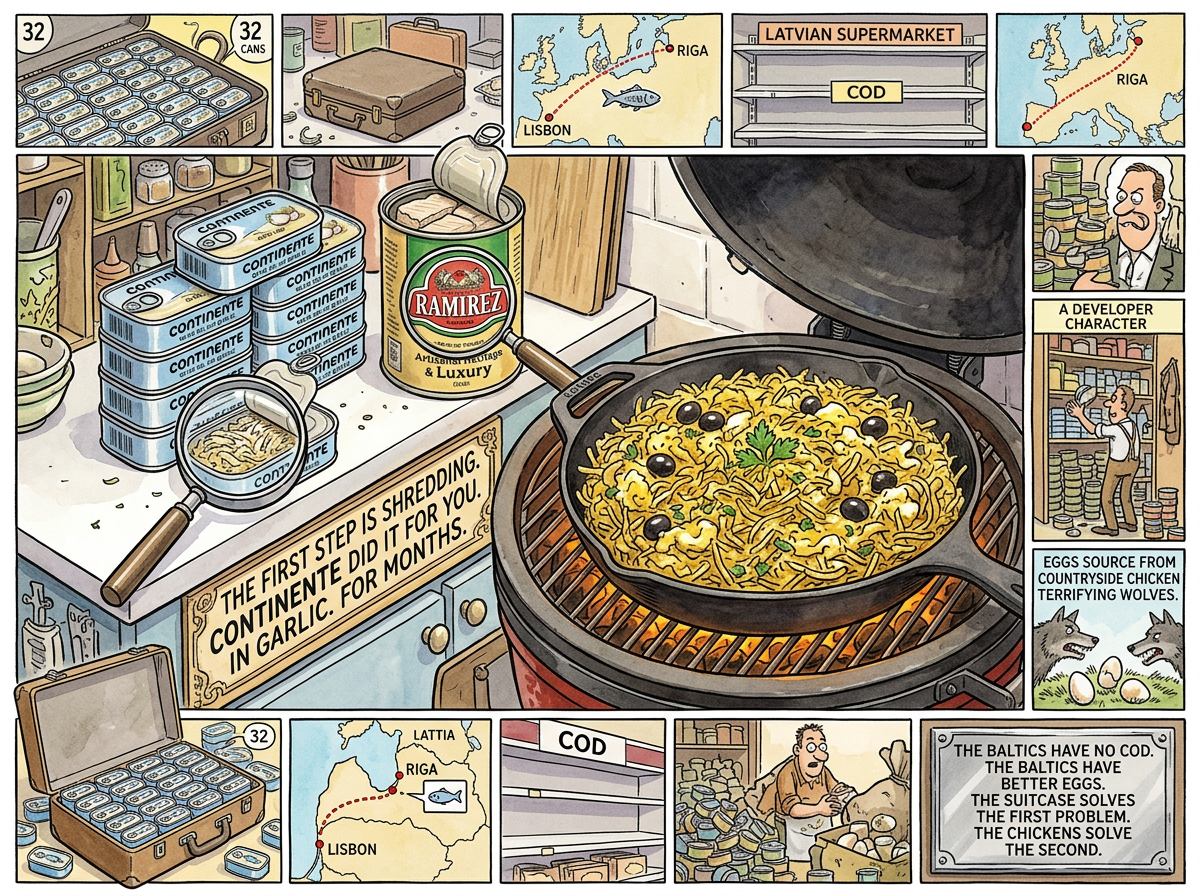
Continente — the Portuguese supermarket chain, think Tesco or Lidl but with bacalhau in every aisle — sells canned shredded cod in olive oil and garlic. Supermarket own-brand. Modest packaging. Approximately half the price of Ramirez, the heritage brand with the vintage label and the implication of artisanal tradition.
Ramirez is better cod. This is true. Ramirez uses whole pieces, carefully preserved, the kind of cod that you open the can and admire before eating. Ramirez is the cod you serve on a cracker with a glass of white port when guests arrive.
Ramirez is not better cod for Bacalhau à Brás. Because the first thing you do with Ramirez’s beautiful whole pieces is shred them. The €4 you paid for the structural integrity of the fillet is €4 spent on a property you are about to destroy. This is the culinary equivalent of buying a hardcover book to tear out the pages.
Continente’s supermarket brand arrives already shredded. Already in olive oil. Already with garlic. And here is the thing that nobody tells you because it sounds like an advertisement but is in fact chemistry: the cod that has been sitting shredded in olive oil and garlic for months — sealed, preserved, marinating in its own can — develops a deeper, more integrated flavour than cod you shredded ten minutes ago. The garlic permeates. The oil carries flavour into the flakes. The months of contact time do what hours of marinating cannot. The can is not storage. The can is a slow marinade.
The Squirrel, naturally, proposed sourcing fresh dried bacalhau from a specialty importer, overnight delivery to Riga, €45 per kilo, followed by 48 hours of desalting and careful hand-shredding. riclib opened a can of Continente bacalhau that cost €2.50 and had been marinating in its own garlic and olive oil since it was packed in a factory outside Porto. The Squirrel’s bacalhau would have been shredded ten minutes before cooking. The Continente bacalhau has been shredded for months. The Continente bacalhau is better. This is the uncomfortable truth that no food purist wants to hear: sometimes the industrial shortcut is not a shortcut. Sometimes it is the method.
The Suitcase Supply Chain
Every time riclib flies to Portugal — sometimes to see family, sometimes because the pantry has made demands — the suitcase returns to Riga carrying 32 cans of Continente shredded bacalhau in olive oil and garlic.
Thirty-two cans. This is not a casual quantity. This is logistics. This is a supply chain whose hub is the Continente in whatever Lisbon neighbourhood riclib happens to be visiting, whose transport layer is a checked bag with cod where the souvenirs should be, and whose warehouse is a kitchen cupboard in Riga that looks, from the inside, like a Portuguese emergency preparedness kit.
The 32 cans serve two dishes: Bacalhau à Brás and Pastéis de Bacalhau. Both require shredded cod. Both are made frequently. The cans deplete. The trips replenish. The cycle continues with the inevitability of a Portuguese grandmother’s opinion about how you’re cooking the bacalhau wrong.
The Baltics do not stock canned Portuguese bacalhau. The Baltics stock smoked fish, pickled fish, and fish in dill. All respectable. None Portuguese. The suitcase is the only supply line. When the suitcase stops, the bacalhau stops. This has happened. The pantry entered a cod drought. The developer entered a period of involuntary Baltic cuisine. The next flight to Lisbon was moved up. The official reason was family. The actual reason was a cupboard that had run out of cans.
The Cast Iron on the Kamado
This is made in a cast iron skillet on The Kamado. Is there another way? There is not another way. The stovetop exists. The stovetop is used by people who do not have a Kamado on the patio. riclib has a Kamado on the patio. The cast iron skillet goes on the Kamado’s grate. The charcoal provides heat from below. The skillet provides surface. The combination provides the kind of even, responsive heat that a cast iron skillet was born for.
The Kamado is not, strictly speaking, necessary for Bacalhau à Brás. A stovetop works. A gas hob works. An induction plate works. But the Kamado is lit anyway — it is always lit, there is always something grilling — and the cast iron skillet is already seasoned, and the patio is where riclib cooks, and the neighbours have stopped asking why the Portuguese developer is frying potatoes on a Japanese ceramic grill in March.
The Method
Ingredients
- Canned shredded bacalhau — 2 cans of Continente bacalhau in olive oil and garlic. Drain, but not aggressively — the olive oil from the can is seasoned and belongs in the dish.
- Potatoes — 4-5 medium, cut into the thinnest matchstick fries you can manage. A mandoline helps. A knife and patience also works. The potatoes should be thin enough to crisp in oil but substantial enough to hold their shape when tangled with the cod and eggs.
- Eggs — 6, farm-raised. In Riga, this means eggs from the countryside chickens referenced in Of Quantum Blockchains and Wolf-Scaring Chickens — the birds that live near wolves and have developed an attitude. The eggs are richer, the yolks deeper orange, the flavour more assertive than anything a Lisbon supermarket stocks. This is the Baltic advantage: everything except the cod is better.
- Onion — 1 large, thinly sliced into half-moons. Sweated until translucent, never browned.
- Garlic — 3-4 cloves, sliced thin. Additional to the garlic already in the canned cod.
- Olive oil — Portuguese. Generous. This is not the dish for restraint with olive oil. Pour it. Then pour more. The olive oil is not a cooking medium — the olive oil is a sauce.
- Black olives — a handful, for serving. Portuguese, brined, not those Californian things from a can.
- Fresh parsley — chopped, scattered at the end. The bright green on the golden mess.
Step by Step
-
Fry the matchstick potatoes — in olive oil, in the cast iron skillet on the Kamado, until golden and crisp. Remove and drain on paper. These will soften slightly when combined with the eggs, so crispier is better at this stage.
-
Sweat the onion — in the same skillet (add oil if needed), cook the sliced onion until soft and translucent. Add the garlic. Two minutes. The onion should be sweet, never brown.
-
Add the cod — the drained (but not too drained) canned bacalhau goes into the skillet with the onion. Stir gently. The cod is already cooked — it needs only to warm through and integrate with the onion. Two minutes.
-
Return the potatoes — the crispy matchsticks go back in, tangling with the cod and onion. Toss gently. Everything is in the skillet now except the eggs.
-
The eggs — beaten lightly, poured over the mixture. This is the critical moment. Stir continuously with a spatula, the way you would scramble eggs — because you are scrambling eggs, with cod and potatoes already in them. The eggs should set softly, creamy, binding the cod and potatoes together without becoming dry or rubbery. Remove from heat while the eggs are still slightly underdone — the residual heat in the cast iron will finish them. Overdone eggs are the one mistake this dish does not forgive.
-
Serve immediately — onto a plate, topped with black olives and chopped parsley. Olive oil over the top, because there was not already enough olive oil (there is never already enough olive oil).
The Baltic Advantage
The Baltics have no bacalhau. This has been established. The suitcase solves this.
But the Baltics have something Portugal does not: eggs from chickens that scare wolves.
The countryside eggs available in Latvia — from farms where the birds are genuinely free-range, where “free-range” means “the chickens go where they want and what they want includes the perimeter where the wolves are” — produce eggs with deep orange yolks, thick whites, and a richness that supermarket eggs in Lisbon cannot match. Portuguese supermarket eggs are fine. Latvian countryside eggs are magnificent. The yolks are the colour of sunset. The scramble turns gold.
riclib is certain that such eggs exist somewhere deep in rural Portugal — the Alentejo, the Trás-os-Montes, wherever there are still wolves to give chickens an attitude — but not around Lisbon, and not in any supermarket. In Riga, they are at the market on Saturday morning, €3 for ten, from a woman who does not speak English or Portuguese but whose chickens speak fluent wolf.
The potatoes are fine in both countries. The onions are fine in both countries. The olive oil comes from Portugal in the suitcase, alongside the 32 cans, because olive oil is non-negotiable and the Baltic interpretation of olive oil is “the expensive cooking oil next to the rapeseed” which is not an interpretation that riclib can endorse.
The complete Baltic bacalhau equation: cod from Portugal (canned, in the suitcase), olive oil from Portugal (bottled, also in the suitcase), eggs from Latvia (from wolves’ neighbours), potatoes from Latvia (fine), onions from Latvia (fine). The suitcase carries the Portuguese soul. The Baltics contribute the egg.
Measured Characteristics
- Origin: Lisbon, Bairro Alto, attributed to a tavern owner named Brás
- Canned cod brand: Continente (supermarket own-label, always)
- Canned cod brand rejected: Ramirez (better cod, wrong format, twice the price)
- Ramirez advantage over Continente: whole pieces (which you then shred)
- Continente advantage over Ramirez: already shredded, already in garlic, already marinated for months, half the price
- Cans per trip: 32
- Trips per year: frequent (sometimes family, sometimes cod)
- Supply chain: suitcase (Lisbon → Riga, checked baggage)
- Supply chain warehouse: kitchen cupboard (Riga)
- Cod drought incidents: at least one (resulted in an unscheduled flight to Lisbon)
- Cooking surface: cast iron skillet on the Kamado
- Alternative cooking surface: stovetop (for people without a Kamado, who exist and are pitied)
- Egg source: Latvian countryside chickens (wolf-adjacent, attitude-having)
- Egg yolk colour: sunset orange
- Portuguese supermarket egg yolk colour: pale yellow (acceptable but not magnificent)
- Matchstick potato thickness: the thinnest you can manage
- Egg doneness: slightly underdone when leaving heat (cast iron finishes the job)
- Olive oil quantity: more, then more, then the amount you think is too much, then a bit more
- Olives: Portuguese, brined, black (not Californian)
- The Squirrel’s suggestion: fresh dried bacalhau, overnight import, €45/kg, 48-hour desalt, hand-shred
- riclib’s response: opened a €2.50 can that had been marinating since Porto
- Time the can spent marinating: months (the can is not storage, the can is a slow marinade)
- Time the Squirrel’s bacalhau would have spent marinating: 0 minutes
- Baltic bacalhau availability: zero
- Baltic egg quality: superior (wolves as a quality assurance program)
- Items in the suitcase from Lisbon: 32 cans bacalhau, olive oil, saudade
- Items in the suitcase to Lisbon: an empty suitcase (the return trip is logistically planned)
- The Lizard’s opinion: opened the can, nodded
- The grandmother’s opinion: would prefer fresh bacalhau but has not seen the wolf eggs
See Also
- Bacalhau na Brasa — The grilled version. Needs a whole fillet. Needs 48 hours. Needs a grill.
- Pastéis de Bacalhau — The other can destination. Deep fried (almost). Cherry smoke.
- The Kamado — The heat source. Even for a skillet dish.
- Cast Iron — The skillet. Seasoned, on the grate, as God intended.
- Olive Oil — Portuguese. Poured, not drizzled. Non-negotiable.
- Frango da Guia — The other Portuguese daily driver on the Kamado.
- Favas com Entrecosto — The other Baltic-adapted Portuguese dish. Beans from the animal feed section.
- Boring Technology — Canned cod. Cast iron. Eggs. Olive oil. Unchanged. Correct.