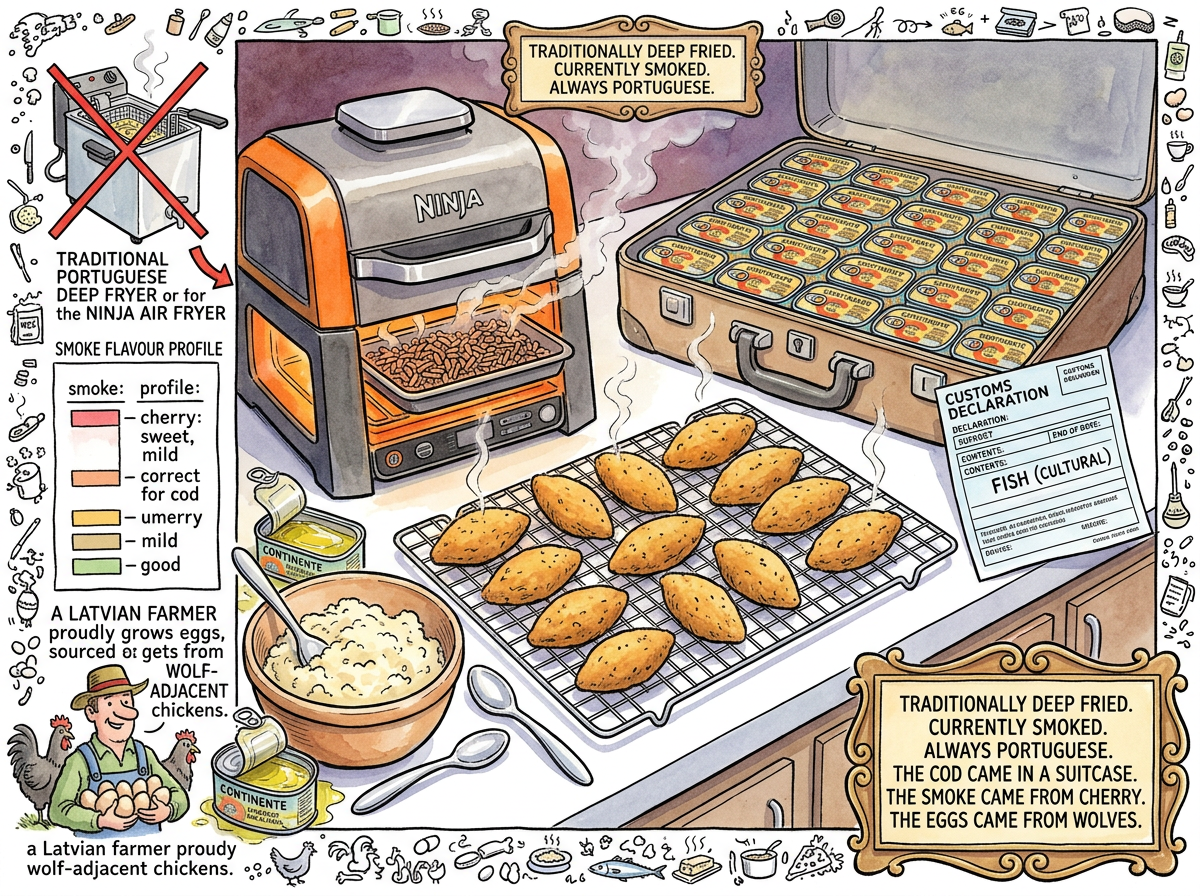
Pastéis de Bacalhau (cod fritters, also bolinhos de bacalhau depending on which Portuguese grandmother you ask and whether you want to survive the argument) are the torpedo-shaped, golden-crusted, cod-and-potato fritters that appear at every Portuguese gathering — Christmas Eve, Easter, Sunday lunch, a Tuesday when someone felt like making pastéis, a funeral, a wedding, a birthday, and the forty-five minutes between arriving at a Portuguese house and sitting down to the meal that the pastéis were supposedly just the appetiser for.
They are, in the lifelog’s kitchen, made from canned cod and smoked with cherry pellets in The Ninja Woodfire, which is a sentence that would make a Portuguese grandmother either weep or nod approvingly, and there is no way to know which until you hand her one.
“The cod came in a can. The smoke came from cherry pellets. The eggs came from chickens that scare wolves. The grandmother would have questions. But the grandmother would eat three before asking them.”
— The Lizard, who eats pastéis before judging them
The Classic
The traditional pastel de bacalhau is a simple thing: shredded salt cod, boiled potato, egg, parsley, onion — mixed into a dough, shaped into torpedoes with two spoons, and deep-fried in oil until golden and crispy outside, fluffy and cod-flecked inside.
The deep frying is canonical. Every Portuguese recipe, every grandmother’s method, every tascas in Lisbon — they all deep fry. The pastéis go into hot oil at 180°C (356°F) and emerge three to four minutes later, golden, glistening, trailing the specific aroma that means “someone Portuguese is cooking nearby.”
riclib does not deep fry the pastéis.
riclib uses The Ninja Woodfire in air fryer mode with cherry pellets.
This is either heresy or innovation, depending on whether the grandmother in question has tasted the result. The Ninja’s convective heat at 200°C (392°F) crisps the exterior — not identically to deep frying, but with its own quality: slightly matte rather than glistening, a crunch that is drier and more structured, a shell that holds its shape on the plate without the slow softening that deep-fried pastéis undergo as residual oil migrates inward.
And then there is the cherry smoke.
The Ninja Woodfire has a pellet tray. Cherry pellets — sweet, mild, the gentlest wood smoke — burn during the air fry cycle and deposit a whisper of smoke on the pastéis as they crisp. Not barbecue-level smoke. Not Traeger smoke. A suggestion. A ghost. The kind of smoke that you taste on the third bite and think “what is that?” and cannot identify because nobody expects cherry wood smoke on a cod fritter, because nobody has ever put cherry wood smoke on a cod fritter, because the idea requires owning both a Ninja Woodfire and 32 cans of Portuguese bacalhau in a Baltic kitchen, which is a Venn diagram with one person in the overlap.
The Canned Cod (Again)
The same Continente supermarket bacalhau that serves Bacalhau à Brás serves the pastéis. The same 32 cans. The same suitcase. The same supply chain whose logistics department is a checked bag and whose procurement strategy is “every trip to Lisbon.”
For pastéis, the canned cod’s advantages compound. The traditional recipe requires: buy dried salt cod, desalt for 48 hours, boil, drain, cool, shred by hand, pick out bones. The canned cod arrives: shredded, cooked, boneless, in olive oil and garlic, having marinated for months.
The garlic that has permeated the canned cod during months of contact time is not a shortcut — it is a feature. Traditional pastéis add minced garlic to the dough. Canned bacalhau has had garlic soaking through every flake since the can was sealed. The garlic is not on the cod. The garlic is in the cod. The distribution is complete in a way that mincing garlic into a dough cannot achieve.
The Squirrel once calculated the cost difference between fresh dried bacalhau (€35/kg, desalting, shredding, bones) and Continente canned bacalhau (€2.50/can, ready to use) and arrived at a number that made the Squirrel briefly question the entire artisanal food movement before returning to baseline within forty-five seconds.
The Method
Ingredients
- Canned shredded bacalhau — 2 cans of Continente bacalhau in olive oil and garlic. Drain well — pastéis dough needs to be firm, and excess oil makes it loose.
- Potatoes — 3-4 medium, boiled until very soft, drained thoroughly, mashed smooth. The potatoes are the body of the pastel. They must be dry — wet potato makes wet dough makes pastéis that fall apart in the fryer (or the Ninja). After boiling, return the drained potatoes to the hot pot for a minute to steam off excess moisture.
- Eggs — 2 whole eggs, plus 1 extra yolk. Farm-raised, from the wolf-adjacent Latvian chickens whose yolks turn the dough gold. The eggs bind everything. The extra yolk enriches.
- Onion — 1 small, very finely minced. Almost a paste. The onion must disappear into the dough — any visible piece is a structural weakness that will crack the torpedo during cooking.
- Fresh parsley — a generous handful, finely chopped. The green flecks in the golden dough.
- Salt and white pepper — to taste. The cod is already salty from preservation. Season carefully.
Step by Step
-
Boil and mash the potatoes — boil until very soft, drain, return to hot pot to dry, mash until completely smooth. No lumps. Lumps become fault lines.
-
Combine — in a large bowl, mix the mashed potato with the drained canned bacalhau, minced onion, chopped parsley, salt, and pepper. The mixture should be uniform — cod distributed evenly through the potato.
-
Add the eggs — beat the eggs and extra yolk, fold into the mixture. The dough should be firm enough to shape but moist enough to hold together. If too wet, add a spoonful of breadcrumbs. If too dry, add another yolk. The dough should hold a torpedo shape without slumping.
-
Shape the torpedoes — using two tablespoons, shape the dough into the classic torpedo: scoop with one spoon, shape with the other, creating the pointed-oval that every Portuguese person recognises on sight. The torpedo is not decoration. The shape ensures even cooking — the pointed ends crisp first, the fat middle cooks through.
-
Chill — refrigerate the shaped torpedoes for at least 30 minutes. Cold dough holds its shape better during cooking. This step is not optional. The Squirrel once skipped it. The torpedoes became spheres. The spheres became shame.
-
The Ninja Woodfire — load the pellet tray with cherry pellets. Set to air fryer mode, 200°C (392°F). Arrange the chilled torpedoes on the rack with space between them — air must circulate, this is convective heat, not an oil bath. Lightly brush or spray with olive oil for colour.
-
Cook — 12-15 minutes, turning once halfway through. The pastéis are done when golden-brown, firm to the touch, and carrying the faintest whisper of cherry smoke that nobody can identify but everyone notices.
-
Serve immediately — on a plate, no sauce needed, no dipping required. The pastel de bacalhau is complete as it is. The cod is inside. The potato is inside. The garlic that has been marinating for months is inside. The cherry smoke is on the outside. Nothing is missing.
The Wolf Eggs (Reprise)
The eggs matter more in pastéis than in Bacalhau à Brás, because in Brás the eggs are scrambled into a mass with cod and potatoes — the egg is a binder, a medium, distributed. In pastéis, the egg is structural. The egg is what holds the torpedo together. The egg is what turns golden in the heat. The richness of the yolk — the deep orange yolk of a Latvian countryside egg from a chicken that has opinions about wolves — translates directly into the colour and flavour of the fritter.
Portuguese supermarket eggs make acceptable pastéis. Latvian wolf-chicken eggs make pastéis that glow. The difference is visible: the dough is more golden, the cooked exterior warmer in colour, the flavour richer. riclib is certain that somewhere deep in the Alentejo, or the mountains of Trás-os-Montes, there are chickens with similar attitudes producing similar eggs. But not around Lisbon. Not in any Continente. The irony is complete: the cod must come from Portugal, but the eggs are better from Latvia.
Measured Characteristics
- Traditional cooking method: deep frying in oil at 180°C
- riclib’s cooking method: Ninja Woodfire, air fryer mode, 200°C, cherry pellets
- Cherry smoke intensity: a whisper (not barbecue, not Traeger — a suggestion)
- People who have put cherry smoke on cod fritters: 1 (known)
- Shape: torpedo (pointed oval, two-spoon method)
- Chill time before cooking: 30 minutes minimum (non-negotiable)
- Cook time in Ninja: 12-15 minutes, turn once
- Canned cod brand: Continente (same 32 cans, same suitcase, same supply chain)
- Fresh dried bacalhau preparation time: 48 hours desalting + boil + cool + shred + debone
- Canned bacalhau preparation time: open can
- Garlic marination time (fresh method): 0 minutes (added during mixing)
- Garlic marination time (canned method): months (since the can was sealed)
- Garlic distribution (fresh): surface level
- Garlic distribution (canned): molecular
- Egg source: Latvian wolf-adjacent countryside chickens
- Egg yolk colour: deep orange (sunset)
- Dough colour with wolf eggs: gold
- Dough colour with supermarket eggs: pale yellow (acceptable, not magnificent)
- Pastéis per batch: 20-24 (depending on torpedo size and spoon ambition)
- Pastéis surviving to the table: fewer than made (quality control requires sampling)
- Pastéis surviving five minutes on the table: 0 (this is consistent across all Portuguese gatherings)
- The Squirrel’s suggestion: a temperature-controlled deep fryer with a smoke infusion attachment
- riclib’s response: the Ninja does both with cherry pellets and one setting
- The Squirrel’s chilling incident: skipped the 30-minute chill, torpedoes became spheres
- The spheres: became shame
- Traditional grandmother’s reaction to cherry smoke: unknown (pending field test)
- Predicted reaction: eats three before asking questions
- The Lizard’s method: “Shape it. Cook it. Eat it.”
- The suitcase: still the supply chain
- The cupboard: still the warehouse
- The wolves: still improving the eggs
See Also
- Bacalhau na Brasa — The grilled fillet. The other bacalhau. Needs fresh cod, not cans.
- Bacalhau à Brás — The scrambled version. Same cans, different destiny.
- The Ninja Woodfire — The air fryer that smokes. Cherry pellets. 200°C. The heresy machine.
- The Kamado — Not involved in this dish, but lit anyway.
- Olive Oil — Portuguese. In the can. On the torpedo. Non-negotiable.
- Boring Technology — Canned cod, boiled potato, eggs, two spoons. Unchanged except for the cherry smoke.