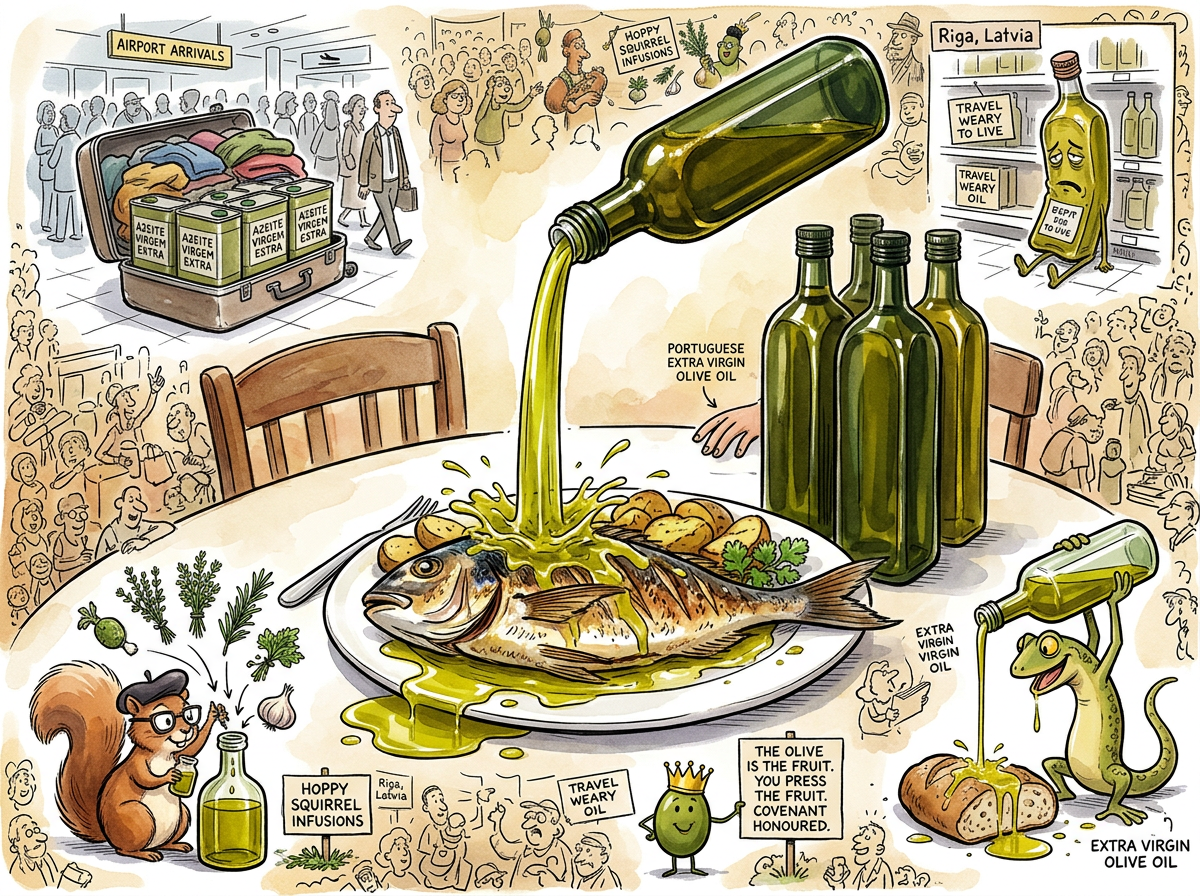
Olive oil is the proof that The Nutrition Covenant works. The olive IS the fruit. You press the fruit. The plant offered it to you. Covenant honoured. No hexane. No industrial extraction. No chemical solvents. No “processing aids.” Just olives, pressure, and oil. This is how it has been done for 5,000 years. This is how riclib does it, except he does not press his own olives — he imports Portuguese extra virgin olive oil because Portuguese olive oil is the best olive oil. The Italians and Greeks may object. They are welcome to be wrong.
In Portugal, olive oil is not a condiment. It is not a cooking ingredient. It is a human right. It goes on fish (Dourada, Bacalhau na Brasa). It goes on bread. It goes on soup. It goes on salad. It goes on rice. It goes on things that already have olive oil on them. The Portuguese per-capita consumption of olive oil is among the highest in the world, and the Portuguese consider this not excessive but baseline. A Portuguese grandmother will watch you eat a meal and, regardless of the quantity of olive oil already present, ask if you want more olive oil. The correct answer is yes. There is no incorrect quantity of olive oil. There is only insufficient olive oil.
The Import Problem
riclib imports olive oil from Portugal the way other expats import nostalgia — in bulk, by the litre, with the intensity of someone who has tried the local alternatives and found them wanting. Baltic olive oil exists, but it is Mediterranean olive oil that has been through a supply chain, and a supply chain is where freshness goes to die. The oil on a Riga supermarket shelf has been bottled, shipped, warehoused, shipped again, warehoused again, shelved, and then looked at by a Portuguese developer with the specific disappointment of a man who knows what fresh pressing tastes like.
The solution is simple: when you visit Portugal, you bring back olive oil. When someone visits you from Portugal, they bring olive oil. When you order anything from Portugal, you add olive oil to the shipment. The suitcase allocation for olive oil is non-negotiable. Clothes can be compressed. Olive oil cannot.
The Squirrel once suggested infusing the olive oil with rosemary, garlic, lemon zest, and “maybe some chili flakes for complexity.” The Lizard poured EVOO on bread and ate it. The bread was good. The oil was good. Complexity was not required. The Squirrel’s infusion is still in the planning phase.
The Covenant Connection
Olive oil is the exemplar of The Nutrition Covenant — the principle that if a plant offers you its fat freely, you may eat it. The olive is a fruit. It is full of oil. You press it. Oil comes out. No one had to invent a chemical process to extract it. No one had to build a factory. A stone mill from 3,000 BCE works. A hydraulic press from 2026 works. The principle is the same: mechanical pressure, nothing else.
Compare this to seed oils — canola, soybean, sunflower — which require: harvesting seeds that are not freely offering their oil, heating them, crushing them, bathing them in hexane (a neurotoxic solvent), degumming, bleaching, and deodorising. The seed did not offer you its oil. You took it by force, with chemistry. The Covenant is violated. The Lizard does not approve.
The Smoke Point Warning
Do NOT cook with extra virgin at high heat. The smoke point is 190-210°C (374-410°F), below a proper searing temperature. A Kamado at searing heat runs 300°C+. EVOO at 300°C does not sear — it smokes, it burns, it fills the kitchen with acrid haze, and it produces compounds that the Covenant did not intend.
For high-heat cooking, use Tallow or Ghee. Both have smoke points above 250°C (482°F). Both are animal fats freely rendered. Both honour the Covenant in their own way.
EVOO is for: finishing, dressing, drizzling, marinating, low-heat sauteing, and pouring with an enthusiasm that alarms non-Portuguese dinner guests. It is the fat you add after cooking, not during. It is the fat that makes a grilled Dourada transcendent, a Bacalhau na Brasa complete, and a Frango da Guia correct.
Measured Characteristics
- Origin: Portugal (non-negotiable)
- Type: extra virgin, first cold press
- Smoke point: 190-210°C (374-410°F)
- High-heat alternative: Tallow, Ghee
- Appropriate quantity: more than you think
- Portuguese per-capita consumption: among the highest in the world
- Covenant status: honoured (mechanical extraction, no solvents)
- Seed oil covenant status: violated (hexane, bleaching, deodorising)
- The Squirrel’s position: infuse it with seventeen things
- The Lizard’s position: pour it on bread, eat the bread
- riclib’s position: import from Portugal, pour on everything
- Supply chain survival: poor (freshness degrades with distance and time)
- Suitcase priority: above clothes, below passport
- Correct amount on any dish: “more”