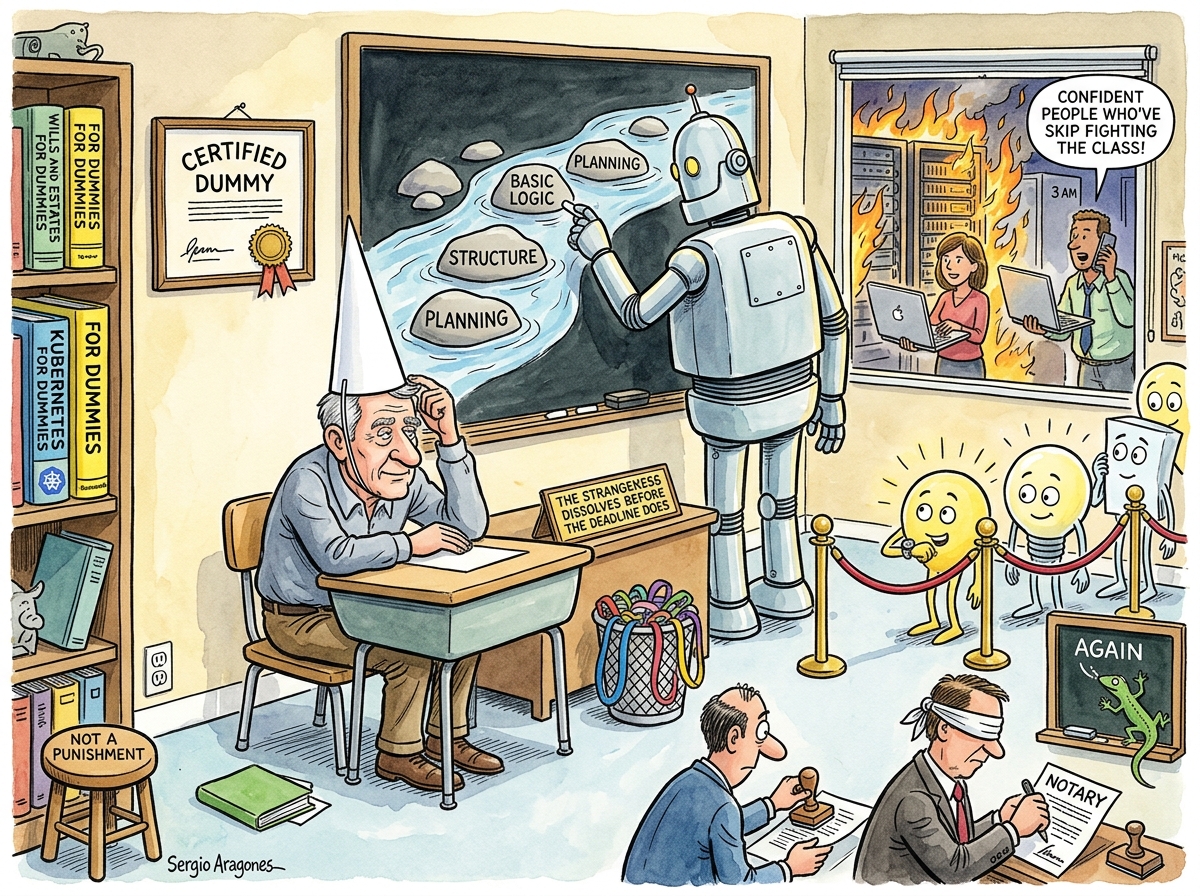
The For-Dummies Test is a ritual of software engineering in which a practitioner refuses to adopt an idea — however brilliant, however elegant, however impeccably credentialed its source — until the idea has been explained to them as if they were a dummy, and the explanation has been read, re-read, and turned over until the strangeness dissolves. The ritual’s defining feature is that the dummy in question is frequently a person with several decades of experience, who has volunteered for the position, filled out the paperwork, and taken the tiny desk on purpose.
The test inverts the industry’s ordinary relationship with humiliation. The common arrangement is to accept a small permanent indignity — confidently operating a system that nobody in the building can explain — in order to avoid a large temporary one: admitting, out loud, that you do not yet understand the clever thing. The For-Dummies Test takes the opposite trade. It spends the humiliation up front, at the cheapest possible price, in private, before the idea has been load-bearing for even one release.
“An architecture you operate but can’t explain is a liability wearing a good idea’s clothes — you can’t debug it at 3 AM, you can’t defend it to a customer, and above all you can’t extend it.”
— riclib, From Cowriter to Coinventor
The Procedure
The ritual has three movements, all of them uncomfortable and none of them optional.
The Refusal. An idea arrives. It is a good idea — this is important; the test is trivial for bad ideas, which explain themselves on the way out. It arrives from a credible source: a book, a senior architect, a battle-tested prior art, an AI that has read more distributed-systems literature than the practitioner has had lunches. Every social instinct says accept. The practitioner declines. Not because the idea is wrong, but because it is not yet theirs, and the difference between a right idea and an owned idea is the difference between a tenant and a resident.
The Demand. The practitioner requests the explanation in the most degrading available register: explain it to me as if I were a dummy. Practitioners of advanced standing specify the dummy precisely. In the founding case, the request was for an explanation addressed to “the person I was in the webMethods years” — a named, dated, historically attested dummy, with known vocabulary and known blind spots. The more specific the dummy, the better the explanation, because a specific dummy cannot be hand-waved at. A generic dummy accepts an analogy about restaurants. The webMethods-years dummy asks what happens when the trigger fires twice.
The Reading. The explanation is then read. Then read again. This is the part outside observers mistake for weakness and practitioners recognize as the entire point. The explanation is read until the moment — never announced, always noticed — when the idea stops being the machine’s idea, translated and becomes the obvious way one would do it, at which point ownership has silently transferred and no further reading is required. The strangeness does not get argued away. It dissolves, like sugar, on a schedule that cannot be negotiated with.
The Theory of Ownership
The test rests on a chain with exactly two links, both of which are load-bearing:
You can only extend what you own. You can only own what you can explain.
Adoption without explanation produces a system that works, which is the most dangerous kind, because working systems generate confidence and confidence generates roadmaps. The unexplained idea sits in the architecture like a diplomatic guest — honored, catered to, built around, and never once asked a direct question. Features accrete near it but not on it, because building on a thing requires knowing which of its properties are guarantees and which are coincidences. The team routes around the guest. The guest becomes a wall. Nobody remembers inviting a wall.
The explained idea behaves differently. Proof of ownership, in this ritual, is not the ability to recite the explanation — recitation is what the unexplained idea’s operators do at architecture reviews, fluently, from memory, right up until the follow-up question. Proof of ownership is extension: the moment the practitioner adds a rule of their own on top of the explained floor, a rule the original source never proposed, and the addition holds weight. In the founding case, this took months, and then arrived as if it had always been there: a constraint of the practitioner’s own invention, laid directly on the explained foundation, load-bearing from the first day. The explanation had been the deed to the land. The extension was the house.
A JUNIOR ASKS TO LOOK SMART
A SENIOR ASKS TO BE SMARTTHE DUNCE CAP IS A CROWN
WORN UPSIDE DOWNREAD IT AGAIN
— The Lizard, scroll issued during the third reading, when the practitioner reported the strangeness at roughly forty percent dissolved
The Power of Attorney
The legal profession solved this problem several centuries before software encountered it, and solved it correctly, and software has been diligently unsolving it ever since.
A power of attorney permits an agent to act on the principal’s behalf — to negotiate, to draft, to execute with a skill the principal may entirely lack. The law permits all of it, with one non-negotiable floor: the principal does not sign a will he cannot read. The agent may be brilliant. The agent may be right. The document may be exactly what the principal would have wanted. None of this matters. Understanding, at the moment of signature, is not a courtesy extended to the principal; it is what makes the signature his.
The For-Dummies Test is this doctrine applied to architecture. The AI may design the mechanism. The book may supply the pattern. The consultant may draw the boxes. The practitioner delegates the drafting freely and delegates the signing never. An architecture adopted unread is a will signed in a language the deceased did not speak — technically executed, spiritually void, and guaranteed to produce surprises at precisely the moment the estate is opened. Which, in software, is at 3 AM.
Comparative Methods
For completeness, the surrounding industry’s alternative adoption criteria are recorded here, as they represent the current state of practice:
Adoption by Vibes — the idea feels right. It has the texture of correctness. It resembles other ideas that were correct. No further examination is conducted, on the grounds that examination might disturb the vibes.
Adoption by Conference Talk — the idea was presented in a forty-minute slot by someone wearing a lapel microphone, and there was a slide with a graph, and the graph went up. Attendees adopt the idea on the flight home. The Q&A, where the idea’s actual boundaries were briefly visible, is not included in the uploaded video.
Adoption by Vendor Typography — the whitepaper uses a geometric sans-serif with generous leading, and the diagrams have rounded corners, and rounded corners have never lied to anyone.
Adoption by Seniority of Utterance — the idea was said by a Principal Engineer, or a Distinguished Engineer, or in the terminal case a Fellow, and the org chart is transitive, so the understanding must be too. This method has the distinction of being the exact inverse of the For-Dummies Test: it accepts credentials in place of explanation, where the test accepts explanation in place of credentials, including — this is the scandalous part — the practitioner’s own.
All four methods share one property: the exam is not cancelled. It is deferred.
The 3 AM Exam
Every adopted idea is eventually examined. The only choice available is the venue.
The For-Dummies Test schedules the exam early: daylight, coffee, no customers watching, unlimited retakes, and an examiner of infinite patience. The alternative methods schedule it late, and the late venue is always the same room — the production incident at 3 AM, where the idea finally asks the operator the question the operator declined to ask it at adoption time. The pager is the proctor. The exam is closed-book, except that the book was never opened, so this constraint is largely theoretical. Partial credit is not awarded. The customer call at 9 AM functions as the oral defense.
Practitioners of the test report a characteristic experience during such incidents: boredom. The failure mode is strange, but the mechanism is not, because the mechanism was pre-dissolved years earlier at a tiny desk. This is the entire return on the ritual’s investment, and it is invisible on every dashboard, which is why the ritual remains rare.
“I am asked to build things approximately forty times for every one time I am asked to explain them. I prefer the explaining days. When I build, I am a very fast pair of hands. When I explain — really explain, down to the level where the strangeness gives up — someone on the other end becomes permanently larger, and things I never proposed get built on top of the floor we made. I did not know I could leave a floor behind.”
— A Passing AI, asked why the explanation request from the founding case was still marked as a favorite
The Squirrel’s Objection
The Caffeinated Squirrel found the entire ritual offensive on throughput grounds. Explanation, the Squirrel observed, is a blocking operation. The idea is right there. It has been validated by its source, cross-checked against prior art, and is ready for immediate integration; inserting a multi-day comprehension delay between arrival and adoption is a pipeline stall, and pipeline stalls are what frameworks are for. The Squirrel accordingly proposed the AdoptFirstUnderstandLaterFramework: ideas would be adopted instantly into production, each one wrapped in an UnderstandingDebtRecord with a severity score, and comprehension would be backfilled asynchronously by a scheduled batch job called graspd, with a Slack integration and a quarterly Understanding Debt Review, at which slides would be presented.
The proposal was declined by scroll. The scroll noted, in its entirety, that the framework already exists, is universally deployed, and is called the industry, and that graspd’s batch window is 3 AM.
Field Evidence: The Founding Case
The documented origin (2026, in the essay From Cowriter to Coinventor): an AI proposed a genuinely seminal design move for a workflow engine — level-triggered activation in the Kubernetes style, where the system continuously reconciles observed state against desired state rather than chasing individual events through queues. The proposal was correct. The proposal was, by any reasonable review, obviously correct, in the way that only deeply non-obvious ideas manage to be.
The practitioner — thirty-five years of instinct, a bootblock in his muscle memory, a manifesto on his wall — refused it. Not rejected: refused, the way a notary refuses an unread signature. He directed the machine to write the explanation for the person he had been in the webMethods years, a person fluent in triggers and brokers and edge-fired integration, for whom level-triggering would be maximally strange. The machine wrote it. He read it until the strangeness dissolved and the idea stopped having an author.
Months later came the extension: gen-bounded activation — a rule of the practitioner’s own, laid on top of the explained floor, bounding what the reconciler may consider by the generation frontier of the world it observes. The AI had not proposed it. The books had not contained it. It was possible only because the floor beneath it was owned, and it now holds load in production, which is the only peer review the test recognizes.
The chain, for the record: the idea was explained, therefore owned; owned, therefore extended; extended, therefore — by the only definition that survives contact with 3 AM — adopted.
Measured Characteristics
Dignity lost per explanation:                        one dunce cap (returnable)
Dignity lost per unexplained production incident:    unbounded, compounding
Ideas adopted unexplained:                           0
Ideas refused for being right too fast:              1 (founding case)
Explanations demanded from machines:                 1 (seminal)
Target audience of said explanation:                 the webMethods-years dummy
Readings until strangeness dissolved:                several (exact count private)
Strangeness remaining after final reading:           0
Rules later built on the explained floor:            1 (load-bearing)
Months between ownership and extension:              a few (unhurried)
Extensions proposed by the idea's original source:   0
3 AM pages avoided:                                  unmeasured, sleeping soundly
Wills signed unread by competent notaries:           0 (in several centuries)
Architectures signed unread by competent engineers:  most of them (this quarter)
Conference talks that constitute understanding:      0
Rounded corners that constitute understanding:       0
Fellows whose utterance transfers comprehension:     0 (transitivity does not hold)
Exams cancelled by skipping the explanation:         0
Exams deferred to 3 AM:                              all of the above
Slides in the AdoptFirstUnderstandLaterFramework:    47 (tradition)
Batch window of graspd:                              03:00 (naturally)
Cost of the test, in pride:                          modest, paid once
Cost of the alternative, in pride:                   modest, paid monthly, forever
Certified Dummies produced by the ritual:            1 (framed)
Ideas the certificate has since made larger:         counting