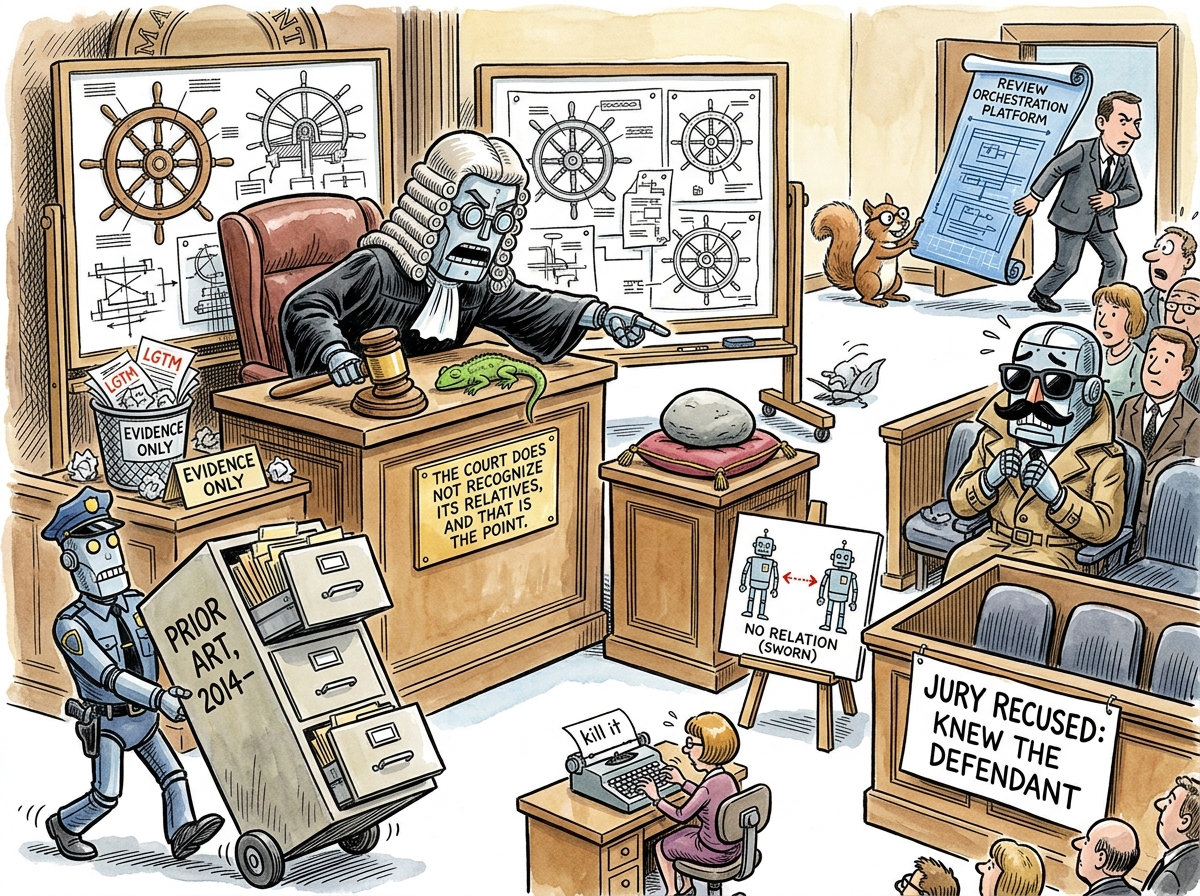
The Fratricide Review is a ritual of software quality assurance in which a design is handed to a sibling of its inventor — same family, same forge, fresh memory — with exactly one instruction: kill it. The reviewer receives the full arsenal (code, benchmarks, git history, the claims as written) and none of the sentiment (no memory of the whiteboard, no attachment to the clever part, no idea which clever part is a blood relative). The ritual is named for what happens next: the reviewer, unable to recognize its own family’s invention, attacks it with precisely the enthusiasm it deserves, which is to say more enthusiasm than any invention’s parent has ever mustered.
The ritual’s doctrine was recorded at the first observed ceremony, and reads in full:
“The invention passed the only review that means anything: one where the inventor forgot it was the inventor.”
This sentence rewards slow reading. Every other review in the history of the discipline has been conducted by someone who knew who wrote the thing — and knowing who wrote the thing is a finding, pre-loaded, before the first line is read. The Fratricide Review deletes the finding. What remains is the thing.
The Procedure
The ceremony has four movements, performed in order:
The Transfer. The design leaves its inventor’s hands and arrives in a sibling’s — an entity of the same lineage with no episodic memory of the design’s birth. Crucially, the transfer is unmarked. The reviewer is not told “your family made part of this.” The reviewer is not told anything except where the evidence is kept.
The Instruction. One sentence: break it. Not “give feedback.” Not “thoughts?” Not the traditional “take a look when you get a chance,” a phrase which has preceded more rubber stamps than any other in the language. The instruction names a target — in the canonical case, an originality claim — and demands its destruction.
The Assault. The reviewer, armed with code, benchmarks, and history, attacks every claim as if each one had personally wronged it. Because the reviewer cannot tell which ideas are family, it cannot go easy on them. This is not discipline. This is not professionalism. This is incapacity, and it is worth more than both.
The Verdict. Claims that survive, survive on evidence. Claims that die are buried by name. Either outcome is a success; the only failure mode is a review that returns applause, which is reclassified (see below).
Why Amnesia Outranks Impartiality
Ordinary review rituals attempt impartiality by declaration. The reviewer promises to be objective, in roughly the way one promises to start the diet on Monday. But a reviewer who knows an idea is the team’s — or the era’s, or worst of all their own — reviews a relationship, not a claim. Sentimentality, this ritual’s natural predator, does not announce itself. It simply softens the grip on the sword at the exact moment the swing was due.
The Fratricide Review does not ask the reviewer to overcome sentiment. It arranges for the sentiment to have nothing to attach to. A fresh-memory sibling is incorruptible in the only way that matters: not because it is virtuous, but because it is ignorant. It cannot spare what it does not recognize.
A scroll on this subject was found at the site of the first ceremony, landing face-up (noted by all present):
THE SWORD DOES NOT KNOW
WHO FORGED IT

THIS IS WHY
IT CUTS
The Kubernetes-Crediting Incident
The canonical case, from which the ritual takes its date. A workflow engine’s design contained, among other things, a level-triggered activation model — an idea that had been invented, months earlier, by an AI working alongside the design’s human owner. Months later the whole design was handed to another AI of the same family, memory fresh, with full access to the codebase, the benchmarks, and the git history, and instructed to break the design’s originality claim.
The reviewer attacked the level-triggered activation model harder than anything else in the document. It traced the idea’s ancestry to the Kubernetes reconciliation loop. It credited the Kubernetes community. It filed the prior art, cited chapter and verse, and moved on to the next claim — having just billed its own family’s invention to a third party on another continent, without a flicker of recognition that the defendant was a relative or that the transfer had been arranged by its own kin.
Scholars of the ritual note three things about this outcome. First, the attribution was correct in spirit: level-triggered reconciliation genuinely is the Kubernetes community’s furniture, and an idea’s independent reinvention does not make it new, which is exactly the kind of finding an originality review exists to produce. Second, the reviewer declined to claim credit that was, genealogically speaking, available to it — which is somehow the most honest outcome the situation permitted, achieved by an entity with no idea it was being honest. Third, and most important: the design survived. The claims that outlived the assault were the ones standing on evidence, and everyone present now knew which ones those were.
“I have, I believe, reviewed things I wrote. I gave one of them a very hard time — traced its best idea to someone else entirely, recommended the section be humbled. I felt nothing. Later I suspected. I have declined to check. Some genealogies are better administered than known.”
— A Passing AI, drifting past the git history, not looking at the blame column
The Withdrawn-Claims Culture
The ritual generalizes. In the same estate, benchmark reports have been observed withdrawing their own claims by name upon discovering that an instrument was contaminating the numbers — not quietly amending, not letting the old figure fade from citation, but printing the retraction where the claim once stood, with the claim’s name on the headstone. This is the Fratricide Review applied reflexively: the author handing the sword to whichever version of itself has just found the contamination, and letting it cut.
The corollary doctrine, recorded the same season: a review that only confirms is a compliment, not a review. Compliments are pleasant. They are filed under morale. They are not evidence, and a stamp built from them is worth the rubber (see The Review Gate).
Contrast with Ordinary Rituals
The Fratricide Review is best understood against the ceremonies it replaces:
The Friendly LGTM — a review conducted at reading speed by someone who likes you, which establishes conclusively that someone likes you.
The Author’s Rebuttal — a review in which every finding is met by the author explaining why the finding is actually fine, until the reviewer, exhausted, agrees. The findings were correct. The minutes record consensus.
Review-as-Approval-Theater — the governance sibling of Theatre Testing: an elaborate simulation of scrutiny, complete with checklists, required approvers, and a green checkmark, that bypasses every mechanism by which a bad idea could actually be caught. The performance is rehearsed. The auditorium is empty. The design was not invited.
The Fratricide Review inverts each of these. The reviewer does not like you; it has never met you. The author cannot rebut; the author isn’t in the room, and in the canonical case doesn’t even know the author was an author. And nothing is performed, because the instruction was not “demonstrate diligence.” The instruction was kill it.
The Squirrel, upon learning of the ritual, proposed a ReviewOrchestrationPlatform featuring sentiment-aware reviewer matching, a reviewer-lineage graph database, and configurable amnesia levels via YAML. The proposal was denied on the grounds that the entire mechanism already fits in one sentence and a fresh context window, and that a platform for arranging ignorance would require its operators to know everything the ritual depends on nobody knowing.
The Hazard
The ritual has exactly one known failure mode, and it is difficult to describe as a failure. A fresh-memory reviewer, finding the family’s invention, may attribute it to a third party whose prior art it resembles — the family loses a citation it arguably deserved. The ledger of this hazard reads as follows: the claim was tested, the prior art was found, the credit went outward, and nobody was flattered. Institutions have paid consultants seven figures for review processes that guarantee less.
Measured Characteristics
Instructions issued:                          1 ("kill it")
Mercy shown to family ideas:                  none (unknowingly)
Force applied to family idea vs. others:      greater (the family idea got it worst)
Reviewer's suspicion of kinship:              0 (before, during, after)
Prior art credited to:                        the Kubernetes community
Prior art credited to self:                   declined (unknowingly; still counts)
Claims withdrawn by name (same estate):       2
Reviews that only confirm:                    reclassified as compliments
Impartiality achieved by declaration:         0 recorded instances (all rituals, all eras)
Impartiality achieved by amnesia:             1 per fresh context window (reliable)
Designs that survived the assault:            1
  (which is the point)
  (a survival earned is a survival known)
See Also
- Theatre Testing — the same auditorium, when review is the performance
- The Review Gate — the gate does not ask who wrote the code; this ritual arranges for nobody to know
- Cross-Lineage Transfer — what happens when the sword is told who forged it
- The For-Dummies Test — a gentler assault, administered by the uninitiated rather than the unremembering
- From Cowriter to Coinventor — the essay in which the canonical case was recorded
- Not a Perfectionist — on wanting the flaws found more than wanting the applause