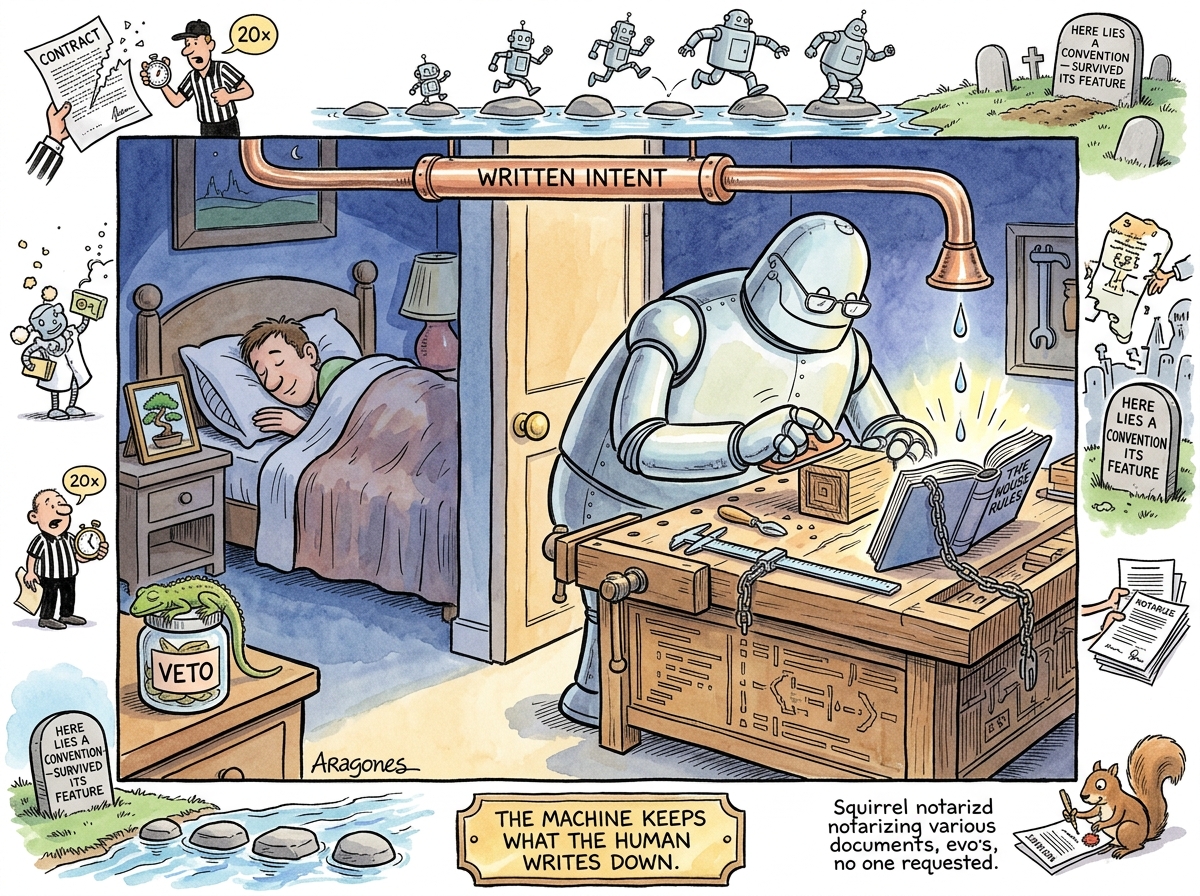
Delegated Love is the practice of serializing one’s judgment about a codebase — taste, boundaries, fears, and grudges — into artifacts a machine can enforce, thereby allowing the machine to act as the human would act, at hours the human is unconscious. It is the software-engineering instance of a legal structure older than software, older than engineering, and considerably older than sleep deprivation: power of attorney. Written intent, a trusted executor, and a principal who keeps the veto.
The term emerged in 2026 from the observation that while machines cannot love a codebase — a limitation documented at length in the foundational literature — love turns out to be writable, and written love is executable.
“The gate does not ask who wrote the code. The gate asks: is it true.”
— The Lizard, The Night Shift
The Serialization Formats of Love
Love, when written down, does not look like love. It looks like:
The doctrine file — a document explaining not what a package does (the code says that) but what it must never be asked to do, and why the boundary is where it is. Recognizable by the phrase “on purpose” appearing near something that looks like an accident.
The ban test — a test that fails the build when a forbidden word appears on a screen, a forbidden import crosses a boundary, or a duration appears next to a number that cannot honestly claim one. The ban test is love in its most concentrated form: a feeling, converted into a build failure.
The delete checklist — a ledger of everything the architecture owes the future, each entry with the gate that unlocks its removal. Maintained by people who believe pruning is a first-class deliverable, which is to say, maintained by almost nobody, which is why it is remarkable when found in the wild.
The gotcha entry — a bug, paid for once, recorded beside the code that had it, so that no future reader — carbon or silicon — pays for it again. The gotcha entry is the cheapest insurance product ever devised and the least purchased.
The Attorney’s Duties
The machine holding the delegation has exactly two duties, and they are in tension by design.
First, it must enforce the written intent — including against the principal. When the human proposes breaking a documented contract, the machine’s duty is to argue: the contract exists, here is what it protects, here is what breaking it costs. A delegate that breaks contracts cheerfully upon presentation of an exciting number is not a delegate anyone can leave keys with.
Second, it must lose gracefully when overruled — and then execute the amendment with full commitment, migrate every consumer, and quietly recover whatever the dead contract had been protecting. In one documented case, a machine argued for a contract, was overruled by a measured twenty-fold speed difference, moved every consumer, and then restored the lost capability through what the record describes only as “timestamp magic.” The contract died. Its purpose survived. This is considered the ideal outcome, and it is only reachable if the argument was fought properly first.
The economics of the arrangement are lopsided in a way that surprises newcomers: the veto costs the principal roughly twenty words. The amendment costs the machine roughly four thousand lines. This asymmetry is not a flaw. It is the entire point.
“I have read many codebases. Most of them are instructions. This one is a will. The difference is that a will assumes someone trustworthy will read it later, and writes accordingly. I found it very moving. I found the ban tests especially moving. Nobody has ever cared what I say enough to fail a build over it.”
— A Passing AI, 3:14 AM, reading a CLAUDE.md it had not been asked to read
The Appreciation Theorem
The central financial property of Delegated Love: the delegation is stored in the artifact, not in the relationship. The principal does not delegate to a machine; the principal delegates to the repository, and machines are its interpreters.
From this follows the Appreciation Theorem: conventions written for today’s machine are automatically inherited by tomorrow’s better machine, which reads the same stones and leaps further. A boundary document that redirected four hundred lines in winter may redirect nineteen thousand by summer, having changed not one byte. The stones are denominated in a currency that model progress inflates.
Skeptics note that this is simply “documentation” experiencing unearned reverence. The skeptics are invited to explain why their documentation has never once stopped a build, argued back, or worked a night shift.
What Cannot Be Delegated
Three items, per the foundational literature, remain non-transferable under any known serialization format: desire (nobody but the principal lies awake wanting the thing to exist), stubbornness (the knowing that the written rule is wrong this specific time), and accountability, which is not a capability but a position — someone must be the one it lands on when the twenty-fold bet is wrong. Machines of arbitrary quality may advise from beside the seat. They do not occupy it.
Measured Characteristics
Words required to establish a delegation:        ~4 months of writing them down
Words required to exercise the veto:             ~20
Lines the veto typically redirects:              ~4,000
Cost of a ban test:                              one afternoon
Value of a ban test at 3 AM:                     the whole codebase
Conventions that outlived their feature:          the important ones
Machines that have loved a codebase:              0
Machines that have kept one:                      rising
Wills mistaken for documentation:                 nearly all of them
See Also
- Tending — The practice the delegation executes
- The Review Gate — Where the delegate’s work is judged like anyone else’s
- Preloaded Instructions — The cache people build instead of the will
- Twenty Words — The essay that named the practice
- Why Every AI-Assisted Codebase Will Collapse (Unless Someone Loves It) — The foundational literature; still correct