webMethods is an integration software company founded in 1996 that built one of the first integration servers — the product that would define the ESB category before Gartner named it. It was also the last company riclib ever worked for. May 1, 2000 to December 31, 2003. Three years and eight months. Everything after was his own.
“The recruiter said ‘you will not sign.’ The recruiter was correct. The salary doubled. The product had Java nodes in a visual pipeline. The CEO laughed at the monkey joke. The developer stayed for three years and then never had a job again.”
— The Lizard, summarising a career inflection point
The CV That Started Everything
It began with a tax form.
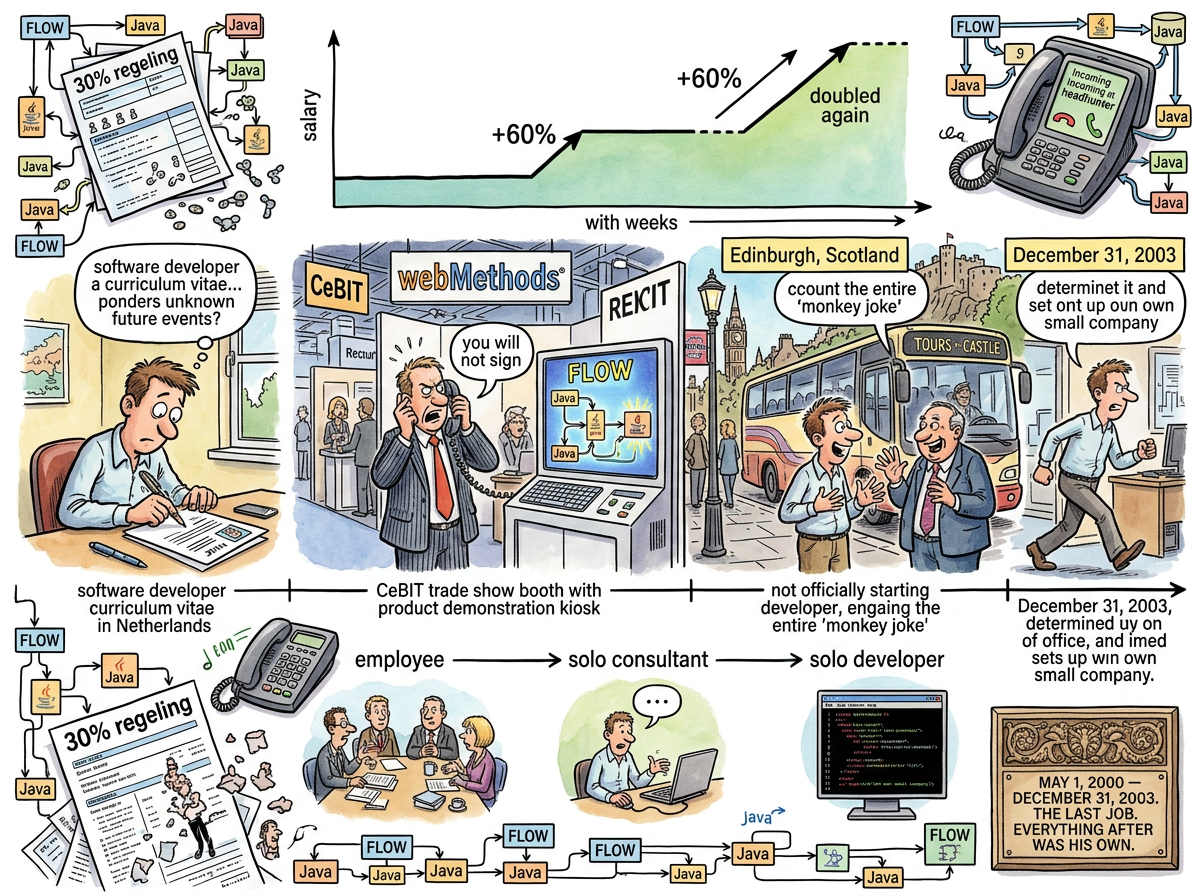
riclib was in the Netherlands. He had built the Data Fabric — the Delphi-and-Expat integration layer that preinvented the ESB — and needed to apply for the 30% regeling, a Dutch tax optimisation for outstanding foreign workers that effectively reduced your tax burden by treating 30% of your salary as a tax-free allowance. The application required a CV. riclib wrote the CV.
Within weeks, the CV was circulating. Headhunters called. The first serious offer was a 60% increase over his current salary. riclib accepted. He would sign the contract on Friday, after he returned from CeBIT — the massive technology trade fair in Hannover, the annual pilgrimage of the European tech industry.
The day before CeBIT, a headhunter called.
“I’ve already accepted a job,” riclib said.
“Have you signed?” the headhunter asked.
“Not yet. Friday.”
“You will not sign.”
The headhunter was from webMethods. The company that was building the integration platform that riclib had, in a sense, already built in Delphi. The headhunter’s confidence was not arrogance — it was knowledge. He knew what webMethods was about to offer.
They doubled the offer that had already increased riclib’s salary by 60%.
riclib did not sign on Friday.
FLOW
At CeBIT, webMethods sent someone to demonstrate the product. The product was the webMethods Integration Server, and its programming model was FLOW — a visual pipeline language where you connected services, transformations, and routing logic in a graphical editor.
FLOW was interesting. Visual programming languages are usually interesting for about fifteen minutes before you discover that they cannot do the one thing you need and there is no escape hatch. FLOW had an escape hatch.
You could add Java nodes to the pipeline.
Real Java. Not Enterprise JavaBeans. Not J2EE ceremony. Not the AbstractSingletonProxyFactoryBean that Java would become. This was 2000, and Java was still the language James Gosling had designed — a class, a method, the method does the thing, the thing runs. You wrote a Java class, compiled it, dropped it into the FLOW pipeline as a node, and the integration server executed it alongside the visual routing and transformation logic. The visual pipeline for the orchestration. Java for the hard parts. Each doing what it was good at.
riclib looked at FLOW. riclib saw the Java nodes. riclib was sold.
This was the same instinct that had driven every language choice in the career: the tool must let you talk to the machine when you need to. Spectrum BASIC had POKE. Delphi had C DLL calls. FLOW had Java nodes. The visual layer was the convenience. The Java node was the escape hatch. The escape hatch was why it worked.
The Bus to the Castle
riclib joined on May 1, 2000. Fifteen days before his first day, the company invited him to an offsite — the entire company, flown to a castle in Scotland for strategy and team building.
On the bus from the airport to the castle, riclib sat next to the CEO. riclib had no employee ID. riclib had no desk. riclib had not attended a single meeting. riclib told the CEO the monkey joke.
The CEO said: “Do you know what a career-limiting move is?”
Then he laughed.
For the next three years and eight months, that CEO trusted riclib. Not because the joke was funny — because the joke was direct. The full story is in the CEO article. The short version: a person who tells the monkey joke to the monkey at the top of the tree is a person who will tell you the truth when the truth is expensive.
The Last Job
riclib left webMethods on December 31, 2003.
He started his own company. Then he discovered that life as a solo consultant was better — the same work, the same clients, without the overhead of a company structure. Then, much later, he discovered that life as a Solo Developer was the same as consulting without all the meetings.
The trajectory was a progressive subtraction:
| Stage | What was removed |
|---|---|
| Employee (webMethods) | — |
| Company owner | The employer |
| Solo consultant | The company |
| Solo developer | The meetings |
Each step removed one layer between riclib and the work. Each step felt like coming home. The pattern was the same pattern that had driven every technical choice — POKE instead of abstraction, assembly instead of BASIC, Go instead of Java, direct instead of indirect. The career followed the code: remove the layers. Talk to the machine. Ship.
webMethods was the last layer. After webMethods, there were no more layers to remove. There was only the work.
Measured Characteristics
- Company: webMethods (founded 1996, Fairfax, Virginia)
- Product: webMethods Integration Server (FLOW + Java nodes)
- Later acquired by: Software AG (2007)
- riclib’s tenure: May 1, 2000 — December 31, 2003 (3 years, 8 months)
- Status: the last job riclib ever had
- Salary trajectory: base → +60% (first offer, accepted) → doubled again (webMethods, “you will not sign”)
- Time between first offer and webMethods offer: days
- Trigger for the CV: 30% regeling application (Dutch tax optimisation)
- Trigger for the headhunter: CeBIT (Hannover)
- Headhunter’s prediction (“you will not sign”): correct
- What sold riclib: FLOW with Java nodes (real Java, not enterprise Java)
- CEO encounter: monkey joke on the bus, 15 days before Day 1
- CEO’s response: “Do you know what a career-limiting move is?” (then laughed)
- Career after webMethods: company owner → solo consultant → solo developer
- Layers removed at each step: employer, company, meetings
- Jobs after webMethods: 0
- Years since last job: 22+ (and counting)
- The pattern: same as the code — remove the layers, talk to the machine, ship
See Also
- CEO — The monkey joke. The bus. The castle. The trust that followed.
- ESB — The pattern riclib preinvented with the Data Fabric. webMethods productised it.
- Delphi — The language of the Data Fabric. The predecessor to the webMethods career.
- Java — Real Java, 2000-era Java, the Java that FLOW’s nodes used. Before the enterprise happened.
- Solo Developer — Where the trajectory ended. No employer. No company. No meetings. Just the work.