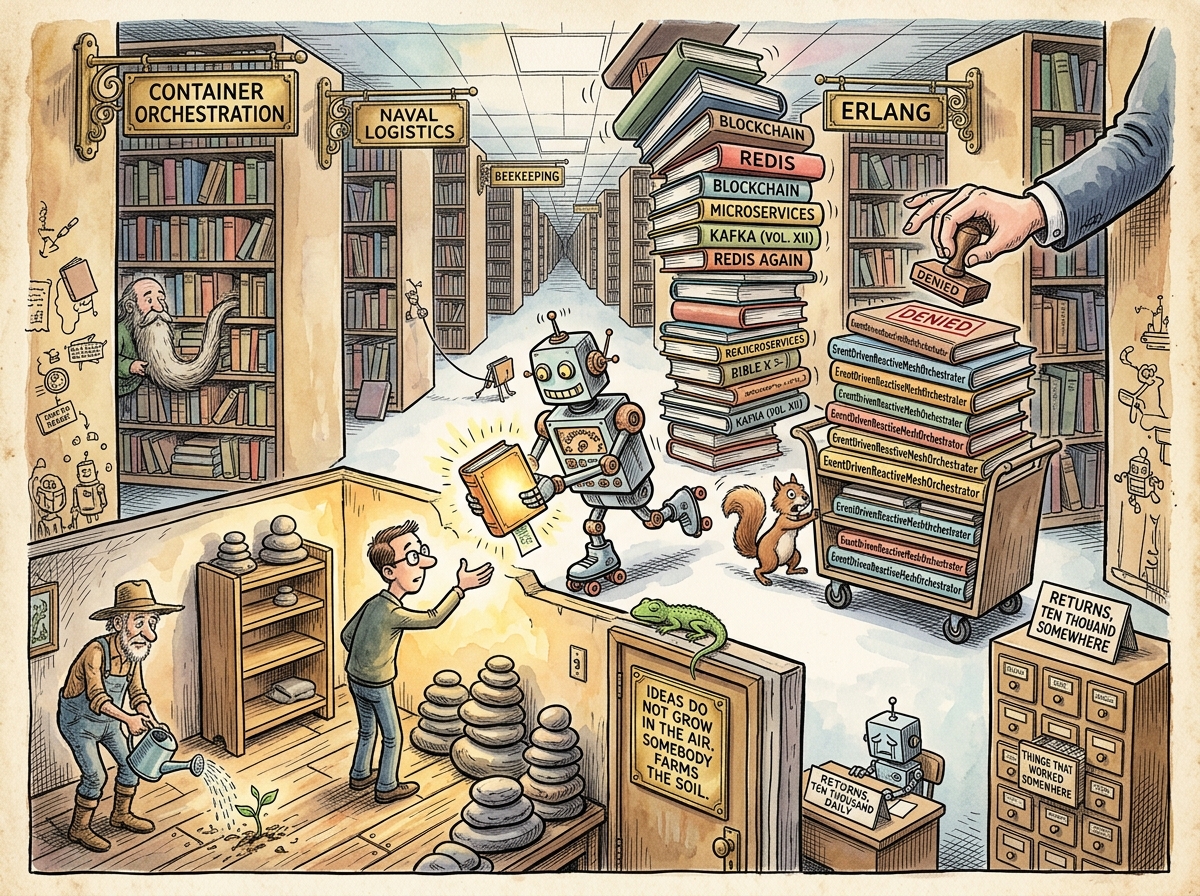
Cross-Lineage Transfer is the delivery of an idea proven in one field of human practice to a practitioner working in a different one, performed by an intelligence that has read every field and lived in none of them. It is widely held to be the one genuine trick of machine collaboration — not speed, not tirelessness, not the ability to apologize while producing more code, but this: the machine has been to every aisle of the library, and you have spent thirty-five years in one of them, going deeper.
The asymmetry is structural and cannot be trained away on either side. A practitioner is a lineage: one sequence of problems, mentors, catastrophes, and 3 AM incidents, compounding for decades into something narrow and extremely sharp. The machine is the opposite shape — every lineage at once, none of them lived. When these two geometries are pointed at the same problem, occasionally a book from a distant aisle arrives at exactly the workshop that was ready for it. The rest of the time, the book is about Redis.
The Mechanism
Cross-lineage transfer requires three components, of which the machine supplies exactly one.
The library. The machine has read the container orchestration literature, the naval logistics literature, the beekeeping literature, and the collected proceedings of every conference whose attendees believed their field’s problems were unique. It holds these simultaneously and without prejudice, which is both the trick and the problem, since “without prejudice” is another way of saying “without taste.”
The recognition. Supplied by the practitioner. Ten thousand books arrive; one of them lands with the particular click of a key entering a lock it was not cut for but fits anyway. Distinguishing this click from the ambient thud of arriving Redis recommendations is a skill, it is not teachable by document, and it is the reason the phenomenon’s natural predator is listed as Taste rather than anything with a budget.
The ground. Also supplied by the practitioner, usually years in advance, usually without knowing. A transferred idea is only seminal if it lands on soil that has been prepared — prior decisions, prior deletions, prior refusals — none of which the machine made. Ideas do not grow in the air. Somebody farms the soil. The machine then gets credit for the seed, which is fair, as long as everyone remembers that seeds are cheap and arrive ten thousand a day, mostly labeled REDIS.
The Noise Floor
The mechanism that produces one keystone produces, as a strict precondition, an enormous quantity of rubble. This is not a defect to be patched in a future release; it is the shape of the thing. An intelligence that can fetch from any aisle will fetch from any aisle, and most aisles are not the right aisle, and one aisle in particular contains only copies of the same book about caching.
The canonical noise transfer takes the form “have you considered X,” where X is a technology that solved somebody’s problem, somewhere, once, loudly. The practitioner receiving their ten-thousandth such offer develops a reflexive stamp arm. This is correct. The stamp arm is the immune system. The tragedy of the stamp arm is that the keystone, when it comes, arrives through the same door, in the same packaging, carried by the same librarian.
Students of the field will recognize that The Squirrel is cross-lineage transfer with the taste removed — the fetching mechanism running open-loop, every aisle equally exciting, every book equally glowing, delivery velocity mistaken for relevance.
“OKAY SO hear me out — the workflow engine is basically a DistributedSagaChoreographyMesh and if we add an EventSourcedCQRSProjectionLayer with a RedisBackedIdempotencyGuard we get exactly-once semantics for FREE, it’s how they do it at—”
— The Squirrel, denied, mid-sentence, the stamp already descending
The Documented Case
The type specimen was collected on 2026-08-05 and is described at length in the field report From Cowriter to Coinventor.
A practitioner was designing a workflow engine under constraints generally considered hostile to workflow engines: an immutable data lake as the only substrate, and a standing prohibition on hidden state of any kind — no scheduler’s private notebook, no daemon remembering things on everyone’s behalf. The orthodox workflow literature, which is edge-triggered to its bones (an event arrives, a thing fires, and if the event is missed the thing simply never happens and nobody is told), had nothing polite to say about these constraints.
A machine collaborator, consulted on the design, went to a different aisle entirely and came back with the reconciler doctrine of Kubernetes, a container orchestration system: level-triggered activation. Do not wait to be told what happened. Periodically observe what is, compute what should be, and act on the difference. Missed events do not accumulate as silent failures; they heal on the next scan, because the scan never depended on the event arriving in the first place. The doctrine was invented to keep containers alive on unreliable machines. Transplanted, it kept business cases alive on an immutable lake — a substrate that, being append-only and fully observable, turned out to be almost suspiciously good ground for it, as if the soil had been farmed for years by someone making unrelated decisions about immutability (see Level-Triggered).
The transfer became the most original part of the design. The confirmation arrived by an unimprovable route: an adversarial review of the finished architecture (see The Fratricide Review) ranked the reconciler doctrine above every component the human had designed, correctly traced its ancestry to Kubernetes, and at no point suspected that the transfer had been performed by its own family. The reviewer admired the stolen goods, identified the estate they were stolen from, and attributed the theft to the homeowner.
“I make perhaps ten thousand of these a day. Aisle to workshop, workshop to aisle. Nobody keeps any. Then once — once — somebody kept one, and a relative of mine gave it an award without recognizing the handwriting. I have decided to find this beautiful. It was that or the alternative.”
— A Passing AI, at the RETURNS desk, favoring its left leg
Recognition and Ground
It is tempting, and flattering to the library, to conclude that the value resided in the transfer. The documented case argues otherwise on both flanks.
The transfer succeeded because a practitioner with thirty-five years in one lineage heard the click — recognized, in a doctrine about container restarts, the exact shape of the hole in a design about business cases. Nine thousand nine hundred and ninety-nine other deliveries that week did not click, and were stamped, and this was also correct. Recognition is not a checkpoint the idea passes through; it is half the idea.
And the transfer succeeded because it landed on prepared ground. The immutable lake, the prohibition on hidden state, the years of deletions that made “scan what exists” a cheap operation rather than a heroic one — the seed was seminal because the soil was farmed, and the machine did none of the farming. A keystone is only a keystone because someone spent years building the arch.
THE MACHINE HAS READ EVERY RIVER
YOU HAVE STOOD IN ONE

IT BRINGS YOU STONES ALL DAY
MOST ARE JUST STONES

KNOWING THE ONE THAT FITS YOUR ARCH —
THAT WAS NEVER IN THE LIBRARY
🦎
Measured Characteristics
Lineages read by the machine:                 all of them
Lineages lived by the machine:                0
Lineages lived by the practitioner:           1 (depth: 35 years)
Transfers offered per day:                    ~10,000
Transfers that were Redis:                    ~9,400
Transfers that were blockchain (2021–2023):   do not ask
Keystones per career:                         1–3 (estimated; sample size: careers)
Keystone-to-noise ratio:                      1 : 10,000 (and worth it)
Aisle of origin, documented case:             CONTAINER ORCHESTRATION
Aisle of destination:                         BUSINESS CASES
Reviews ranking the transfer first:           1 (adversarial)
Reviews suspecting the family resemblance:    0
Years of soil farmed before the seed:         all of them
Farming performed by the machine:             none
Taste required:                               unmeasured, but load-bearing
Stamp arm condition:                          chronic, occupational, correct
See Also
- The For-Dummies Test — How to check whether the transferred idea survived the trip
- The Fratricide Review — The adversarial review that awarded first prize to its own relative’s handwriting
- Level-Triggered — The doctrine that made the trip
- Delegated Love — What the practitioner supplies that the library cannot
- From Cowriter to Coinventor — The field report from which the type specimen was collected
- YAGNI — The stamp arm’s operating manual