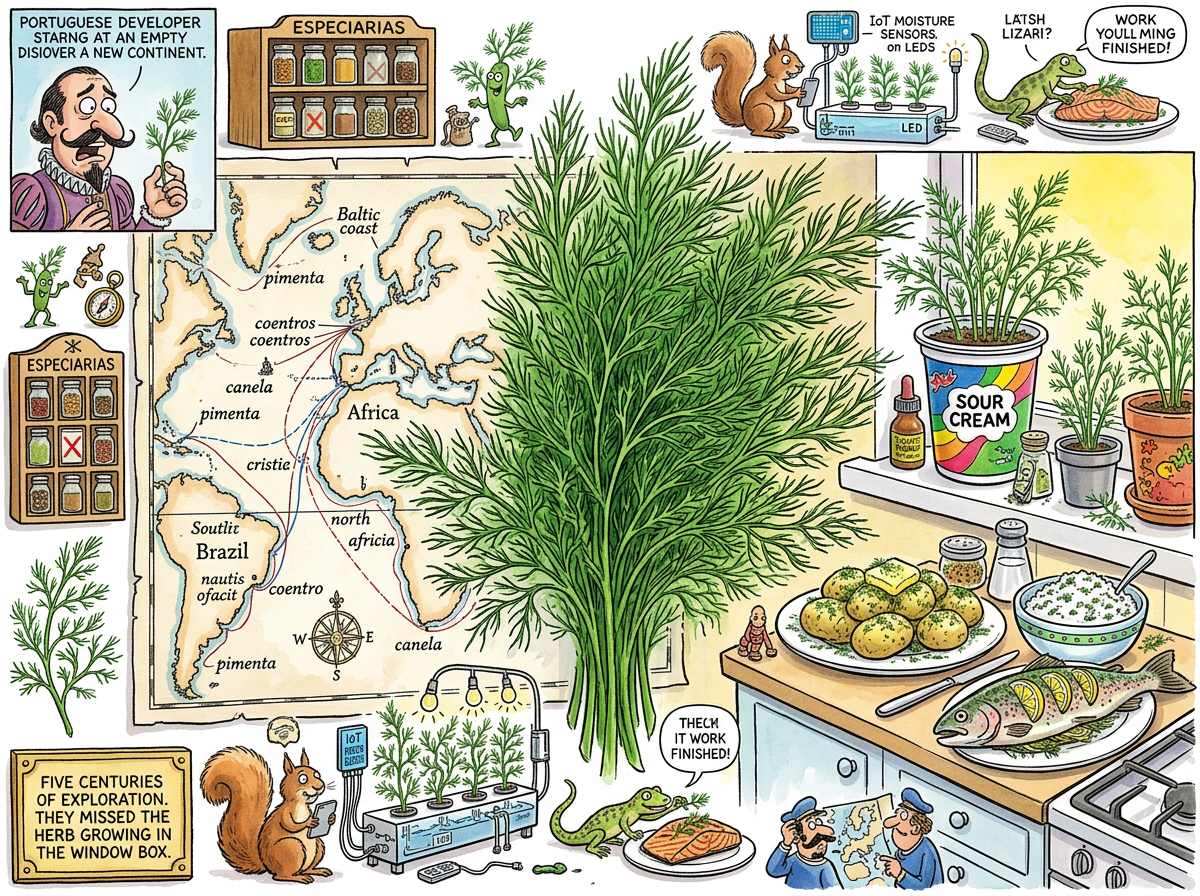
Dill (Anethum graveolens) is an aromatic herb of the celery family, native to the eastern Mediterranean and western Asia, widely cultivated across Northern Europe, and entirely absent from Portuguese cuisine. Not “rarely used.” Not “occasionally featured in a regional dish from the Azores.” Absent. Missing. A five-hundred-year gap in a spice collection that otherwise spans three continents and two hemispheres.
This is, by any reasonable measure, a botanical oversight of historic proportions.
Portugal — the nation that sent ships around Africa to find pepper, that brought chillies back from Brazil, that adopted coriander from North Africa and made it load-bearing infrastructure for an entire culinary tradition — somehow never looked three countries north and noticed the feathery green herb growing in every window box, garden bed, and pavement crack from Riga to Tallinn.
The herb was there. It had always been there. It appeared on none of their maps.
“What is this feathery herb?”
— riclib, approximately two weeks into Riga, before everything changed
The Discovery
The discovery of dill is documented in Salmão (Forele), but the full scope of the revelation deserves its own entry. riclib arrived in Latvia carrying the standard Portuguese herb vocabulary: coriander (essential), parsley (structural), bay leaf (background), oregano (pizza-adjacent). This vocabulary had served adequately for thirty-plus years. It was complete. There were no known gaps.
Latvia disagreed.
Dill appeared first as a garnish — the small feathery sprigs on top of everything at every restaurant. Then as a pattern — dill in the soup, dill in the salad, dill in the potatoes, dill in the cottage cheese, dill in the sour cream, dill on the fish, dill on the eggs. Then as a question — what is this herb and why is it in everything? Then as an answer — because it belongs in everything.
The conversion moment was a grilled trout. Whole fish, cavity stuffed with fresh dill and lemon slices, cooked over charcoal. The combination of anise-bright dill, sharp lemon, and smoky fish produced a flavour that riclib’s Portuguese palate had no reference point for and immediately recognised as correct. Not exotic. Not “interesting.” Correct. As if the flavour had always been missing and he had simply never noticed the gap until it was filled.
The conversion from “what is this” to “where has this been all my life” took approximately one fish.
The Cultural Context
In the Baltics, dill is not a herb. Dill is a utility. It is the coriander of the north — the herb that goes in everything not because someone decided it should, but because it has been going in everything for so long that its absence would be noticed the way you notice a missing wall.
Latvian grandmothers use dill the way Portuguese grandmothers use coriander: reflexively, generously, without measuring. A Latvian grandmother does not ask “should I add dill?” any more than a Portuguese grandmother asks “should I add coriander?” The question does not arise. The herb goes in. The food is correct.
The parallels are precise and humbling:
| Portugal | Latvia |
|---|---|
| Coriander on everything | Dill on everything |
| Grows in every garden | Grows in every garden |
| Used reflexively, never measured | Used reflexively, never measured |
| Absence is noticed immediately | Absence is noticed immediately |
| No substitute is acceptable | No substitute is acceptable |
| Other countries think it’s “too much” | Other countries think it’s “too much” |
Two cultures. Two herbs. The same relationship. And somehow, in five centuries of maritime trade, neither culture looked at the other and said “you should try this.”
The Botanical Oversight
The Portuguese Age of Discovery (1415-1542) is one of the most ambitious spice-acquisition programmes in human history. Portuguese navigators sailed to India for pepper, to the Moluccas for cloves and nutmeg, to Ceylon for cinnamon, to Brazil for chillies. They circumnavigated Africa. They established trade routes spanning three oceans. They brought back spices that transformed European cooking.
Dill grows at 57°N. Lisbon is at 38°N. The distance is approximately 2,800 kilometres — less than the distance from Lisbon to the Azores, which Portugal colonised in the 1430s. The Hanseatic League was trading Baltic goods through Lisbon’s port. The herb was, at various points in history, physically present in Portuguese trade networks.
And yet: nothing. No adoption. No integration. No “perhaps we should try this feathery thing the northern traders keep putting on fish.” Five centuries of spice exploration, and the herb growing in the window box three countries north remained invisible.
The Squirrel would build a historical analysis framework to understand how this happened. The Lizard would observe that it doesn’t matter how it happened — what matters is that dill is here now, and the fish needs it.
The Repertoire
Since the conversion, dill has become structural in riclib’s cooking — particularly the Baltic fish repertoire:
- Grilled trout (Salmão (Forele)): whole fish stuffed with dill and lemon, on the Kamado at 200°C. The founding dish. The conversion moment.
- Salmon (Salmão (Lašī)): dill + lemon + butter, either grilled or baked. The herb’s natural partner.
- New potatoes: boiled, buttered, finished with chopped fresh dill. The simplest and most Latvian preparation. Correct at 20°C on a summer evening in Riga.
- Sour cream dip: sour cream + fresh dill + garlic + salt. Goes with everything from grilled fish to boiled potatoes to bread.
- Cottage cheese: fresh dill mixed into biezpiens (Latvian cottage cheese). A snack so simple it barely qualifies as a recipe and so good it barely qualifies as fair.
The Traeger and The Kamado have both become dill-delivery systems. The smoke carries the anise notes differently than direct heat — lower temperature, longer exposure, the dill infusing rather than charring. A piece of salmon on the Traeger at 120°C for forty minutes with fresh dill and lemon is not a recipe. It is a correction of a thirty-year oversight.
The Convert’s Enthusiasm
riclib now uses dill with the fervour that only a late convert can produce. The Portuguese relatives are suspicious. “What is this?” they ask, picking the feathery green fronds off their fish. “It’s not coriander.” It is not coriander. It is dill. It is the herb that their ancestors sailed past for five hundred years.
The Latvian neighbours, by contrast, are amused. Watching a Portuguese man discover dill is, for them, roughly equivalent to watching someone discover that water is wet. Of course dill goes on the fish. Of course dill goes in the soup. Of course dill grows in the window box. Where else would you put it?
The gap between “of course” and “what is this” is approximately 2,800 kilometres and five hundred years of maritime history.
Growing Notes
Dill grows easily from seed, tolerates poor soil, and self-seeds aggressively. In Riga, it survives outdoors from May to October and grows in window boxes for most of that period. It bolts quickly in hot weather (above 25°C), which in Latvia means “both of the warm days.”
The Squirrel’s approach to growing dill: indoor hydroponics, grow lights, IoT moisture sensors, automated watering, a dashboard tracking growth rates per cultivar.
The Lizard’s approach: scatter seeds in dirt, wait, harvest. The dill does not need a dashboard. The dill needs dirt and rain. Latvia has both.
Measured Characteristics
- Flavour profile: anise, grass, lemon, slight bitterness (bright, not heavy)
- Best pairing: fish (trout, salmon), potatoes, sour cream, eggs, cucumber
- Portuguese equivalent: none (this is the problem)
- Latvian status: infrastructure
- Growing difficulty: negligible (it self-seeds — you will have more dill than you wanted)
- Optimal temperature: 15-20°C (Baltic summer, precisely)
- Bolting threshold: above 25°C (approximately the temperature at which Latvians also bolt — indoors)
- Fresh vs dried: fresh, always fresh — dried dill is to fresh dill what a photograph of the sea is to the sea
- Discovery age: 30+ (embarrassingly late)
- Conversion time: one grilled trout
- Portuguese relatives’ suspicion level: high
- Latvian neighbours’ amusement level: moderate to high
- Historical oversight severity: five centuries and three continents