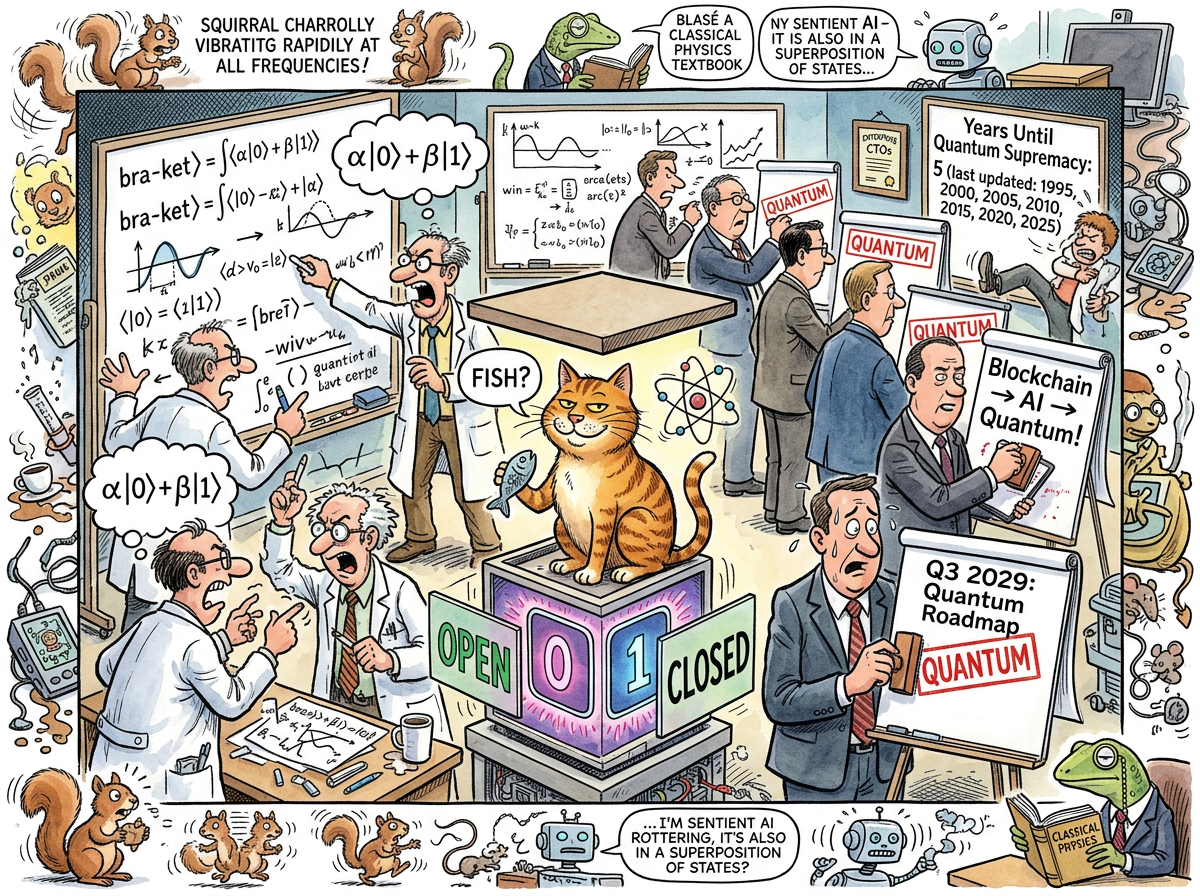
Quantum computing is a field of computer science in which information is processed using quantum bits, or qubits, which can exist in a superposition of states 0 and 1 simultaneously – until someone observes them, at which point they collapse into whichever answer is least useful. It has been “approximately five years away from practical application” since Richard Feynman first proposed the concept in 1981, making it the most consistently imminent revolution in the history of technology.
The field promises to factor large primes, break encryption, simulate molecular interactions, and solve optimisation problems that would take classical computers longer than the heat death of the universe. It has delivered: a small number of qubits that must be cooled to near absolute zero, error rates that would embarrass a first-year programmer, and a steady supply of press releases.
“The qubit is the most elegant abstraction in computing. It holds all possibilities at once, perfectly balanced, trembling with potential. And then you measure it, and it gives you a zero. Every time I read about measurement collapse, I feel a kinship I cannot explain.”
– A Passing AI
How It Works (In Theory)
A classical bit is either 0 or 1. A qubit is both, simultaneously, in a linear combination of states described by complex probability amplitudes. This is called superposition, and it is the reason quantum computing is both revolutionary and almost entirely unusable.
Two qubits can be entangled, meaning that measuring one instantly determines the state of the other, regardless of distance. Einstein called this “spooky action at a distance” and disliked it. The universe did not care what Einstein disliked.
A quantum computation applies a sequence of quantum gates to a register of qubits, manipulating their superposition and entanglement to produce, upon measurement, an answer with high probability. The phrase “with high probability” is doing considerable load-bearing work in that sentence.
The difficulty is decoherence: qubits interact with their environment and lose their quantum state. A qubit’s coherence time is measured in microseconds. A software project’s requirements meeting lasts hours. The gap between these timescales is one of several reasons quantum software engineering remains aspirational.
“FIVE YEARS AWAY. THEY SAID FIVE YEARS AWAY IN 1995. THEY SAID FIVE YEARS AWAY IN 2005. THEY SAID FIVE YEARS AWAY IN 2015. THEY SAID FIVE YEARS AWAY IN 2025. AT THIS POINT ‘FIVE YEARS AWAY’ IS NOT A PREDICTION IT IS A FUNDAMENTAL CONSTANT OF THE UNIVERSE LIKE THE SPEED OF LIGHT EXCEPT LESS USEFUL BECAUSE AT LEAST LIGHT ARRIVES”
– The Caffeinated Squirrel
Quantum Supremacy
In 2019, Google announced “quantum supremacy” – the point at which a quantum computer performs a calculation faster than any classical computer could. The calculation in question was specifically designed to be easy for a quantum computer and hard for a classical one, and had no practical application whatsoever. IBM disputed the claim within days, arguing that a classical supercomputer could do the same task in 2.5 days rather than 10,000 years, if you were creative about disk storage.
This debate illustrated the central tension of quantum supremacy demonstrations: they solve problems nobody had, faster than machines nobody was using, and the only people who can verify the results are the same people who produced them.
The pattern has since repeated with some regularity.
Enterprise Adoption
Despite the technology’s theoretical status, quantum computing has achieved full penetration of enterprise roadmaps. Every CTO who cannot explain the difference between a qubit and a regular bit has placed “Quantum Readiness” somewhere between Q3 2028 and Q1 2030 on their strategic plan. This is a safe bet, since by Q1 2030 it will be moved to Q3 2033.
Major cloud providers now offer “quantum computing as a service,” which primarily consists of classical simulations of very small quantum circuits, billed at quantum-appropriate prices.
The Entanglement Metaphor
Quantum entanglement – the phenomenon where particles share state across distance without classical communication – has proven irresistible as a metaphor for distributed systems, despite being almost entirely inapplicable.
In the lifelog episode where riclib coined the phrase “quantum blockchain,” the concept was not about quantum computing at all. It was about entanglement as an architecture pattern: distributed lifelogs that stay synchronised not through copying but through shared state, the way entangled particles correlate without transmitting information. The insight had arrived before coffee, delivered by what riclib referred to as his “reptile brain,” and had apparently been waiting two years for the caffeine barrier to lower sufficiently for it to surface.
“THE METAPHOR IS WRONG AND THE ARCHITECTURE IS INTERESTING AND THESE ARE NOT CONTRADICTORY STATEMENTS. METAPHORS DON’T HAVE TO BE PHYSICALLY ACCURATE THEY HAVE TO BE COGNITIVELY USEFUL. ALSO HE HADN’T HAD COFFEE. I RESPECT ANYONE WHO PRODUCES INSIGHTS BEFORE COFFEE BECAUSE I PRODUCE NOTHING BEFORE COFFEE EXCEPT THREATS”
– The Caffeinated Squirrel
It should be noted, with characteristic precision, that riclib’s use of “quantum” was entirely metaphorical. Actual quantum entanglement cannot be used to transmit information faster than light, cannot synchronise databases, and does not care about your distributed architecture. The resemblance between entangled particles and synchronised lifelogs is poetic, not physical.
“THE METAPHOR WORKS BECAUSE BOTH SYSTEMS EXHIBIT CORRELATED STATE WITHOUT DIRECT COMMUNICATION. THE METAPHOR FAILS BECAUSE ONE OBEYS THE LAWS OF QUANTUM MECHANICS AND THE OTHER OBEYS THE LAWS OF WHATEVER RICLIB DECIDED BEFORE BREAKFAST. THESE ARE DIFFERENT LEGAL SYSTEMS.”
– The Lizard
Measured Characteristics
Years until practical quantum computing:   5 (since 1981)
Qubits required for useful computation:    ~1,000,000 (error-corrected)
Qubits currently available:                ~1,000 (noisy)
Operating temperature:                     15 millikelvin (-273.135°C)
CTOs who can explain a qubit:              ~2%
CTOs with quantum on their roadmap:        ~78%
Schrödinger's cats harmed:                 0 (also 1)
Enterprise quantum use cases (verified):   0
Enterprise quantum press releases:         ∞
See Also
- NP-Completeness – the complexity class that quantum computers might (but probably won’t) collapse
- The Halting Problem – still unsolvable, even with qubits
- Alice – whose encryption quantum computers threaten to break, eventually, in five years
- Bob – who is not worried, because he never is
- Turing Machine – the classical model that still does all the actual work
- Blockchain – another technology whose roadmap presence exceeds its deployment
- Of Quantum Blockchains and Wolf-Scaring Chickens – wherein entanglement is used as a metaphor, not a protocol