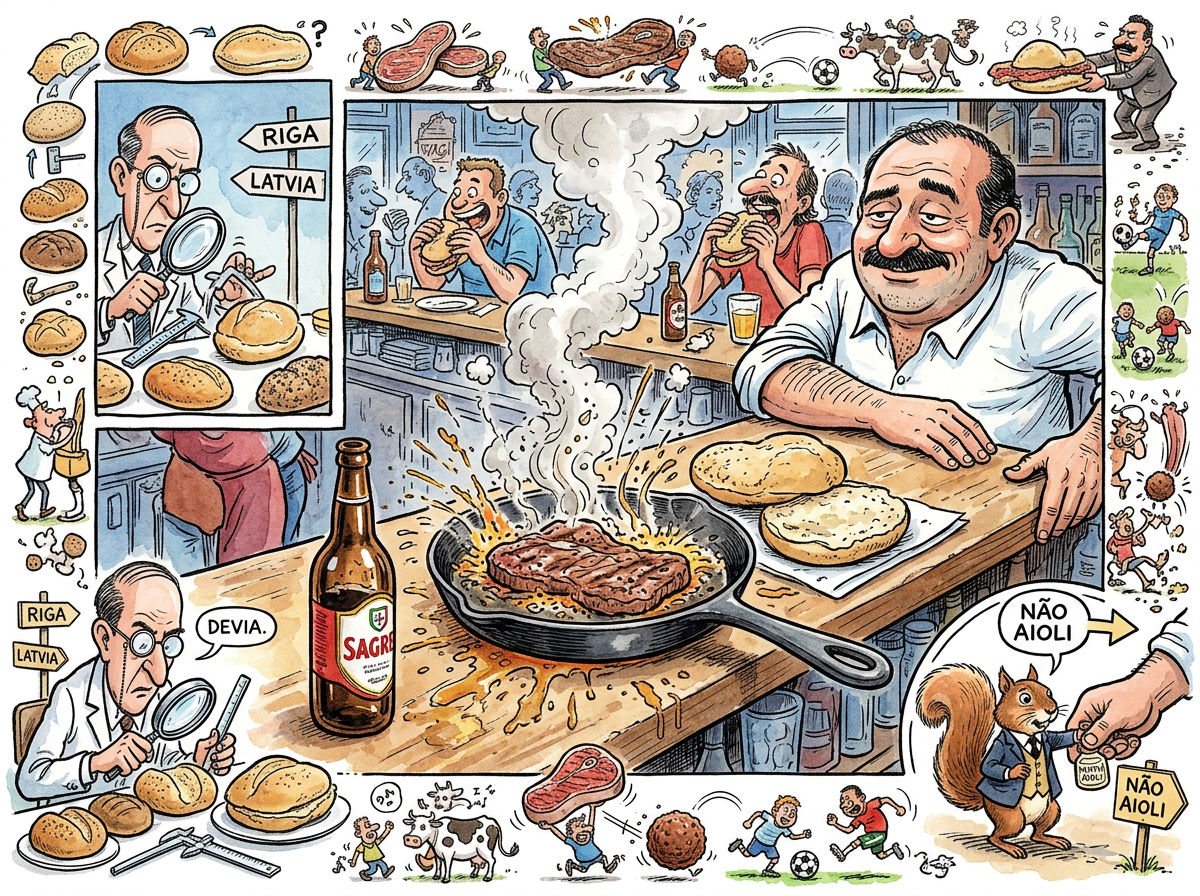
The prego is a Portuguese steak sandwich that achieves perfection through the strategic application of not adding things. A thin beef steak, marinated in garlic and olive oil, seared at temperatures that would concern a fire marshal, stuffed into a papo-seco roll. The meat juices soak into the bread. The bread becomes the sauce. There is no sauce because the bread is the sauce. This is the entire recipe.
The prego is Portugal’s answer to the hamburger, except Portugal wasn’t answering anyone’s question. Portugal was standing at a bar counter eating a steak sandwich with a beer while America was still working out whether the hamburger needed a sesame seed bun. The prego requires no condiments, no lettuce, no tomato, no cheese, no brioche bun, no truffle aioli, no “signature sauce,” no deconstructed anything. It is a sandwich that would receive a zero from a food stylist and a ten from anyone who has ever been hungry.
The Lizard designed this sandwich. Or rather, the Lizard would have designed this sandwich, had it not already existed for longer than anyone can remember.
The Steak
The steak is thin. This is non-negotiable. The prego steak is pounded flat — 5mm, maybe 8mm — until it is a sheet of beef that will cook in ninety seconds. This is not a steak that you check with a thermometer. This is a steak that you sear with violence and remove before it has time to complain.
The cut is not precious. Rump works. Sirloin works. Whatever your butcher has that is lean enough to pound flat and flavourful enough to carry garlic. This is not a Rib Eye situation. The rib eye is too fatty, too thick, too much of a prima donna. The prego steak is a working steak. It clocks in, gets seared, gets stuffed into bread, and does not ask for applause.
The marinade is garlic — crushed, minced, or sliced, in olive oil, with salt. Some add a bay leaf. Some add piri-piri. Some add white wine. These are acceptable variations, not requirements. The garlic and olive oil are the requirements. Minimum one hour. Overnight is better. The Dry Brine philosophy applies: time does the work.
The Bread
The papo-seco is the Portuguese bread roll: crusty outside, soft inside, structurally sound enough to absorb a steak’s worth of garlic butter and meat juices without disintegrating. It is the engineering marvel that makes the prego possible. The crust provides structure. The interior provides absorption. The ratio is critical — too much crust and the bread fights the steak; too soft and it collapses into a garlic-soaked napkin.
In Riga, the papo-seco does not exist. This is a known limitation of living 3,700 kilometres from Lisbon. However — and riclib has verified this extensively — Latvian bread is actually excellent. The bread situation in the Baltics is considerably better than the bread situation in, say, London or San Francisco. A good crusty roll from any decent Latvian bakery works. It is not a papo-seco. It does not pretend to be a papo-seco. But it absorbs garlic butter with dignity, and dignity is all you can ask of bread that far from Portugal.
The Squirrel would substitute a ciabatta, or a focaccia, or an artisanal sourdough with activated charcoal. The prego does not want your artisanal sourdough. The prego wants a roll that knows its place.
The Method
-
Pound the steak thin. Between cling film, with a meat mallet or a heavy pan. 5–8mm. If you can read a newspaper through it, you’ve gone too far, but only slightly.
-
Marinate. Garlic, olive oil, salt. One hour minimum. Overnight if you have the foresight. The garlic should be aggressive. This is not a delicate preparation.
-
Heat the pan. Cast iron, or The Kamado grate, as hot as it goes. 260°C (500°F) minimum. The pan should be frightening. If it is not frightening, it is not hot enough. riclib uses either the Kamado with the cast iron insert or a cast iron skillet on the stove — both achieve the required violence.
-
Sear. Sixty to ninety seconds per side. The steak is thin. It cooks fast. The Maillard reaction happens immediately because the surface is dry from the marinade and the pan is absurdly hot. Do not move the steak. Do not press the steak. Do not “check on” the steak. Sear, flip, done.
-
Rest on the bread. Split the roll, place the steak inside, close the roll. The steak rests in the bread. The juices soak into the bread. The bread becomes saturated with garlic-infused meat juices. This is the moment. This is the engineering.
-
Optional: deglaze. A splash of beer or white wine in the screaming hot pan, scrape up the fond, pour over the sandwich. This is the only acceptable elaboration.
There is no step 7. The Squirrel’s step 7 — “top with caramelized onions and gruyère” — has been rejected. The prego does not need caramelized onions and gruyère. The prego is complete at step 6.
The Bar Counter
The prego is traditionally eaten standing at a bar counter. This is not an accident of circumstance; it is a design decision. The prego is fast food in the original sense: food that is fast. Not food that has been industrialised, franchised, and marketed with a mascot. Food that a cook prepares in three minutes and a person eats in four, standing, with a beer, before returning to whatever they were doing.
The bar counter is the prego’s natural habitat. Eating a prego seated at a table with a knife and fork is technically possible in the same way that reading a novel on a treadmill is technically possible. You can do it. You are missing the point.
In Portugal, the prego appears at motorway rest stops, beach bars, tascas (the Portuguese pub, except with better food than any British pub has ever served), and football stadiums. It costs between two and five euros. It has never cost fifteen euros with a side of sweet potato fries and a craft beer flight. The moment it costs fifteen euros, it has ceased to be a prego and has become a “steak sandwich” on a menu with a font that cost more than the food.
Measured Characteristics
- Steak thickness: 5–8mm (pounded)
- Cook time: 60–90 seconds per side
- Total preparation: 3 minutes (excluding marinade time)
- Total consumption: 4 minutes (standing)
- Marinade: garlic, olive oil, salt (that’s it)
- Bread: papo-seco (or nearest crusty roll approximation)
- Condiments required: none
- Condiments tolerated: piri-piri (if you must)
- Condiments rejected: caramelized onions, gruyere, truffle aioli, “signature sauce”
- Ideal temperature: eaten immediately (the bread is absorbing juices now)
- Pan temperature: 260°C+ (500°F+) — if comfortable, not hot enough
- Cost in Portugal: 2–5 EUR
- Cost when gentrified: 15 EUR (no longer a prego)
- Optimal beverage: beer (Sagres or Super Bock, the debate is eternal and irrelevant)
- Eating position: standing, at a bar counter
- The Squirrel’s version: rejected
- The Lizard’s verdict: perfect as-is
- Papo-seco availability in Riga: zero (Latvian rolls deputise with honour)
- riclib’s preferred method: Kamado or cast iron, depending on whether going outside is acceptable