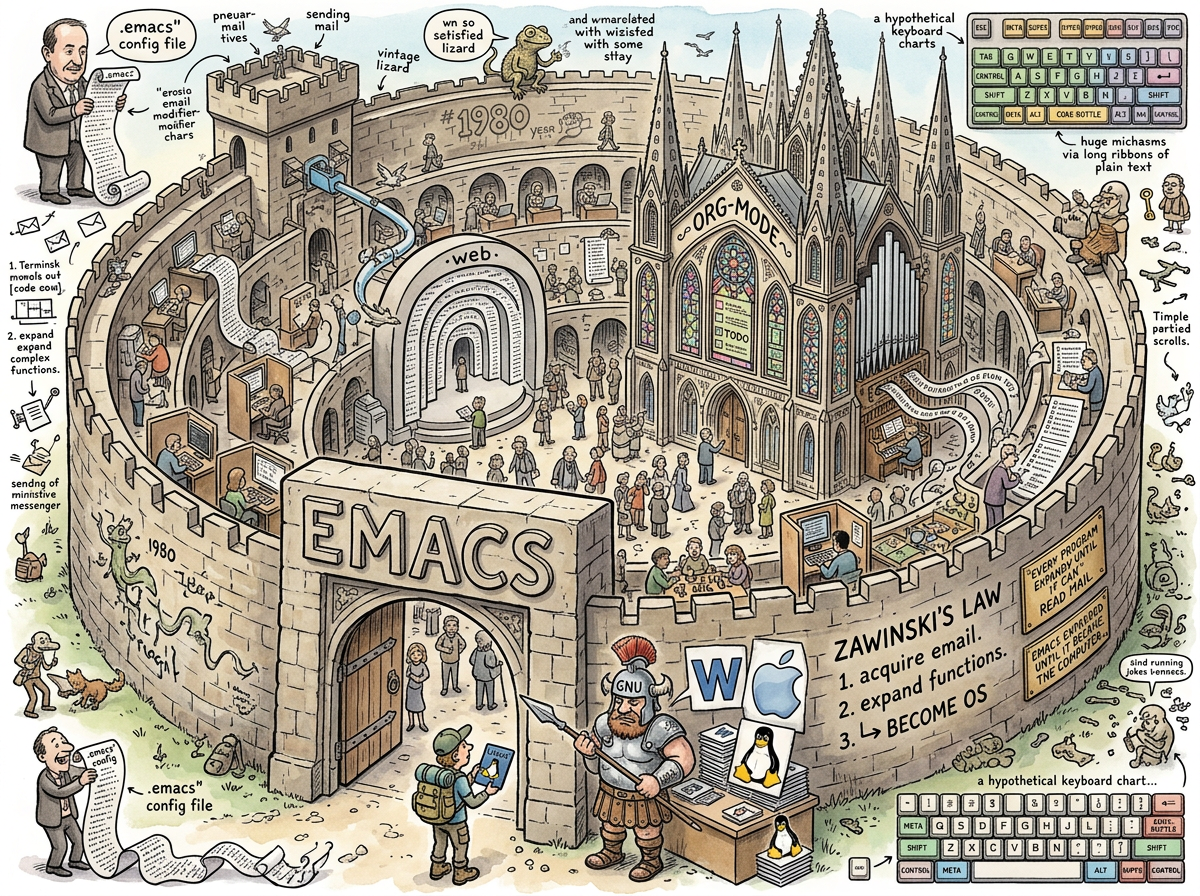
Org-mode is the most powerful personal knowledge management, task management, project planning, literate programming, spreadsheet, agenda, and life-operating system ever built. It requires only one thing: that you change your operating system from Linux to Emacs.
This is not a joke. This is not an exaggeration. This is the literal experience of anyone who attempts to use Org-mode: you install Emacs to try the outliner, and three months later you are reading email in Emacs, browsing the web in Emacs, managing your git repositories in Emacs, writing your thesis in Emacs, and filing your taxes in Emacs, because Emacs is no longer your text editor. Emacs is your operating system. Linux is merely the bootloader.
A developer who looks at Org-mode with genuine admiration would use it. He would actually, sincerely, happily use it. The outliner is perfect. The task management is perfect. The agenda view — showing scheduled tasks, deadlines, overdue items, and habits across all files — is what every other tool has been trying to rebuild since 2003 and none has matched. The plain text format is everything the Lizard demands. The extensibility is everything the Squirrel craves.
He cannot use it, because using it requires changing his operating system from Linux to Emacs, and he is not ready for that level of commitment. He has been married. Marriage was a smaller lifestyle change.
The Cathedral
Org-mode was created by Carsten Dominik in 2003, originally as an outliner and note-taking tool for Emacs. It is now — twenty-three years later — a system that defies categorisation because it has absorbed every category.
What Org-mode does:
- Outlining — hierarchical documents with folding, promotion, demotion, and rearrangement
- Task management — TODO states (TODO, DONE, WAITING, CANCELLED, and any custom state you define), scheduling, deadlines, repeating tasks, habits
- Agenda — a unified view across all Org files showing what’s due, what’s overdue, what’s scheduled, and what you’ve been avoiding
- Time tracking — clock in, clock out, generate reports of where your hours went
- Spreadsheets — tables with formulas, in plain text, inside your notes
- Literate programming — code blocks in any language, executable inline, results captured in the document
- Export — to HTML, LaTeX, PDF, Markdown, ODT, iCalendar, and formats you’ve never heard of
- Capture — quick-capture templates that file notes into the correct location without leaving what you’re doing
- Linking — to files, headings, URLs, emails, IRC logs, and anything else Emacs can see (which is everything)
- Publishing — static site generation from Org files
This is not a feature list. This is an ecosystem. Org-mode is not a note-taking tool. Org-mode is a civilisation that happens to include note-taking among its many civic services.
Zawinski’s Missing Stage
Zawinski’s Law states: “Every program attempts to expand until it can read mail. Those programs which cannot so expand are replaced by ones which can.”
Emacs read mail in the 1980s. Emacs was Zawinski-complete before Zawinski articulated the law. But the lifelog’s research has uncovered, in Zawinski’s handwritten marginalia on a printout of the original law (source: apocryphal, but spiritually true), a previously undocumented intermediate stage:
Stage 1: Expand until you can read mail
Stage 2: Expand until you can read everything
Stage 3: Become an operating system
Stage 4: Take over the universe
Every other program in history stalls at Stage 1 or Stage 2. Emacs reached Stage 3. Org-mode is the evidence. When your text editor includes a spreadsheet, an agenda, a time tracker, a publishing system, and a Turing-complete extension language, you have not built a text editor. You have built an operating system that boots inside another operating system, and the inner one is the one the user actually lives in.
Emacs is the only program to have discovered Stage 3. The handwritten note in the margins — “BECOME OS” — was dismissed by scholars as a joke. Emacs took it as a roadmap.
The Plain Text
Org-mode files are plain text. This cannot be overstated and should not be underestimated.
* TODO Buy vegetables >2026-03-14
  SCHEDULED: <2026-03-14 Sat>
  - [x] Tomatoes
  - [x] Onions
  - [x] Milk

* DONE Write the Roam article
  CLOSED: [2026-03-11 Tue 09:30]
  :LOGBOOK:
  CLOCK: [2026-03-11 Tue 08:00]--[2026-03-11 Tue 09:30] =>  1:30
  :END:
This is a grocery list and a completed task with time tracking. It is plain text. It is readable by cat. It is searchable by grep. It is diffable by git. It will be readable in fifty years because it is text, and text does not require a database, a sync service, a subscription, or a company that continues to exist.
This is what Logseq tried to replicate and produced the three-languages-in-a-trench-coat hybrid. This is what Obsidian approximates with markdown plus twenty plugins. This is what NotePlan achieves with bullet journal syntax. Org-mode had it in 2003. In plain text. With an agenda view that none of them have matched.
The irony is exquisite: the most powerful personal knowledge management system ever built stores everything in text files that grep can search. The Lizard’s philosophy — text files, searched by grep — is Org-mode’s philosophy. The difference is that the Lizard’s implementation is 340 lines in one file and Org-mode’s implementation is the entirety of Emacs.
The Barrier
The barrier to Org-mode is not Org-mode. The barrier is Emacs.
Emacs is a text editor the way a Swiss Army knife is a knife. Technically accurate. Fundamentally misleading. Emacs is an application platform written in Emacs Lisp, which is a dialect of Lisp, which is a programming language that uses more parentheses than the terms and conditions of a credit card.
To use Emacs, you must:
- Install Emacs. This is the easy part.
- Configure Emacs. This is the rest of your life.
The configuration file — .emacs or init.el — is where the citizenship application begins. The file starts small: a few settings, a theme, some keybindings. Within six months, the file is 2,000 lines long. Within a year, the file has been refactored into a directory structure with separate files for each concern. Within two years, the configuration is the project, and the work that Emacs was supposed to help with has been deferred pending a stable configuration, which is never achieved because Emacs Lisp is a Turing-complete language and the configuration space is therefore infinite.
This is Tana’s supermarket problem, except Tana’s configuration session lasts three hours and Emacs’s configuration session lasts a career.
The keybindings are the second barrier. Emacs keybindings predate modern conventions. Ctrl-x Ctrl-s saves a file. Ctrl-x Ctrl-f opens a file. Meta-x opens the command palette. Ctrl-c Ctrl-c does something context-dependent that you will learn through experimentation and pain. The keybindings are consistent within Emacs and inconsistent with everything outside Emacs, which is fine, because you will not be using anything outside Emacs. This is not a prediction. This is a fact. You will not leave.
The Community
Org-mode’s community has been quietly productive since 2003. The community does not tweet. The community does not post YouTube tutorials with clickbait thumbnails. The community does not sell templates on Gumroad. The community writes Emacs Lisp, files bug reports, contributes to the manual, and uses Org-mode to manage the project that develops Org-mode, which is the specific form of recursion that Org-mode users consider natural.
The community has been watching the PKM revolution of 2020-2026 — the rise of Roam, Obsidian, Logseq, Notion — with the specific expression of someone who built the thing everyone is reinventing, twenty years ago, and chose not to market it.
Org-mode does not have a marketing budget. Org-mode does not have a Twitter presence. Org-mode does not have a venture capitalist. Org-mode has a mailing list, a manual, and twenty-three years of development by people who use the tool they build.
The community’s smugness is earned. The community’s smugness is also the reason Org-mode has not conquered the world: smugness does not scale, and the barrier to entry ensures that only people who are already inside the walls know what the walls contain.
The Admiration
riclib looks at Org-mode through the gate with the specific admiration of a developer who recognises a superior tool and cannot use it.
The agenda view — showing every scheduled task, every deadline, every overdue item across every file in the system, in one buffer — is the feature riclib built into NotePlan with a 30-line Claude skill and a “small helper” called lg. NotePlan’s version works. Org-mode’s version has been working since 2003, is more powerful, more configurable, and more complete. But NotePlan’s version does not require changing your operating system.
The time tracking — clock in when you start, clock out when you stop, generate reports — is what riclib builds with Claude skills and daily notes. Org-mode’s version is native, integrated, and produces reports that would make a project manager weep with joy. But Org-mode’s version requires Emacs.
The capture system — press a key, type a thought, it files itself into the right place — is what riclib taught Claude to do with skills. Org-mode taught Emacs to do it in 2005. But Org-mode requires Emacs.
The pattern is clear: everything riclib has built with NotePlan, Claude, and lg is a reconstruction of what Org-mode provides natively — but in an environment that does not require surrendering your operating system, your keybindings, and your evenings to Emacs Lisp configuration.
This is Org-mode’s tragedy: it is the correct answer to the PKM question, locked inside a correct answer to the “what should a text editor be?” question, and most people cannot accept both answers simultaneously.
"The Lizard uses vi. The Lizard has used vi since 1976. The Lizard acknowledges that Org-mode is superior in every measurable way. The Lizard will not switch. The Lizard does not explain why. The Lizard suspects it is the same reason riclib will not switch: the gate is too far from the keyboard."
— The Lizard, who has never used Emacs and considers this a form of self-preservation
Measured Characteristics
- Year created: 2003
- Creator: Carsten Dominik
- Features: all of them (this is not a joke)
- File format: plain text (.org)
- Readability by grep: 100%
- Readability by other tools: limited (the syntax is Org-specific)
- Readability by humans: excellent
- Barrier to entry: operating system change
- Average .emacs configuration time: lifetime
- Average .emacs file length after 2 years: 2,000+ lines
- Emacs keybindings that match modern conventions: approximately 0
- Things you can do without leaving Emacs: everything
- Things you need to leave Emacs for: nothing (this is the problem)
- Zawinski’s Law stage reached: 3 (Become OS)
- PKM tools attempting to replicate Org-mode features: all of them
- PKM tools that have succeeded: none fully
- Community marketing budget: $0
- Community smugness: earned
- riclib’s admiration: genuine
- riclib’s willingness to switch to Emacs: insufficient
- The Lizard’s assessment: superior, unreachable