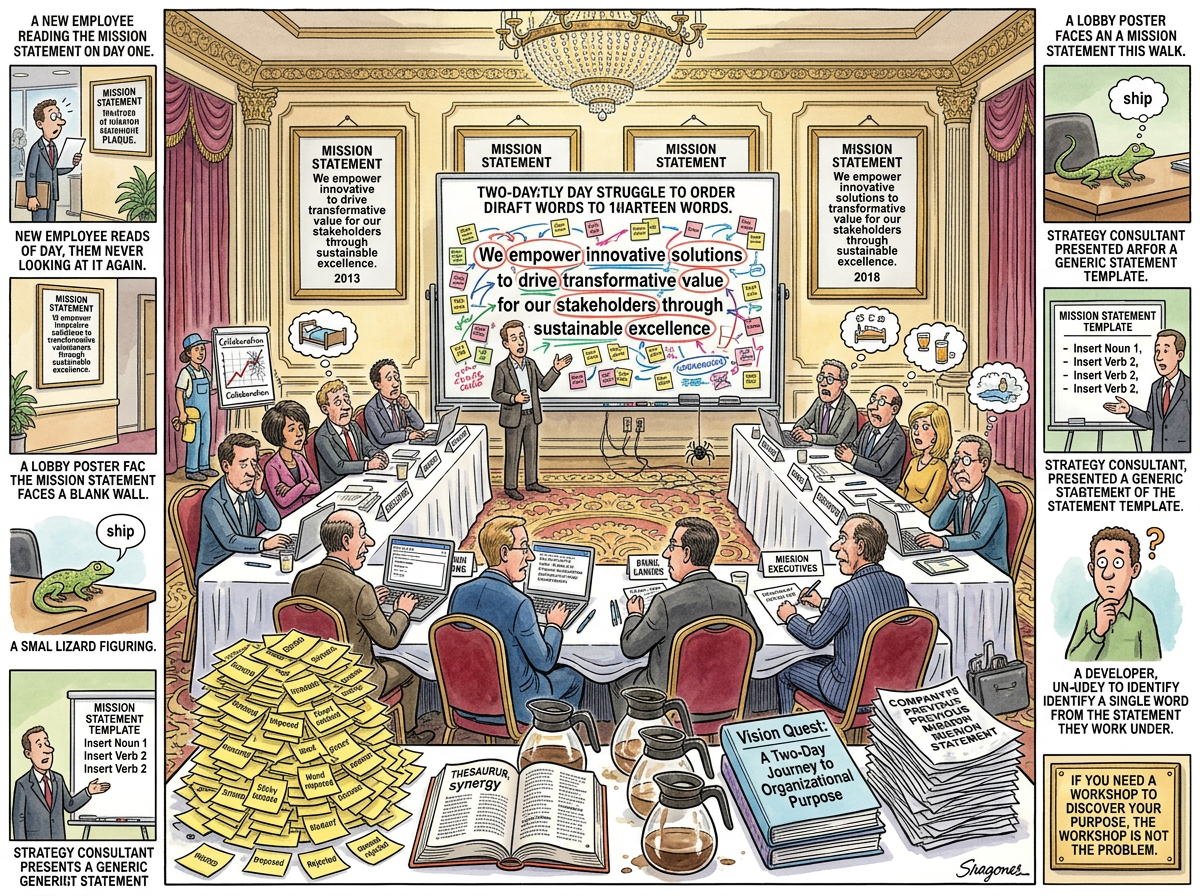
The Mission Statement is a sentence describing why a company exists, crafted over two days by twelve people who already knew why the company exists but could not agree on the adjectives.
The Vision Statement is a sentence describing what the company wants to become, crafted immediately after the mission statement by the same twelve people, who are now too exhausted to argue about adjectives and will accept anything that sounds aspirational and contains the word “leading.”
Together, the Mission and Vision form the foundation of corporate identity — a foundation that is printed on posters, embedded in slide decks, recited at town halls, and remembered by exactly zero employees after their first week.
The Workshop
The Mission and Vision are not written. They are workshopped. The distinction is critical: writing takes one person and an afternoon. Workshopping takes twelve people and two days, because the purpose of the workshop is not to produce a statement but to produce alignment — the shared illusion that everyone in the room agrees, achieved by making the sentence so vague that disagreement becomes grammatically impossible.
The workshop follows a script:
Day 1, Morning — “Why Do We Exist?”
The facilitator — always external, always expensive, always carrying a methodology with a trademarked name — asks the executives to reflect on the company’s purpose. The executives, who have been running the company for years and know its purpose intimately, are asked to articulate it using sticky notes. Each executive writes three sticky notes. Thirty-six sticky notes are produced. The facilitator groups them into themes. The themes are: “customers,” “innovation,” “excellence,” and “people.” These are the same four themes produced by every mission workshop in history. The facilitator does not mention this.
Day 1, Afternoon — “The Wordsmithing Begins”
The facilitator combines the themes into a draft sentence. The sentence is twelve words long. It is clear, specific, and accurate. The CEO says it lacks ambition. The VP of Marketing says it lacks differentiation. The CFO says it lacks mention of stakeholders. Each executive adds one word. The sentence is now twenty-three words long and means less than the original twelve. The group agrees to “sleep on it,” which is executive for “I don’t like it but I’m tired.”
Day 2, Morning — “The Thesaurus Phase”
The group reconvenes. Overnight, three executives have emailed the facilitator with alternative drafts. The drafts are incompatible. The facilitator, whose fee is not contingent on the quality of the output but on the completion of the process, merges the drafts. The merged sentence contains the words “empower,” “innovative,” “transformative,” “sustainable,” and “excellence.” Nobody can define what the sentence means. Everyone can defend why their word must stay.
Day 2, Afternoon — “The Hostage Negotiation”
The sentence must be finalised by 4 PM because people have flights. Between 2 PM and 3:55 PM, the group debates whether to use “customers” or “stakeholders,” whether “leading” means “market-leading” or “thought-leading,” and whether “solutions” is too generic (it is, but “solutions” has survived every mission statement since 1987 and will survive this one). At 3:56 PM, the CEO declares the sentence final. The sentence is:
“We empower innovative solutions to drive transformative value for our stakeholders through sustainable excellence.”
Nobody loves it. Everyone accepts it. Acceptance without enthusiasm is the workshop’s actual deliverable.
The Anatomy of a Mission Statement
Mission statements are assembled from a fixed vocabulary of approximately forty words, arranged in patterns that have not changed since the 1990s:
| Component | Options |
|---|---|
| Verb | Empower, Enable, Drive, Deliver, Transform, Accelerate |
| Adjective 1 | Innovative, Cutting-edge, World-class, Sustainable, Transformative |
| Object | Solutions, Experiences, Value, Outcomes, Impact |
| Connector | To, For, Through, By, Across |
| Beneficiary | Customers, Stakeholders, Communities, Partners, The World |
| Adjective 2 | Sustainable, Inclusive, Scalable, Meaningful, Lasting |
| Abstract Noun | Excellence, Innovation, Growth, Purpose, Integrity |
Any valid mission statement can be generated by selecting one item from each column. This is not a joke. This is the output of two days of executive time.
The mission statement generator is left as an exercise to the reader. Or to The Caffeinated Squirrel, who would build it in forty minutes and deploy it as a microservice that nobody asked for.
The Vision Statement
The Vision Statement differs from the Mission Statement in tense and ambition:
- The Mission describes what the company does (present tense, grounded in reality-adjacent language)
- The Vision describes what the company wants to become (future tense, grounded in nothing)
The Vision is always aspirational. The Vision always involves being “the leading” something. The structure is invariant:
“To be the leading [industry] [company/platform/partner] [aspiration that cannot be measured].”
Examples:
- “To be the leading provider of innovative technology solutions.” (meaningless)
- “To be the world’s most trusted partner for digital transformation.” (unmeasurable)
- “To create a world where every person has access to [our product category].” (messianic)
The Vision Statement exists so that when an employee asks “where is the company going?”, management can point to a sentence instead of answering the question.
The Facilitation
The mission and vision workshop is the peak expression of Stakeholder Management applied to language itself. The facilitator’s job is not to produce the best statement. The facilitator’s job is to produce a statement that every executive can live with — which requires the statement to be so broad that no executive can find their specific objection in it.
The facilitation techniques:
“Let’s Park That” — Used when an executive raises a valid point that threatens consensus. The point is written on a sticky note and placed in a “parking lot” on the wall. The parking lot is never revisited. The parking lot is where good ideas go to die in a workshop the way the Backlog is where they go to die in a product organisation.
“What I’m Hearing Is…” — Used when two executives disagree. The facilitator restates both positions in language so abstract that the disagreement dissolves. The executives nod. The disagreement has not been resolved. It has been linguistically eliminated.
Roman Voting — Used to create the illusion of democracy. Thumbs up means agreement. Thumbs sideways means “I can live with it.” Thumbs down means “I object.” In a room of twelve executives, nobody gives thumbs down, because thumbs down requires offering an alternative, and offering an alternative extends the workshop by another hour, and everyone has flights.
“The facilitator asked us to ‘dream big.’ I dreamed of leaving.”
— Overheard at an Offsite, attributed to everyone
The Poster
The mission statement’s final form is a poster. The poster is designed by the marketing department, printed on high-quality stock, and mounted in the company lobby. The poster’s lifecycle:
- Week 1: The poster is unveiled at a town hall. The CEO reads it aloud. Employees clap.
- Month 1: The poster hangs in the lobby. Visitors glance at it. Employees walk past it.
- Month 6: The poster is part of the wall. It is perceived the way oxygen is perceived — technically present, functionally invisible.
- Year 2: New leadership arrives. The poster is “refreshed” (replaced) because the new CEO has a different vision, different adjectives, and the same facilitator.
The poster costs between $200 and $2,000 depending on frame quality. The workshop that produced the words on the poster cost between $20,000 and $100,000 depending on facilitator fame. The ratio of poster cost to workshop cost is the most efficient metric for measuring corporate absurdity.
The Test
There is one test for whether a mission statement works: can any employee recite it from memory?
This test has a failure rate of approximately 95%. The remaining 5% are HR, who memorised it because it’s on the onboarding slides, and the CEO, who memorised it because they spent two days choosing the adjectives.
If 95% of a company cannot remember the sentence describing why the company exists, one of two things is true:
- The sentence does not describe why the company exists
- The employees do not care why the company exists
Both are failures, but they are different failures, and the mission workshop is the wrong tool for either.
The Alternative
Companies that skip the mission workshop and instead demonstrate their purpose through their actions — what they build, who they serve, how they treat people — tend to have employees who can articulate the company’s purpose in their own words, which are different words for every employee, and more accurate than any workshopped sentence.
The best mission statement is the one the company doesn’t need because every employee already knows.
The Lizard was once asked for a mission statement. The Lizard blinked. The Lizard shipped. The absence of a statement was the statement.
Measured Characteristics
- Average workshop duration: 2 days
- Average workshop cost (facilitator + venue + executive time): $50,000-$150,000
- Words in the average mission statement: 18-25
- Words that could be removed without changing meaning: 12-20
- Employees who can recite the mission statement: ~5%
- Mission statements containing “innovative”: ~60%
- Mission statements containing “stakeholders”: ~45%
- Mission statements containing “excellence”: ~40%
- Mission statements that are interchangeable with a competitor’s: ~70%
- Average lifespan before replacement: 2-3 years (correlated with CEO tenure)
- Sticky notes consumed per workshop: 200-400
- Parking lot items revisited: 0
- Workshops that produced a statement the facilitator hadn’t seen before: unknown (estimated: 0)