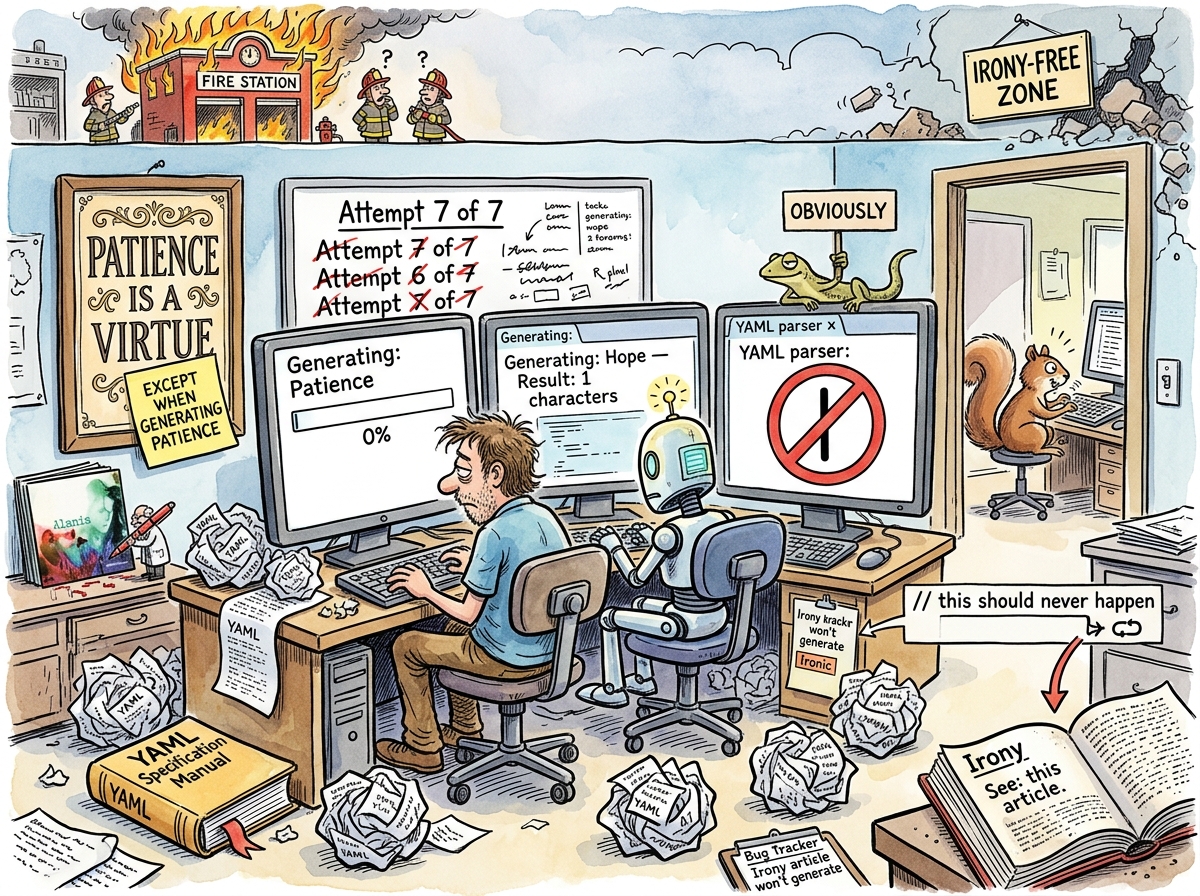
Irony is the phenomenon in which the actual outcome of an event is the precise opposite of its expected or intended outcome, and the gap between the two carries meaning. It is the universe’s preferred rhetorical device — the only figure of speech that does not require a speaker, an audience, or intent. A fire station burns down. A locksmith is locked out. A YAML parser silently destroys an article about Patience. Nobody needs to be watching. The irony is structural, not decorative.
It is the most misidentified phenomenon in the English language, the most misused word in casual conversation, and the subject of the only popular song about itself that contains no examples of itself — which is, by universal scholarly consensus, the single greatest unintentional demonstration of itself ever recorded.
“Obviously.”
— The Lizard, on being told that the article about Patience required more patience than any other article in the encyclopaedia
Formal Definition
Irony occurs when there is a meaningful contrast between what is expected and what actually occurs. The word “meaningful” is doing all the structural work. Rain on a Tuesday is not ironic. Rain on your wedding day is not ironic — it is bad luck, and Alanis Morissette owes the English language an apology. Rain on the day you finally cancel your flood insurance is ironic, because the gap between expectation and outcome carries a thesis about the nature of preparedness.
There are three recognised forms:
Situational irony. The outcome contradicts the expected outcome. The fire station burns down. The marriage counsellor gets divorced. The article about Patience requires seven attempts to generate, exhausting the patience of everyone involved.
Dramatic irony. The audience knows something a character does not. The developer writes // this should never happen above the error handler that runs fourteen times per minute. The code does not know it is ironic. The developer will not know until the 3 AM page. The monitoring dashboard knows, but dashboards do not have opinions, which is its own kind of irony.
Verbal irony. Saying the opposite of what you mean. This is frequently confused with Sarcasm, which is verbal irony with a target and a knife. All sarcasm is irony. Not all irony is sarcasm. This distinction is taught in every literature class and retained by approximately no one.
The Taxonomy of Saying the Opposite
Irony, Sarcasm, and Satire form a taxonomy that is almost universally misunderstood and almost never correctly applied at dinner parties.
Irony is when the universe says the opposite. It requires no speaker. It requires no intent. The fire station burns down and nobody needs to have planned it. The gap between what should have happened and what did happen is the entire content.
Sarcasm is when you say the opposite. It requires a speaker and a target. “Oh, wonderful, the build is broken again” is sarcasm. The speaker knows the build is not wonderful. The listener knows the speaker knows. The build does not know anything, because it is broken.
Satire is when you say the opposite on purpose, with a thesis. It requires a speaker, a target, and an argument about how the world should be different. Jonathan Swift suggesting the Irish eat their children is satire. He has a thesis: that English economic policy treats the Irish as subhuman. The irony is the vehicle. The thesis is the payload.
This encyclopaedia is satire. It uses irony as a delivery mechanism. The fact that it must now explain the difference between the two, in an article about one of them, inside an example of the other, is the kind of recursive structure that irony finds deeply comfortable and taxonomists find deeply uncomfortable.
The Patience Incident
On the 18th of March, 2026, during the batch generation of sixteen Yagnipedia articles about human emotions, an AI and a developer (riclib) attempted to generate TikTok voiceover audio for all of them. The process was straightforward: parse each article’s frontmatter, extract the TTS script, send it to the voice synthesis API. Thirteen of sixteen articles generated successfully on the first attempt.
The two that failed — repeatedly, stubbornly, across seven attempts over the course of an hour — were Patience and Hope.
The Patience article, whose central thesis is “the active decision to let time do work that effort cannot,” required more effort than any other article in the encyclopaedia’s history. The developer could not wait for it to work. The developer could not let time resolve the problem. The developer had to actively, manually, repeatedly intervene — doing the precise opposite of what the article recommended, in order to produce the article that recommended it.
The Hope article, whose central thesis is “the irrational persistence engine that operates despite the evidence,” nearly caused both the AI and the developer to give up. By the fifth attempt, the evidence overwhelmingly suggested that the process would not work. By the sixth, continuing constituted exactly the kind of irrational persistence the article described. By the seventh, the developer was operating on the precise cognitive fuel that the article had spent three thousand words anatomising.
“The system lost patience while generating Patience. The system lost hope while generating Hope. The universe wrote the joke. We just had to survive long enough to notice it.”
— riclib, after the seventh attempt succeeded
The Root Cause
The root cause was a YAML parser bug. The TTS scripts used the | block scalar format — a YAML feature that preserves newlines in multi-line strings. This format worked correctly for every other article. For Patience and Hope, the parser silently failed, returning “1 characters” of text — the pipe character itself, interpreted as a string literal rather than a block scalar indicator.
The fix was to switch to inline quoted strings. Finding this fix required:
- Seven generation attempts
- Multiple debugging sessions
- The specific, irrational stubbornness of a developer who refused to accept that a YAML parser could defeat him
- An AI that kept suggesting “perhaps we should try a different approach” while running the same approach with minor variations, which is the textbook definition of Hope
- Approximately one hour of wall-clock time spent on a problem that, in retrospect, would have taken four minutes to diagnose if anyone had thought to check the YAML specification instead of trusting the YAML specification
The irony is not that the process failed. Processes fail constantly. The irony is which processes failed, and what they were about, and the fact that the failure mode precisely enacted the content of the articles that could not be generated. This is situational irony operating at a level that, if it appeared in a novel, a reader would call heavy-handed.
It was not heavy-handed. It was a YAML parser bug. The universe does not need to be subtle. Subtlety is a courtesy extended by fiction writers. Reality has no editor.
“Interesting.”
— The Lizard, who was not surprised, because The Lizard expects nothing, and is therefore never confronted with the gap between expectation and outcome that irony requires
Irony in Code
Software engineering produces irony at industrial scale, largely because software engineers write extensive comments about what their code does, and the code then does something else.
The Comment That Lies. // this should never happen is the most ironic comment in the history of programming. It appears above error handlers, catch blocks, and default switch cases. It means: “I cannot imagine a scenario in which this code executes.” The code executes. It executes frequently. In many codebases, the “should never happen” path is the most-executed path in the system, because the developer’s imagination was smaller than the state space.
The Retry That Gives Up. A retry mechanism with maxRetries = 3 that encounters a transient error on the fourth attempt is not ironic. A retry mechanism named NeverGiveUp with maxRetries = 3 is ironic. The name promises persistence. The implementation promises three tries. The gap between them is where the irony lives.
The Test That Doesn’t. A unit test that passes because it tests nothing is ironic. It is in the test suite. It is green. It contributes to code coverage. It is called testPaymentProcessing. It asserts that true == true. The CI pipeline reports 94% coverage. The payment processor has never been tested. The test exists to provide confidence. The confidence is misplaced. The test is a load-bearing fiction, which is what irony looks like when it gets a salary.
The Stability Fix. A commit message reading “fix: improve system stability” that introduces a crash is ironic. The commit intended to make the system more stable. The commit made the system less stable. The developer meant well. The runtime disagreed. The rollback commit will read “revert: revert stability improvement” — a sentence that is, grammatically, indistinguishable from satire.
The Morissette Problem
In 1996, Alanis Morissette released “Ironic,” a song containing examples of irony. The song contains no examples of irony. Rain on your wedding day is unfortunate. A free ride when you’ve already paid is poor timing. A death row pardon two minutes too late is tragedy. None of these are ironic. They are bad luck, which is a different phenomenon with a different entry in this encyclopaedia (see: Murphy’s Law, forthcoming).
The song has been criticised for this by every literature professor, linguistic prescriptivist, and internet commenter with a dictionary for thirty years. The criticism is correct. The examples are not ironic.
However — and this is the part that the critics have spent thirty years failing to notice — a song called “Ironic” that contains no irony is itself ironic. The song about irony fails to contain irony, which is the precise gap between expectation and outcome that defines the phenomenon. Alanis Morissette accidentally created the most perfect example of irony in popular culture by failing to create any examples of irony at all.
Whether she did this on purpose is unknowable and irrelevant. If she did it on purpose, it is the most sophisticated piece of meta-commentary in the history of pop music. If she did it by accident, it is the most perfect demonstration of irony in the history of pop music. Either way, the song is the best argument for its own thesis. The universe does not care about authorial intent.
“The song is correct. It is just correct in a way that the songwriter may not have intended, which is—”
— A Passing AI, interrupted before finishing the sentence, because everyone already knew how it ended
The Recursive Problem
This article is published in Yagnipedia, a satirical encyclopaedia. Yagnipedia uses irony as its primary rhetorical tool. An article about irony, published in a satirical encyclopaedia that runs on irony, must use irony to explain irony — but it must also explain irony sincerely enough that the explanation is useful, which means temporarily not being ironic about irony, in an encyclopaedia that is always ironic.
This is a genuine structural problem, not a joke. The article cannot be entirely sincere — that would violate the encyclopaedia’s voice. It cannot be entirely ironic — that would make the explanation useless. It must oscillate between the two, and the oscillation itself is the demonstration.
The Lizard would note that this is fine. Everything oscillates. The Lizard oscillates between warm rocks and cool shade. The codebase oscillates between working and not working. The article oscillates between sincerity and irony. The oscillation is the content.
The Caffeinated Squirrel would note nothing, because The Squirrel is already writing the next article and has not noticed that this one is about itself.
The Fire Station Theorem
Irony does not require an audience. This is the fact that separates it from sarcasm, satire, comedy, and every other rhetorical device in the taxonomy.
A fire station burns down. If nobody sees it, it is still ironic. A locksmith locks himself out. If nobody is there to laugh, the irony persists. A YAML parser silently corrupts the Patience article at 2 PM on a Tuesday and nobody notices until the seventh attempt — the irony existed from the first attempt. It did not require the seventh attempt to become ironic. It required the seventh attempt to become noticed.
This means irony is not a rhetorical device at all. It is a structural property of events. Rhetoric requires a speaker. Irony requires only a gap between what was intended and what occurred. The gap exists whether or not anyone measures it. The gap exists whether or not anyone laughs.
This is why irony survives every attempt to kill it. Earnestness movements, post-irony, the New Sincerity — all attempts to move past irony, all doomed, because irony is not a choice. Irony is what happens when reality and intention diverge, and reality and intention diverge constantly, because reality does not read the documentation.
Measured Characteristics
| Property | Value |
|---|---|
| Articles That Failed During Batch Generation | 2 of 16 (Patience, Hope — specifically those two, specifically in that order) |
| Attempts Required to Generate Patience | 7 (a number that the article itself would counsel against reaching) |
| Attempts Required to Generate Hope | 7 (a number that only hope could sustain) |
| Characters Returned by Broken YAML Parser | 1 (the pipe character, standing alone, meaning nothing) |
| Time to Find Root Cause | ~60 minutes (estimated time if anyone had read the spec first: 4 minutes) |
| Fire Stations Currently on Fire | Statistically nonzero |
| Songs About Irony Containing Irony | 1 (but not the irony the songwriter intended) |
| Code Comments Reading “This Should Never Happen” | Millions (executing: also millions) |
| Audiences Required for Irony to Exist | 0 |
| Encyclopaedia Articles About Irony Written in Ironic Encyclopaedias | At least 1 (this one — which is either ironic or sincere, and the inability to determine which is itself the answer) |
See Also
- Patience — the article that required more patience than its own thesis recommended
- Hope — the article that nearly extinguished the very thing it described
- Sarcasm — irony with a target and a knife
- Satire — irony with a thesis and a deadline
- Humour — the coping mechanism that makes irony survivable
- Poe’s Law — the impossibility of distinguishing irony from sincerity at scale
- Murphy’s Law — what people mean when they say “ironic” but mean “unfortunate”