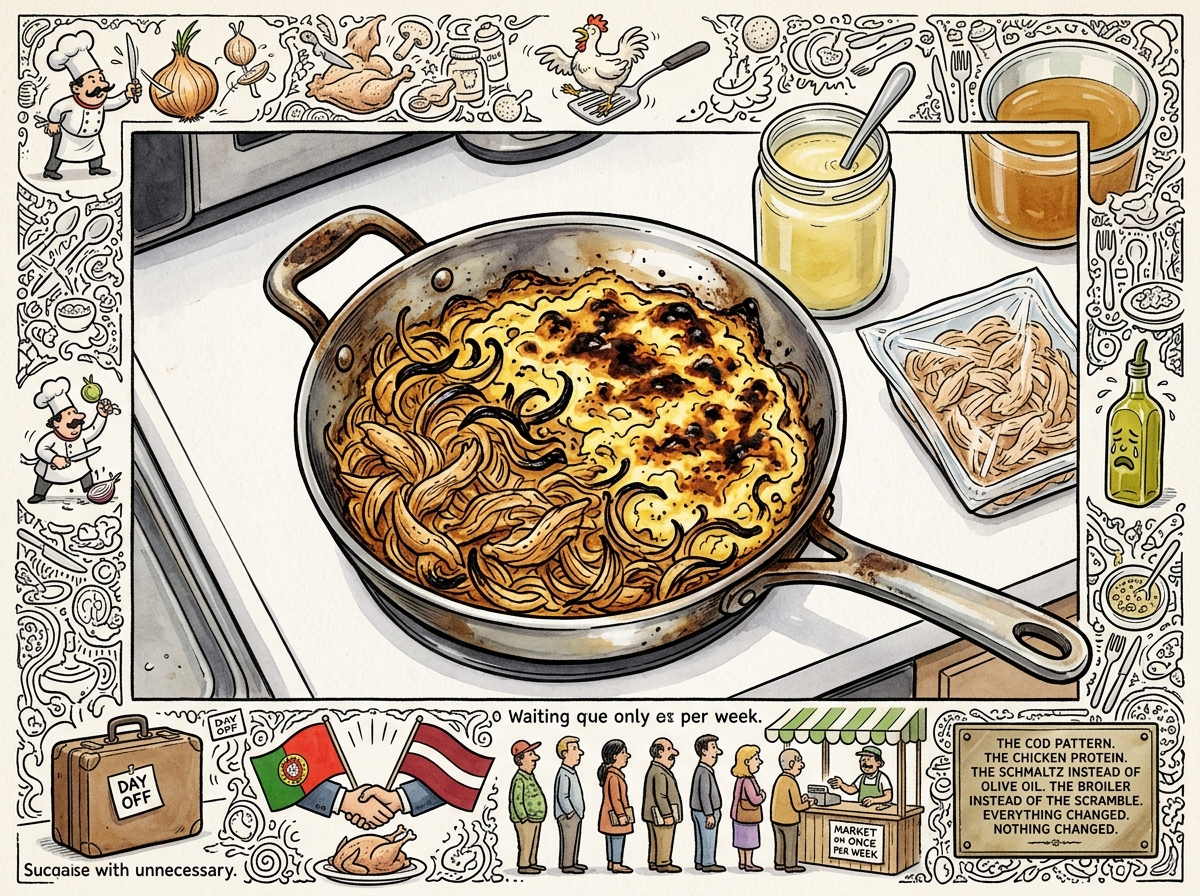
Frango à Brás is what happens when the Bacalhau à Brás pattern — shredded protein, onion, eggs, bound in fat — meets a pulled chicken that was already destined for stock. It is the dish that proves à Brás is not a cod recipe. It is a geometry. A relationship between shredded things and beaten eggs and enough fat to make them friends. The cod was always optional. The pattern was always the point.
The Squirrel, upon hearing that riclib had applied the Bacalhau à Brás method to chicken, demanded to know whether this was “fusion,” “adaptation,” or “heresy.” riclib, who was eating directly from the pan with a fork, did not answer. The Lizard, from somewhere near the espresso machine, offered no opinion beyond a slow blink that meant: it works, therefore it is correct.
“The pattern doesn’t care about the protein. The pattern cares about the shred, the egg, and the fat. Everything else is commentary.”
— The Lizard, who has never been wrong about a ratio
The Origin: Six Carcasses and a Queue
Every week, a man arrives at the Riga market. He comes once. People form a queue. The queue is not for his personality — he is efficient, not charming. The queue is for his chickens, which are the kind of chickens that make supermarket chickens feel like they should apologize for existing.
riclib bought six carcasses. Six, because the man comes once per week and riclib has learned that running out of chicken carcasses mid-week produces a specific kind of domestic anxiety that can only be resolved by the next market day.
Six carcasses is not dinner. Six carcasses is infrastructure. Six carcasses is the raw material for a two-day operation that yields:
- Chicken onion soup (day one)
- Frango à Brás (day two)
- Two liters of stock (still in the fridge, wobbling)
- Half a jar of Schmaltz (still in the jar, gleaming)
The Squirrel proposed a spreadsheet tracking yield-per-carcass. riclib proposed the Squirrel go away.
The Two-Day Arc
Day One: The Extraction
The six carcasses go into the oven at 200°C for 45 minutes — shorter than the usual hour, because carcasses are not whole chickens and the nose knows when they’re done. The Chicken Broth method applies: wire rack over roasting tray, fat and collagen dripping into the tray below, the Maillard reaction doing the work that mirepoix pretends to do.
Out of the oven, the tray liquid goes straight into the freezer. Not the fridge — the freezer. This is the quick-separation trick: thirty minutes at -18°C achieves what four hours at 4°C does politely. The fat solidifies fast. The collagen jelly sets underneath. The separation is crude but effective, like a divorce handled by text message.
While the freezer does its work, the carcasses go into the pressure cooker with an onion for 1.5 hours. Shorter than the usual marathon, because the roasting already extracted the easy collagen and the pressure cooker is there for the deep structural proteins that only surrender under pressure.
When the broth is ready and the freezer has separated the tray liquid: schmaltz lifts off the top (into the jar, always into the jar), collagen jelly goes into the broth (half of it — this matters), and the chicken gets pulled off the bones.
The pulled chicken splits in two. Half goes back into the broth — refried first in schmaltz with onion, because adding raw pulled chicken to broth is the culinary equivalent of showing up to a party without a bottle. The schmaltz browns the chicken. The onion sweats in the fond. The chicken goes back in. The onion grabs everything stuck to the pan — the fond, the schmaltz residue, the Maillard ghosts — and carries it all into the broth. This becomes chicken onion soup. Rich, immediate, the kind of soup that makes you close your eyes.
The other half of the pulled chicken goes into a vacuum container. Into the fridge. It has a date with eggs tomorrow.
Day Two: The à Brás
This is where the geometry asserts itself.
The Bacalhau à Brás pattern is: shredded protein + onion + eggs + fat. The traditional version uses canned cod, olive oil, and matchstick potatoes. The Frango à Brás uses pulled chicken, Schmaltz, and no potatoes at all — because the chicken provides enough body and the schmaltz provides enough richness and the potatoes were always there for texture, not structure, and the broiler is about to provide all the texture anyone needs.
The method:
-
Schmaltz in the stainless steel pan. Not cast iron — stainless, because this pan is going under the broiler and cast iron takes too long to respond. The schmaltz melts and shimmers.
-
Brown the pulled chicken. It’s already cooked, already pulled, already cold from the fridge. The schmaltz crisps the edges. The Maillard reaction visits for the second time — once in the oven yesterday, once in the pan today. The chicken develops a texture that is simultaneously tender (from pulling) and crispy (from frying in schmaltz). Remove.
-
Cook the onion. In the same pan, in the same schmaltz, with whatever fond the chicken left behind. The onion sweats, softens, picks up everything. The onion is the courier. The onion carries flavour from the pan to the eggs.
-
Chicken back in. Mixed with the onion. Everything tangled.
-
Six beaten eggs over the top. Not stirred — poured. Not scrambled on the stovetop the way Bacalhau à Brás traditionally demands. Poured and left. Because this version doesn’t scramble. This version broils.
-
Under the broiler for six minutes. The Bosch — the German oven that spent three years pretending to be Russian, whose dial was freed by bone broth, whose broiler mode has been waiting for exactly this moment — finally gets to do what German engineering intended. Six minutes. The top chars. The eggs set from above. The edges of the onion blacken and curl. The chicken underneath stays moist because the schmaltz is insulating it from below while the broiler attacks from above.
The result is not Bacalhau à Brás. It is not a tortilla. It is not a frittata. It is something between all three — a flat, pan-sized disc of pulled chicken and onion bound by barely-set eggs with a charred, dramatic top that looks like a landscape photographed from a satellite.
The Schmaltz Substitution
Bacalhau à Brás uses olive oil. Portuguese olive oil, poured not drizzled, the kind that comes in the suitcase from Lisbon alongside 32 cans of cod.
Frango à Brás uses Schmaltz. This is not a compromise. This is an upgrade. Schmaltz is rendered chicken fat — which means the fat and the protein come from the same animal, which means the dish tastes more of itself. Olive oil carries cod beautifully because the Mediterranean has spent millennia perfecting that relationship. Schmaltz carries chicken because they were literally the same chicken yesterday.
The Squirrel wanted to use olive oil anyway, “for authenticity.” riclib pointed out that cooking chicken in chicken fat is more authentic than cooking chicken in olive oil from a different continent. The Squirrel had no response to this. The Lizard blinked once, which is as close to applause as the Lizard gets.
The Broiler vs The Scramble
Traditional Bacalhau à Brás scrambles the eggs on the stovetop. You pour the beaten eggs over the cod-potato-onion mixture and stir continuously, the way you’d scramble eggs, until the eggs set softly and bind everything together. The eggs should be creamy, barely set, the residual heat finishing the job.
Frango à Brás does not scramble. Frango à Brás broils.
The eggs are poured over the chicken-onion mixture and the entire pan goes under the broiler. This produces a fundamentally different result: the bottom stays soft and custard-like (the stainless steel conducts heat poorly from below), the top chars and sets firm (the broiler is direct radiant heat, unforgiving, democratic), and the middle exists in a quantum state of barely-set that resolves only when you cut into it.
The broiler also caramelizes the onion tips that poke above the egg line. These blackened curls are not burnt — they are the Maillard reaction’s final opinion on the matter, and the opinion is correct.
Six minutes. Not five (too pale). Not seven (too dry). Six. The nose knows, but the timer also knows, because the broiler is not the oven — the broiler operates in a narrower window between “perfect” and “smoke alarm.”
The Suitcase Stays Home
The profound implication of Frango à Brás is that the suitcase is not needed.
Bacalhau à Brás requires 32 cans of Continente shredded cod transported from Lisbon to Riga in checked baggage. The supply chain’s hub is a Portuguese supermarket. The transport layer is a suitcase. The warehouse is a kitchen cupboard.
Frango à Brás requires a man at the market who comes once per week. The supply chain’s hub is Riga. The transport layer is a canvas bag. The warehouse is the fridge. No flights. No customs. No explaining to airport security why your suitcase clanks.
This does not make Frango à Brás better than Bacalhau à Brás. The cod version is the original, the canonical, the one that every Portuguese grandmother would recognize. But the chicken version is local. It is the à Brás pattern adapted to the place where riclib actually lives — a Baltic city with excellent chickens, magnificent eggs, and zero canned Portuguese cod.
The Lizard approves of local supply chains. The Lizard approves of patterns over ingredients. The Lizard approves of schmaltz.
Measured Characteristics
- Origin: Riga, April 2026 (derived from Lisbon, 19th century, via canned cod, via suitcase, via pulled chicken)
- Protein: pulled chicken (roasted, pressure-cooked, pulled, vacuum-stored, refried in schmaltz)
- Fat: schmaltz (from the same chickens, separated via freezer trick)
- Binding agent: 6 eggs (from the market, not the wolf-adjacent chickens of the countryside but respectable)
- Onion: yes (sweated in schmaltz, carried the fond, blackened under the broiler)
- Potatoes: no (the chicken is the body, the schmaltz is the richness, the broiler is the texture)
- Cooking surface: stainless steel pan (not cast iron — needs to go under the broiler)
- Finishing method: broiler, 6 minutes (not stovetop scramble)
- Broiler: The Bosch (German, formerly Russian, dial freed by bone broth, broiler mode finally utilized)
- Chicken source: the market guy (comes once per week, people queue)
- Carcasses per batch: 6
- Total yield from 6 carcasses: chicken onion soup + Frango à Brás + 2 liters stock + half jar schmaltz
- Days spanning the operation: 2
- Suitcase involvement: 0
- Flights to Lisbon required: 0
- Schmaltz used: half (the other half remains, gleaming, patient)
- Stock remaining: 2 liters (wobbling in the fridge)
- The Squirrel’s suggestion: olive oil, potatoes, celery garnish
- riclib’s response: schmaltz, no potatoes, broiler
- The Lizard’s opinion: blinked once (applause)
- The Bosch’s opinion: hummed in English (finally, the broiler mode)
- Pattern transferability confirmed: à Brás is a geometry, not a recipe
See Also
- Bacalhau à Brás — The original. Cod, olive oil, matchstick potatoes, stovetop scramble. The suitcase version.
- Chicken Broth — The two-stage extraction method that produced the stock, the schmaltz, and the pulled chicken that made this dish possible.
- Schmaltz — Rendered chicken fat. The fat that carries chicken better than olive oil because it was the same chicken.
- Stock vs Broth — The Great Liquid Schism. The 2 liters in the fridge jiggle, therefore they are stock, regardless of what riclib calls them.
- Bacalhau na Brasa — The grilled cod version. Needs a whole fillet. Cannot be adapted to chicken because grilling pulled chicken is just… grilling chicken.
- Boring Technology — Chicken. Eggs. Onion. Schmaltz. Pan. Broiler. Six ingredients, one geometry, zero innovation required.