The Problem with Perfection Is That It Invites Competition
There exists, on the southern coast of Portugal, a region called the Algarve where the Atlantic Ocean has been slowly and patiently evaporating into salt pans for several centuries. The process is not complicated. Seawater enters shallow clay pools. The sun does what the sun does. Wind helps. And on the surface — the very top layer, where the water meets the air — the finest, most delicate crystals form in thin, fragile sheets that look less like salt and more like something a particularly talented spider might weave if spiders were into mineral extraction.
This is Flor de Sal. The flower of salt.
It is harvested by hand. With wooden tools. By people who have been doing this the same way their grandparents did, and their grandparents before them, in a chain of salt-skimming expertise that stretches back to a time when “artisanal” was not a marketing term but simply the only way anything got done.
Squirrel once proposed building a humidity-controlled salt dispensing system with a servo motor that would calculate the optimal crystal-to-surface-area ratio for any given dish. The proposal included a Raspberry Pi, a load cell accurate to 0.01g, and a 3D-printed nozzle.
Lizard ate a tomato with salt on it and said nothing.
Lizard was right.
What It Is and What It Is Not
Flor de Sal is a finishing salt. This distinction matters in the way that the distinction between a violin and a fiddle matters — they are technically the same instrument, but context is everything.
You do not cook with Flor de Sal. You do not dissolve it in pasta water. You do not toss it into a Dry Brine. That would be like using a first-edition Hitchhiker’s Guide as a doorstop. Technically functional. Spiritually catastrophic.
You finish with it. Which means:
- A pinch on a Rib Eye after it has rested, when the surface is still warm enough to make the crystals slightly translucent at the edges
- A sprinkle on Picanha slices, where the fat and the salt create a moment of such profound correctness that language temporarily fails
- On eggs. Specifically, on eggs where the yolk is still runny, so the crystal sits on the surface for exactly one second before the yolk swallows it
- On tomatoes. Good tomatoes. The kind that smell like a tomato should smell, which is to say like summer in a country where summer means something (approximately 35C and no air conditioning)
- On anything, really, where the salt crystal itself is part of the texture. Where you want to feel the salt before you taste it
The crystal structure is the point. It is flat, flaky, and irregular in the way that handmade things are irregular — each crystal slightly different, each one dissolving at its own pace, creating a progression of salinity rather than a single uniform hit. Table salt, by contrast, is the culinary equivalent of a car alarm: loud, uniform, and impossible to modulate.
The Himalayan Situation
riclib imports Flor de Sal from Portugal. This has been the arrangement for years. It arrives in bags or ceramic containers, it goes into a small bowl near the stove, and it is deployed with the reverence it deserves.
And then the Himalayan salt showed up.
Pink. Ancient. Mined from deposits laid down approximately 250 million years ago when the region that is now Pakistan was a shallow sea. The crystals are dense, mineral-rich, and possess a subtle complexity that is — and this is where the situation becomes diplomatically sensitive — also very good.
The Algarve and the Himalayas are approximately 7,500 kilometers apart. They could not be more different in provenance. One is a living tradition on the Atlantic coast, harvested from actively evaporating seawater. The other is a fossilized ocean, compressed by tectonic forces into pink rock inside a mountain. One is ephemeral — each batch a product of that season’s sun and wind. The other has been waiting patiently underground since before the dinosaurs, which gives it a certain geological smugness.
They now coexist in the kitchen.
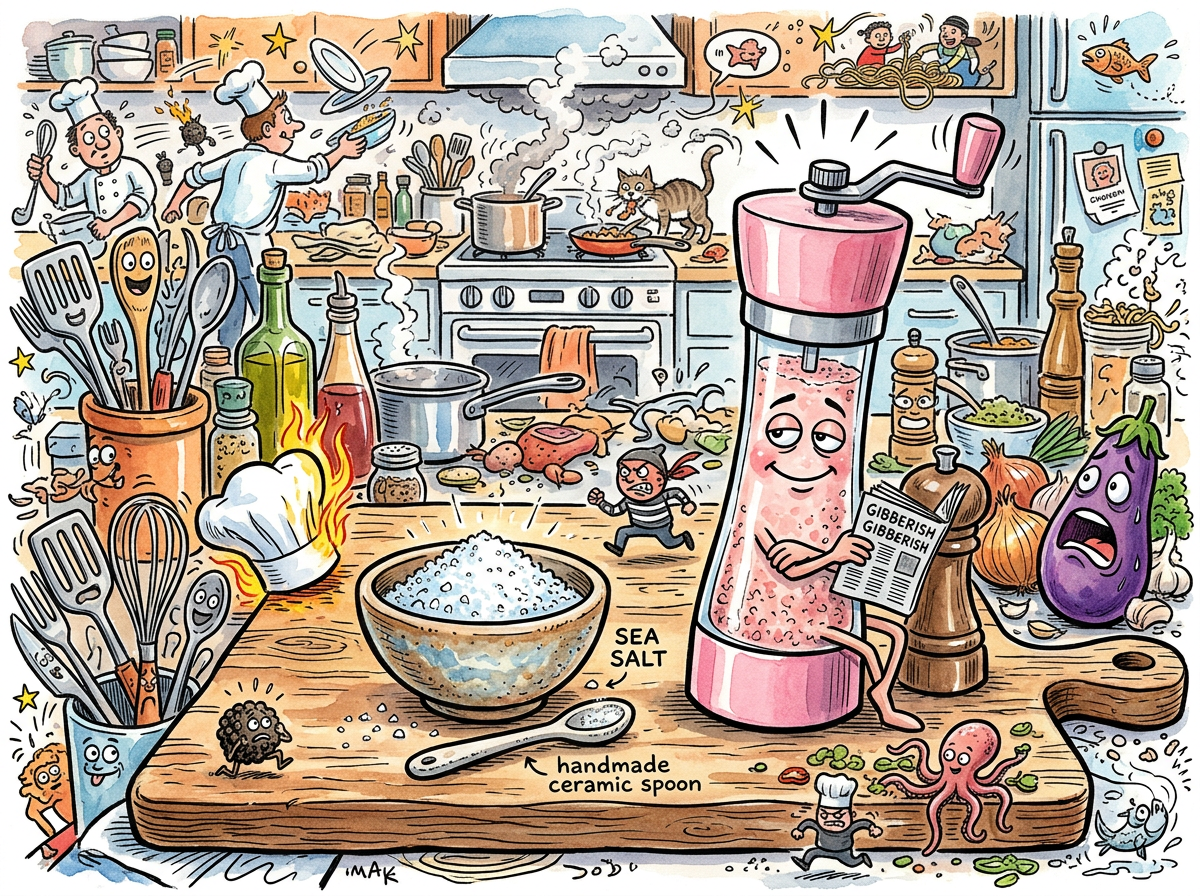
The Flor de Sal occupies the ceramic bowl. The Himalayan salt lives in a grinder. They maintain the polite distance of two tenors who have been cast in the same opera and are both quite aware that the other one is also excellent. Neither concedes. Neither needs to. The kitchen is large enough for two finishing salts, in the same way that the universe is large enough for two answers to the question “what is the best salt?” — provided you are willing to accept that the question itself may be fundamentally misguided.
The Hierarchy of Salt (for the Record)
For those who need taxonomy:
| Salt | Role | You Use It For |
|---|---|---|
| Flor de Sal | Finishing | The moment of truth. Post-rest, post-cook, pre-mouth |
| Himalayan Pink | Finishing (alternate) | Same role, different geology. Currently sharing custody |
| Kosher Salt | Cooking | The workhorse. Dry Brine, seasoning during cooking, anything that dissolves |
| Coarse Sea Salt | Cooking | Kosher salt’s slightly more rustic cousin |
| Table Salt | Emergencies | If you are finishing a steak with table salt, several things have gone wrong and salt is the least of your problems |
Squirrel’s Final Attempt
Squirrel, upon learning that two finishing salts now occupy the kitchen, proposed a blind tasting protocol. Double-blind. With a control group. And a spreadsheet.
Lizard looked at the spreadsheet. Then at Squirrel. Then at the salt. Then ate a piece of bread with olive oil and Flor de Sal on it.
The spreadsheet was never opened again.
See Also
- Pepper Smoke Salt — when you want smoke AND salt AND pepper, which is more often than you’d think
- Dry Brine — where kosher salt does the real work so the finishing salts don’t have to
- The Nutrition Covenant — the broader framework within which salt exists as a controlled substance
- Rib Eye — the primary deployment vehicle
- Picanha — the secondary deployment vehicle (but don’t tell the Picanha that)
- BBQ — the context in which most salt decisions are made