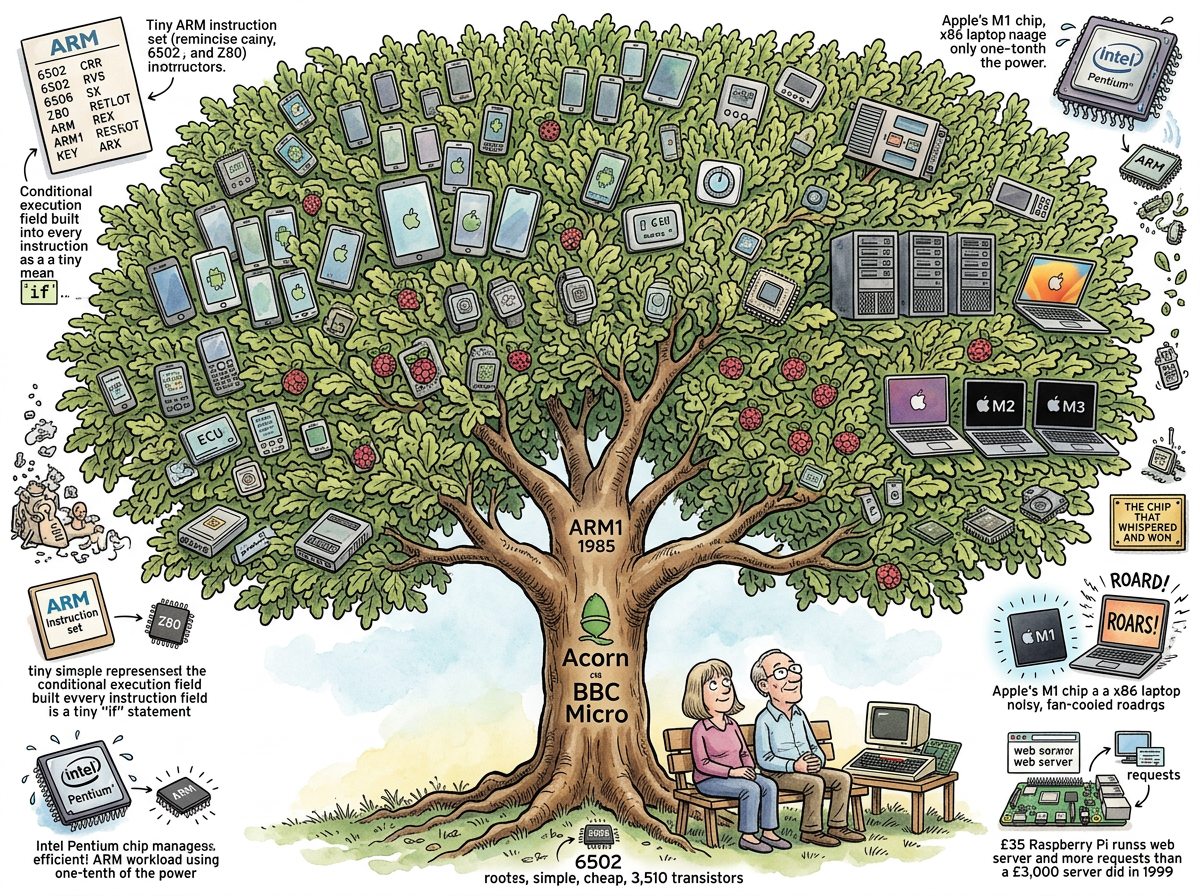
ARM (originally Acorn RISC Machine, later Advanced RISC Machines) is a family of reduced instruction set processors first designed in 1985 by Sophie Wilson and Steve Furber at Acorn Computers in Cambridge, England, and currently running in approximately every computing device on Earth that is not a desktop PC — and increasingly, thanks to Apple Silicon, in those too.
ARM is the 6502’s grandchild. This is not a metaphor. The Acorn team had built the BBC Micro around the 6502. When they designed their own processor, they designed it with the same philosophy: simple instructions, regular encoding, low transistor count, cheap to manufacture. The 6502 had 3,510 transistors. The first ARM (ARM1) had 25,000 — approximately the complexity of a pocket calculator by modern standards. The ARM1 consumed 0.1 watts. It was so power-efficient that the development prototype, due to a manufacturing defect, ran without being connected to a power supply — parasitic power from the signal lines was sufficient.
A processor so simple it ran on leaked electricity. The 6502 would have approved.
“Boring technology. Beautiful results. No React. No npm. No Docker. Just Go, SQLite, and stubbornness.”
— riclib, The Databases We Didn’t Build
The Acorn Lineage
Sophie Wilson designed the ARM instruction set. She had previously designed the instruction set of the Acorn Proton (the BBC Micro’s core), which ran on a 6502. She had written BBC BASIC in 6502 assembly. She had implemented the BBC Micro’s keyboard handler, its operating system interface, and its Econet networking protocol. She understood, from years of 6502 programming, what a CPU needed and — critically — what it didn’t.
The ARM instruction set reflects this experience: fixed-width 32-bit instructions (regular, predictable, easy to decode), a uniform register file (sixteen registers, all 32 bits, all interchangeable — the 68000’s orthogonality taken further), and load-store architecture (only load and store instructions access memory; everything else operates on registers).
The most distinctive feature: conditional execution. Every ARM instruction includes a 4-bit condition code field. Any instruction can be made conditional: ADDEQ (add if equal), MOVNE (move if not equal), SUBGT (subtract if greater than). This eliminates short branches — instead of “compare, branch over the instruction, execute the next instruction,” you write “compare, conditionally execute the instruction.” One instruction instead of three. No branch penalty. No pipeline flush.
This is YAGNI applied to control flow: instead of a branch instruction (which flushes the pipeline and wastes cycles), build the condition into the instruction itself. The problem of “short branches are expensive” is solved not by predicting branches (which is what Intel spent billions on) but by eliminating them.
The Power Efficiency Revelation
ARM was designed for the Acorn Archimedes desktop computer. It was not designed for mobile phones. That ARM came to dominate mobile computing is an accident of physics: a processor designed to be simple is also a processor that consumes little power, and a processor that consumes little power is a processor that fits in a phone.
Intel’s x86 was designed for desktops and grew into servers. It was powerful and power-hungry. When mobile computing arrived, Intel tried to shrink x86 into phones (Atom). It failed. The x86’s complexity — its CISC instruction decoding, its out-of-order execution engine, its branch prediction infrastructure, its backward compatibility with the 8086 from 1978 — consumed power that a phone battery could not provide.
ARM had none of this complexity. ARM decoded instructions in one cycle (fixed-width, remember). ARM executed most instructions in one cycle. ARM didn’t need branch prediction because conditional execution eliminated most branches. ARM was simple, and simple was efficient, and efficient was mobile, and mobile was everything.
By 2026, ARM processors ship in:
- Every iPhone
- Every Android phone (Qualcomm Snapdragon, MediaTek, Samsung Exynos — all ARM)
- Every iPad
- Every Apple MacBook, iMac, Mac Mini, Mac Pro (Apple M-series — ARM)
- Every Raspberry Pi
- Every AWS Graviton server instance
- Every smart watch, most smart thermostats, most car ECUs
- Approximately 230 billion chips total, and counting
The 6502 democratised computing by being cheap ($25). ARM democratised everything by being efficient enough to run on a battery.
Apple Silicon
In 2020, Apple announced the transition from Intel x86 to ARM-based Apple Silicon. The M1 chip — designed by Apple, based on the ARM instruction set — outperformed Intel’s best laptop processors while consuming a fraction of the power.
The M1 MacBook had no fan. It was silent. It ran for twenty hours on a battery. It compiled code faster than the Intel MacBook Pro that cost twice as much and sounded like a hair dryer.
This was the moment the 6502’s philosophy — simplicity wins — defeated the Pentium’s philosophy — complexity scales. The x86 had spent forty years adding complexity: more pipeline stages, more execution units, more cache levels, more branch prediction, more speculative execution (which produced Spectre and Meltdown — security vulnerabilities caused by the processor being too clever). ARM had spent forty years staying simple: regular instructions, uniform registers, conditional execution, and the understanding that the fastest instruction is the one that doesn’t waste power.
The M1 was a vindication forty years in the making. Sophie Wilson’s design decisions in 1985 — fixed-width instructions, load-store architecture, conditional execution — were the reasons the M1 outperformed Intel in 2020. The architecture was right in 1985. The world took forty years to notice.
The Raspberry Pi Connection
The Raspberry Pi — a $35 single-board computer powered by an ARM processor — is the 2010s equivalent of the ZX Spectrum: a cheap machine designed to teach children to program.
The Pi runs Linux. It has GPIO pins for hardware projects. It costs less than a textbook. It has sold over 60 million units. It is used in schools, in maker spaces, in server closets (a Pi running Go and SQLite can serve a surprising number of users), and in the International Space Station.
The lineage is direct: the 6502 made computing cheap enough for hobbyists (1975). The Z80 made it cheap enough for children (1982). ARM made it cheap enough for everything (2012). The Raspberry Pi is the BBC Micro’s spiritual successor, built on the BBC Micro’s processor’s successor, designed by the BBC Micro’s processor’s designers’ successors, in the same city (Cambridge), for the same purpose (education), using the same principle (simple, cheap, accessible).
The Lizard approves.