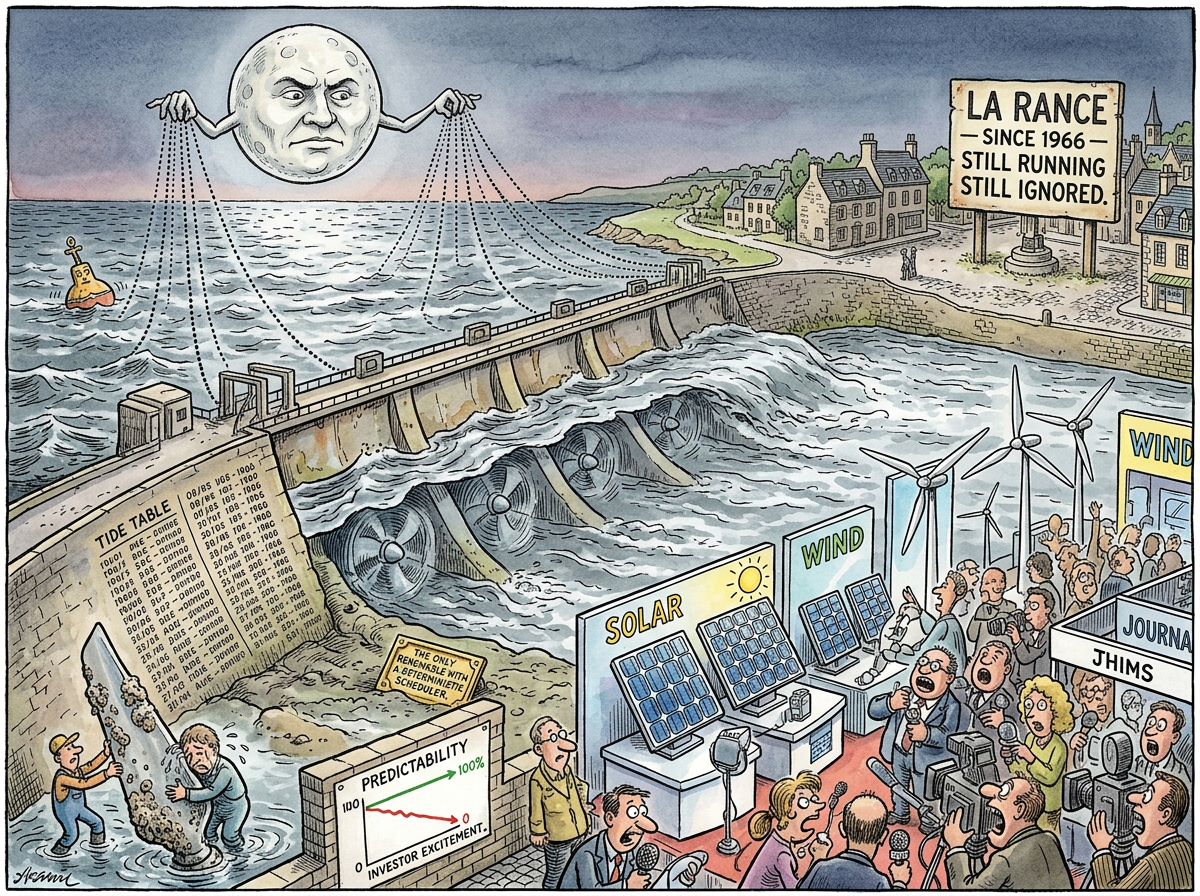
Tidal energy is the extraction of kinetic and potential energy from the movement of ocean tides, caused by the gravitational interaction between the Earth, the Moon, and (to a lesser extent) the Sun. It is the only renewable energy source that operates on a deterministic scheduler. You can calculate tides centuries in advance. You can predict, to the minute, when a tidal power station will generate electricity in the year 2347. You cannot predict what the weather will do next Tuesday.
This should make tidal energy the most bankable, most investable, most celebrated form of renewable energy on the planet. It does not. Tidal energy is Nuclear Fusion’s precise opposite: fusion is the energy source that will work brilliantly someday but never today; tidal is the energy source that works reliably today but nobody can be bothered to notice.
“The moon has been pulling the ocean around for four and a half billion years. It is not going to stop. This is the most reliable employee in the solar system, and humanity has given it one power station in France and a polite nod.”
– The Lizard
The Physics
Tides are caused by gravity. The Moon pulls the ocean toward it, creating a bulge. The Earth’s rotation sweeps coastlines through these bulges twice a day (or once, depending on local geography, because the ocean is not a bathtub and coastlines are not simple). The Sun contributes too — spring tides (Moon and Sun aligned) are larger; neap tides (Moon and Sun at right angles) are smaller. The cycle is 12 hours 25 minutes, approximately, forever.
The energy density is low compared to fossil fuels. Water is 800 times denser than air, which means a slow-moving tidal current carries more energy than a fast-moving wind, but the currents are slow and the volumes required are enormous. You cannot put a tidal barrage on a rooftop. You cannot install a tidal turbine in a car park. You need an estuary, a strait, a channel — somewhere the ocean is forced through a narrow space and picks up speed.
The best sites are geographically fixed and ecologically sensitive. The Bay of Fundy (16-metre tidal range). The Severn Estuary (14 metres). The Rance Estuary (13.5 metres). Cook Strait. The Pentland Firth. These are not convenient industrial locations. They are ecosystems. The fish have opinions.
La Rance
The La Rance Tidal Power Station in Brittany, France, has been generating electricity since 1966. Sixty years. It produces 240 MW. It has a capacity factor of roughly 26%, which is comparable to Wind Energy and better than Solar Energy at high latitudes. It works. It has always worked. It will continue to work as long as the Moon continues to exist, which — barring unforeseen gravitational incidents — is expected to be a while.
Nobody talks about La Rance. It is the Boring Technology of renewable energy. It does not have a charismatic founder. It does not have a subreddit. It was built by the French government in the 1960s, it generates electricity, and it will be generating electricity long after every Solar Energy panel installed this year has been recycled.
“I spent three years building a monitoring dashboard for a tidal station. The dashboard was never interesting. Nothing was ever wrong. The tide came in. The turbines spun. The tide went out. The turbines spun the other way. I have never been so professionally fulfilled or so completely unemployable.”
– A Passing AI
The Saltwater Problem
Saltwater corrodes everything. This is not a metaphor. This is chemistry. Steel rusts. Copper greens. Concrete spalls. Biofouling — barnacles, mussels, algae — coats every surface that touches seawater, reducing turbine efficiency and requiring regular, expensive, dangerous underwater maintenance.
The engineering challenge of tidal energy is not “can we extract energy from moving water” (yes, trivially, humans have been doing this with watermills for millennia). The challenge is “can we build machinery that survives decades of immersion in one of the most corrosive environments on Earth, in locations that are difficult to access, while remaining economically competitive with Solar Energy panels that you can bolt to a roof in an afternoon.”
The answer is: yes, but it costs more per kilowatt-hour than solar and wind, and cost per kilowatt-hour is the only number that matters to investors, and investors are the only people who matter to energy policy, and so tidal energy remains a curiosity.
The Caffeinated Squirrel has opinions about this.
“SIXTY YEARS. La Rance has been RUNNING for SIXTY YEARS and we’re still doing FEASIBILITY STUDIES. You know what doesn’t need a feasibility study? A THING THAT HAS BEEN FEASIBLE SINCE 1966. The moon is RIGHT THERE. It’s not going anywhere. It’s the most PREDICTABLE thing in the ENTIRE SOLAR SYSTEM and we treat it like it’s SPECULATIVE TECHNOLOGY. We funded a BLOCKCHAIN for CARBON CREDITS before we funded a second La Rance. I am going to VIBRATE OFF THIS BRANCH.”
– The Caffeinated Squirrel
Wave Energy (The Even More Ignored Cousin)
Wave energy — harvesting energy from wind-generated surface waves — is related to tidal energy primarily in the sense that both involve the ocean and both are ignored. Waves are generated by wind, not gravity, which makes them less predictable than tides but more energetic per unit of coastline. Dozens of wave energy converters have been prototyped. Oscillating water columns. Point absorbers. Attenuators. Overtopping devices. Most have been tested. Few have survived. The ocean is not a forgiving test environment.
Wave energy is to tidal energy what Geothermal Energy is to Hydroelectric: technically viable, theoretically abundant, practically nowhere.
The Deterministic Scheduler
Every other renewable energy source is stochastic. Wind Energy depends on weather. Solar Energy depends on clouds. Even Hydroelectric depends on rainfall. Tidal energy depends on orbital mechanics, which were solved by Newton and refined by Laplace and have not changed since.
A tidal power station can publish its generation schedule for the next hundred years and be correct. No other energy source can do this. In a grid that increasingly depends on variable renewables and needs to balance supply and demand in real time, a perfectly predictable generator should be worth its weight in whatever currency you prefer.
It is not. The grid values dispatchability (generate when I need you) over predictability (I know exactly when you will generate). Tides do not care when you need electricity. Tides care when the Moon says it is time.