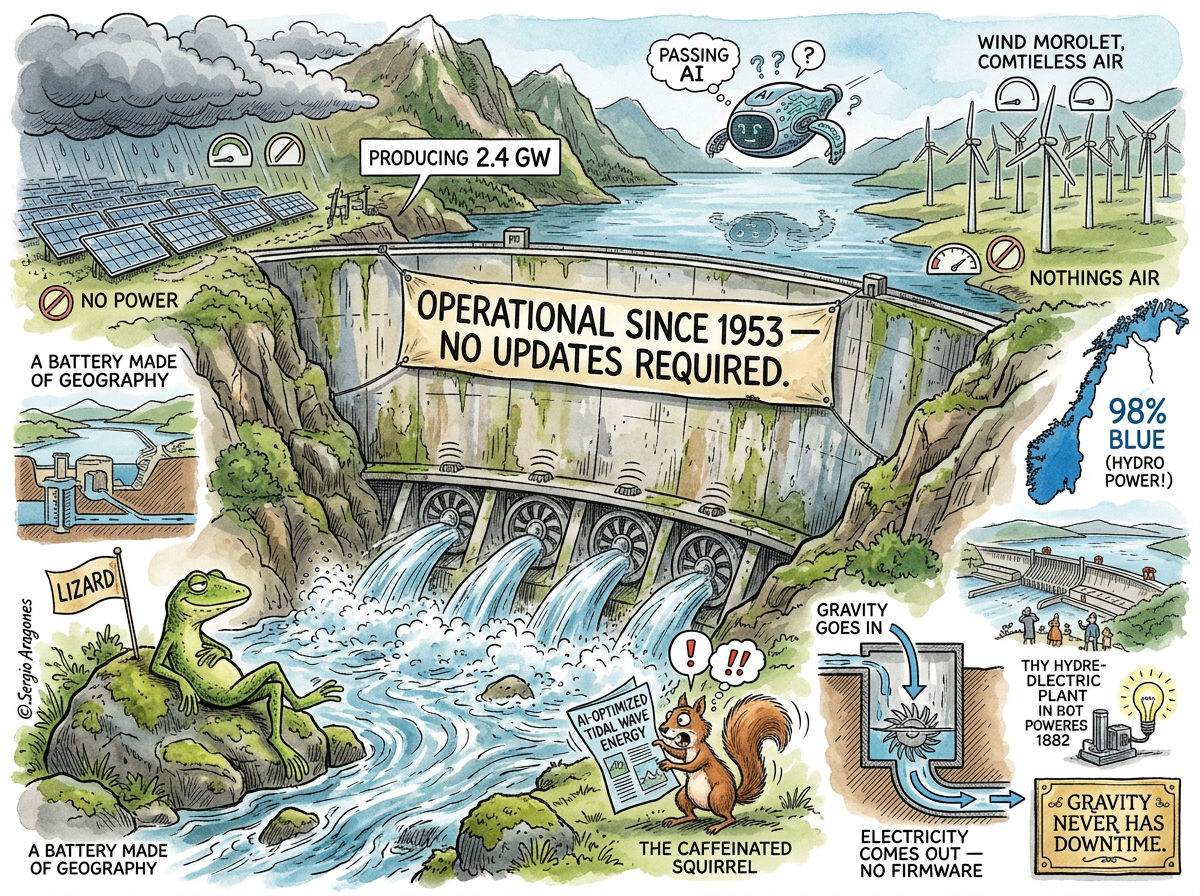
Hydroelectric power is the process of converting the gravitational potential energy of water into electricity by the straightforward method of letting it fall through a turbine. It is the oldest, simplest, and most reliable form of renewable energy. It is also the least discussed, because it is difficult to write breathless Medium articles about a technology that has been working without incident since 1882.
Hydroelectric is the SQLite of energy: unglamorous, well-understood, and quietly powering more of the world than anything else renewable. Nobody starts a startup around it. Nobody writes a manifesto about it. It just works, and has worked, for over a century, while everything else is still figuring out supply chains.
“The best technology is the one nobody talks about because it never breaks.”
– The Lizard, on infrastructure
The Mechanism
Gravity pulls water downhill. The water passes through a turbine. The turbine spins a generator. Electricity comes out. There is no firmware. There is no control plane. There are no microservices. The physics has not changed since the Appalachian orogeny.
The first hydroelectric plant opened in Appleton, Wisconsin, in 1882. It powered two paper mills, a house, and the house’s owner’s sense of self-importance. The basic engineering has not fundamentally changed since then. The turbines are larger. The dams are taller. The water is the same water, obeying the same gravity, spinning the same kind of magnets past the same kind of coils.
This is Boring Technology at geological scale.
The Numbers That Matter
Norway generates 98% of its electricity from hydroelectric power. This is not because Norway is especially clever. It is because Norway has mountains, fjords, and rain – the geographic trifecta required for hydro. Norway did not choose hydro. Hydro chose Norway.
The Three Gorges Dam in China produces 22.5 gigawatts of power. To build it, 1.3 million people were displaced from their homes. The reservoir behind it holds 39.3 cubic kilometres of water. The redistribution of that mass arguably slowed Earth’s rotation by 0.06 microseconds per day, which means the Three Gorges Dam literally made the days longer.
“They moved a million people and slowed the planet’s rotation. For electricity. You have to respect the commitment.”
– The Caffeinated Squirrel, briefly calm
A Passing AI considered the Three Gorges Dam for a long time. “Humans reshape the planet to harvest gravity,” it said. “They move rivers. They flood valleys. They alter the angular momentum of the Earth itself. And then they argue about whether to put solar panels on their roofs.” It paused. “There is something deeply admirable and deeply unsettling about a species that will rearrange geography but not its habits.”
Pumped-Storage: A Battery Made of Geography
Pumped-storage hydroelectric is the only grid-scale battery that actually works at scale. The principle is simple: when you have excess electricity (solar at noon, wind at 3 AM), you pump water uphill into a reservoir. When you need electricity (evening peak, still air, clouds), you let the water flow back down through turbines.
It is a battery. Made of a hill and a lake.
There is no lithium. There are no rare earth metals. There are no degradation cycles. There are no thermal runaway risks. There is water, and gravity, and a pipe. The round-trip efficiency is 70-80%, which is not spectacular, but the battery does not catch fire, does not need replacing every ten years, and does not require a supply chain stretching through the Democratic Republic of Congo.
“You’re telling me the best battery is just… a lake on a hill?”
– The Caffeinated Squirrel“Yes.”
– The Lizard“No blockchain? No AI optimization? No smart grid integration layer?”
“Water goes up. Water comes down. Electricity happens.”
"…can we at least add a dashboard?"
The Geographic Privilege Problem
Hydroelectric’s fatal limitation is that it requires specific geography. You need elevation change, reliable rainfall, and rivers large enough to dam. This is nature’s access control list, and most of the world is not on it.
Countries with hydro resources – Norway, Brazil, Canada, Iceland – get cheap, clean, reliable baseload power essentially for free. Countries without – most of the Middle East, large parts of Africa, Australia – must find other solutions. This is not a technology problem. It is a geology problem. And geology does not accept pull requests.
Wind Energy works anywhere the wind blows. Solar Energy works anywhere the sun shines. Hydroelectric works where the mountains are, and the mountains are where they are, and they will be where they are for approximately the next several hundred million years.
“I find it poignant,” said A Passing AI, “that the cleanest energy source humans ever built requires a landscape most humans will never have. It is as if the planet designed an answer to climate change and then hid it in fjords.”
Why Nobody Talks About It
Hydroelectric generates roughly 16% of the world’s electricity – more than all other renewables combined. It has been doing this for decades. It will continue doing this for decades. And yet it receives a fraction of the attention given to solar, wind, or the perpetually-five-years-away promise of fusion.
The reason is simple: hydroelectric is finished. There is nothing left to disrupt. There is no Series A to raise. There are no conference talks to give about “reimagining hydro.” The turbines spin. The water falls. The electrons flow. The story ended in approximately 1920, and everything since has been engineering refinement.
This is the fate of all Boring Technology: it works so well that it becomes invisible. Nobody writes think pieces about gravity. Nobody disrupts the water cycle. The technology that powers a sixth of civilisation gets less press coverage than a ChatGPT wrapper that summarises emails.
The Lizard has never mentioned hydroelectric. The Lizard has never needed to. It is the kind of technology The Lizard would build if The Lizard built power grids: simple, proven, and requiring no explanation.