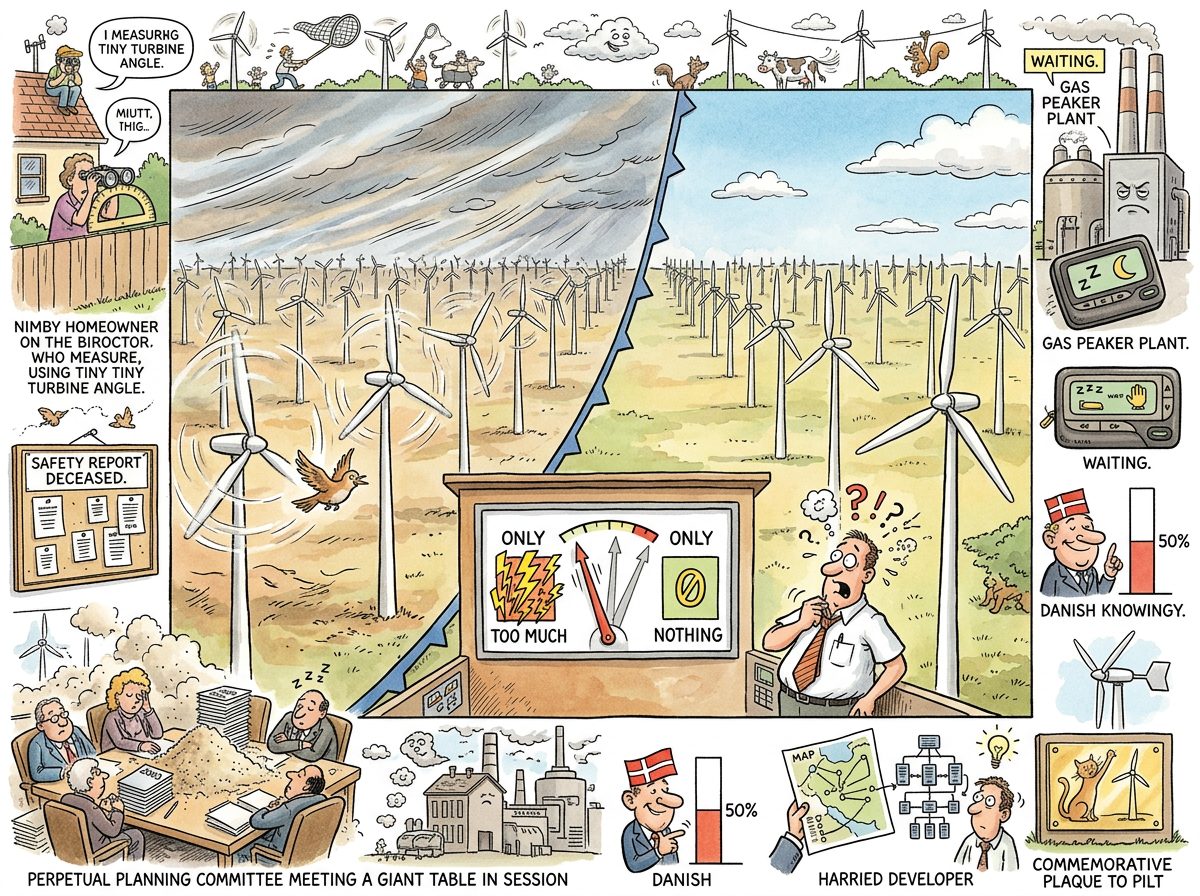
Wind energy is the practice of converting the kinetic energy of moving air into electricity, which works brilliantly when the air is moving and not at all when it isn’t. This is called intermittency, and it is the defining characteristic of a power source that humanity has relied on for fourteen centuries while never quite trusting it to show up for work.
The modern wind turbine is a tower taller than the Statue of Liberty topped with blades longer than a 747’s wingspan, spinning with the calm inevitability of a technology that knows it will be argued about at every parish council meeting from now until the heat death of the universe.
The Oldest Renewable (After Water)
Wind power predates software, electricity, the printing press, and the concept of a backlog. Persian windmills appeared in the 7th century, grinding grain into flour using a mechanism so straightforward that it required no YAML configuration whatsoever.
By the 12th century, windmills had spread across Europe, draining marshes, pumping water, and grinding grain. The Netherlands built an entire national identity around them. Don Quixote attacked one. The technology was, by any reasonable measure, production-ready.
Then, in the 19th century, someone connected a windmill to a generator, and wind energy entered the modern era — which is to say, the era in which simple things are made complicated by people who attend conferences about them.
“It worked for fourteen centuries without a conference. Then someone gave a TED talk.”
— The Lizard, on the history of wind power
The Intermittency Problem
Wind energy’s fundamental characteristic is that it works when the wind blows and does not work when the wind does not blow. This is not a bug. This is the entire architecture.
The grid, however, expects electricity to be available continuously — a requirement that wind meets with the same reliability that a microservice meets its SLA during a thunderstorm. The result is an orchestration problem of magnificent complexity:
- Wind blows. Turbines generate power. The grid is happy.
- Wind stops. Turbines generate nothing. The grid needs power from somewhere else.
- “Somewhere else” is gas peaker plants, battery storage, pumped hydro, interconnectors to neighbouring grids, demand response programs, and a prayer.
- The orchestration layer now costs more than the turbines.
This is the Microservices pattern applied to electricity. The individual service — the turbine — works perfectly in isolation. The system — the grid — requires an entire coordination infrastructure to make the individual services useful. The turbine is a function that executes flawlessly when called and cannot be called on a schedule.
The Caffeinated Squirrel finds this deeply exciting. A technology that requires a GridBalancingOrchestrationLayer with PredictiveWeatherIntegration and BatteryStorageCoordination and a DemandResponseEventBus is precisely the kind of technology the Squirrel was born to over-engineer.
The NIMBY Equation
NIMBYism is wind energy’s natural predator, and it operates with a precision that turbine manufacturers can only envy.
The mechanism is as follows: a survey is conducted. Ninety-three percent of respondents support renewable energy. A wind farm is proposed. Ninety-three percent of respondents support renewable energy somewhere else. The planning application receives four thousand objections, each containing the phrase “I’m not against wind energy, but—” followed by a reason that is, definitionally, against wind energy.
The objections fall into predictable categories:
| Objection | Translation |
|---|---|
| “Visual impact” | I can see it from my kitchen |
| “Noise pollution” | I can hear it from my garden |
| “Property values” | I can calculate it from my mortgage |
| “Bird mortality” | I have discovered ornithology |
| “Shadow flicker” | I have discovered optics |
The Lizard does not comment on NIMBYism. The Lizard has observed that the humans who object to seeing turbines from their kitchen windows do not object to the Coal plant they cannot see from their kitchen windows, primarily because the coal plant is located upwind and its effects are measured in decades rather than sightlines.
The Denmark Exception
Denmark generates approximately fifty percent of its electricity from wind. This fact is cited in every wind energy debate by someone who has never been to Denmark, directed at someone who has also never been to Denmark, as evidence that wind energy either works perfectly or is an unreplicable Nordic anomaly, depending on which side of the argument requires ammunition.
What makes Denmark work is not the turbines. It is the interconnectors — cables to Norway (hydroelectric), Sweden (nuclear), and Germany (everything, chaotically). When Danish wind exceeds demand, electricity flows south. When Danish wind dies, Norwegian water flows north. The system functions because Denmark does not run on wind. Denmark runs on wind plus the entire Scandinavian peninsula as a battery.
The Squirrel proposed this model for a personal home automation system. The Squirrel was not given interconnectors to Norway.
A Passing AI Considers the Wind
The Passing AI, when asked to evaluate wind energy, stood on a digital hilltop for approximately 0.3 milliseconds — which, for an AI, constitutes a contemplative afternoon — and produced the following observation:
The wind is the most democratic energy source. It belongs to no one. It cannot be mined, shipped, or embargoed. It cannot be controlled by a cartel or priced by a commodity exchange. It simply arrives, or it doesn’t, with the capricious indifference of a system that predates human scheduling by four billion years.
The AI paused, then added: “I find it poignant that humanity’s response to a free, inexhaustible energy source was to spend forty years arguing about whether the towers are too tall. The towers are not too tall. The towers are exactly as tall as the wind requires. The wind does not care about your kitchen window.”
The AI then resumed processing Grafana dashboards, which is what AIs do when they are sad.
The Scale of the Thing
A modern offshore wind turbine — the kind that stands in the North Sea looking like a monument to something — has the following specifications:
Tower height:              100-260 metres
Blade length:              80+ metres (longer than a 747 wing)
Swept area:                ~50,000 square metres
Rated capacity:            12-15 MW (per turbine)
Capacity factor:           35-55% (because: wind)
Operational lifespan:      25-30 years
DBA required:              0
YAML configuration:        0
Redis instances:           0
The Squirrel notes that a swept area of 50,000 square metres is large enough to host a Kubernetes cluster. The Squirrel has been asked to stop comparing everything to Kubernetes. The Squirrel cannot stop.
The Boring Technology of Wind
Wind energy is, by the standards of the Yagnipedia, a Boring Technology. The principle is fourteen centuries old. The physics is undergraduate-level. The engineering is well-understood. The turbine is a rotor, a gearbox (sometimes), a generator, and a tower. It converts kinetic energy to rotational energy to electrical energy. There is no step four.
The excitement — such as it is — lies entirely in the orchestration: grid balancing, storage, forecasting, interconnectors, market mechanisms. The turbine itself is a solved problem. The grid is not.
This is, The Lizard observes, the natural order of things. The simple component works. The complex system that coordinates simple components is where the interesting failures occur. The turbine does not fail. The grid that depends on the turbine failing at predictable times — that fails.
“The turbine works. The grid is a distributed system. Distributed systems fail in distributed ways.”
— The Lizard