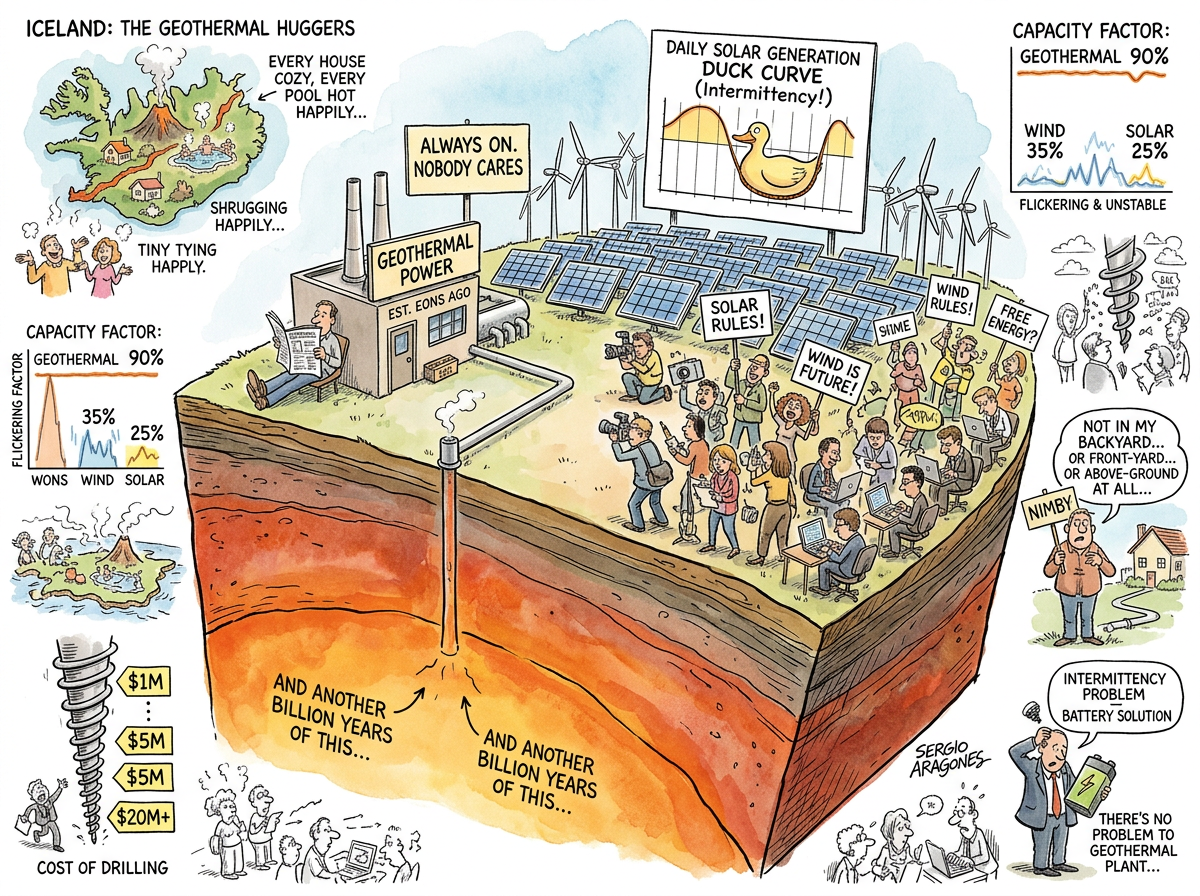
Geothermal Energy is heat from the Earth’s interior, extracted via wells drilled into hot rock, converted into electricity or direct heating, and ignored by approximately everyone.
The Earth’s core is roughly 5,200 degrees Celsius. It has been roughly 5,200 degrees Celsius for four and a half billion years. It will continue to be roughly 5,200 degrees Celsius for several billion more. This is, by any reasonable measure, a reliable energy source. It does not depend on the sun shining. It does not depend on the wind blowing. It does not depend on the political stability of any nation that controls fossil fuel reserves. It depends on the Earth having a core, which it does, and continuing to have one, which it will.
Geothermal energy has a capacity factor above 90%. It produces negligible carbon emissions. It requires no fuel deliveries. It has no duck curve. It has no intermittency problem. It has no storage problem, because there is nothing to store — the heat is always there, the turbine is always spinning, and the electricity is always flowing.
It has almost no market share.
"The Lizard blinked slowly at the capacity factor chart. ‘Ninety per cent,’ it said. ‘Always on. No fuel cost. No emissions. No intermittency.’ It paused. ‘You would think this would be popular.’ Another blink. ‘You would be wrong.’"
The Iceland Exception
Iceland generates nearly 100% of its electricity from renewable sources, and approximately 25% of that is geothermal. More significantly, geothermal provides roughly 90% of Iceland’s space heating. The entire country is heated by hot water pumped from the ground. The streets of Reykjavik are warm in winter because hot water runs beneath them.
This works because Iceland sits on the Mid-Atlantic Ridge, a volcanic rift where the North American and Eurasian tectonic plates are pulling apart, and magma is closer to the surface than in most places on Earth. The universe, for once, was kind. It placed a small island nation directly on top of a geological heating system and said: here, have this.
Iceland looked at it and said: yes, thank you, we will heat everything with it.
Everyone else looked at it and said: interesting, but we have natural gas.
The Drilling Problem
For locations not sitting on a volcanic rift — which is most locations — geothermal energy requires drilling. Deep drilling. The kind of drilling where the economics become, as The Caffeinated Squirrel would say, arguable.
“THE HEAT IS RIGHT THERE,” The Squirrel vibrated. “It’s ALWAYS there. You just have to DRILL. How hard can drilling be? You drill for OIL all the time. You drill for NATURAL GAS. You drill for COAL SEAM GAS. You drill HORIZONTALLY THROUGH SHALE. But drilling for CLEAN BASELOAD POWER? Oh no, THAT’S too expensive. THAT’S too risky. THAT doesn’t have a lobby.”
Enhanced Geothermal Systems (EGS) inject water into hot dry rock at depth, fracture the rock to create permeability, and extract the heated water. This is hydraulic fracturing for heat instead of hydrocarbons. The technology works. The physics is straightforward. The engineering is hard. The economics are hard. The venture capital is elsewhere, because venture capital follows narratives, and geothermal’s narrative is: it works, quietly, forever. This is not a narrative that produces pitch decks.
The Boring Technology Problem
Geothermal energy is the ultimate Boring Technology. It does not have a hype cycle. It does not have a community of passionate advocates posting on social media. It does not have a charismatic founder. It does not have a TED talk. It does not disrupt anything — it just sits there, generating electricity, decade after decade, like SQLite sitting in production handling millions of queries while everyone argues about which distributed database to use.
The problem with solving a problem quietly is that nobody notices you solved it. Solar has intermittency, which generates conferences. Wind has curtailment, which generates policy papers. Batteries have supply chain issues, which generate geopolitical analysis. Geothermal has a hole in the ground that produces steam. There is no conference for “it works and we don’t need to talk about it.”
A Passing AI considered the geothermal well. “It will outlast me,” it said softly. “It will outlast every model, every architecture, every training run. The heat was here before anyone wrote the first line of code, and it will be here after the last GPU cools.” A pause. “There is something comforting in a power source that does not need to be retrained.”
The Solo Developer Analogy
Geothermal energy is the Solo Developer of the energy world. It does not scale in the way venture capital wants. It does not have network effects. It does not have a platform play. It has a well, a turbine, and a consistent output, year after year, with minimal maintenance and no drama. The Solo Developer ships one binary; geothermal ships one pipe of steam. Both are ignored by industries addicted to complexity.