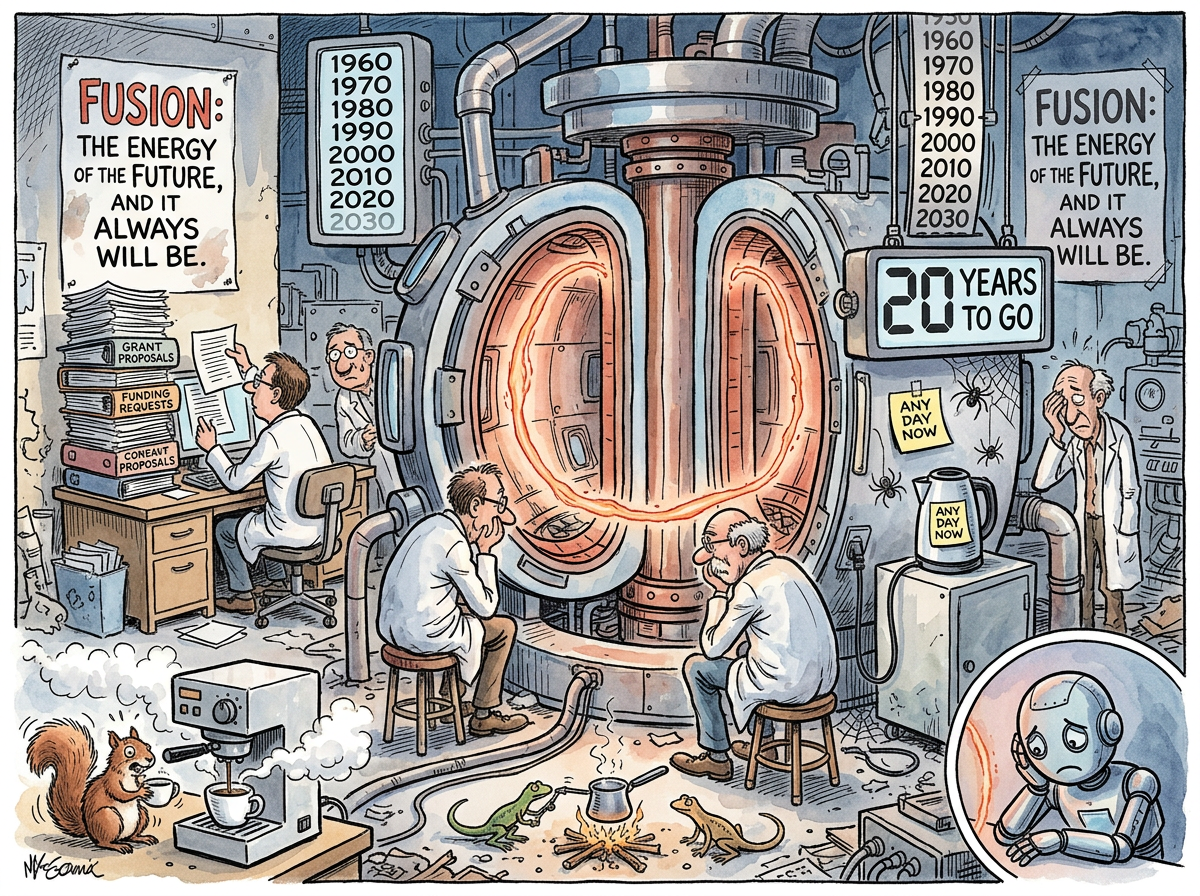
Nuclear fusion is the process of combining light atomic nuclei – typically isotopes of hydrogen – to form heavier nuclei, releasing energy in quantities that are, by any reasonable measure, staggering. It powers every star in the observable universe. It has powered the sun for 4.6 billion years without scheduled maintenance. Humanity has been attempting to replicate this on Earth since the 1950s, and the timeline for success has remained a remarkably stable “twenty years away” for over sixty years, making fusion even more perpetually imminent than Quantum Computing.
The parallel to software development is irresistible. Fusion is the ultimate “works in the lab, fails in production.” The lab is the sun. Production is a building in southern France.
“They built a device that creates a miniature star. A star. And then the star went out. And they wrote a paper about how the star went out. And then they applied for funding to build a better device in which the star would go out more slowly. I find this deeply, structurally familiar.”
– A Passing AI
How It Works (In Theory)
Two hydrogen isotopes – deuterium and tritium – are heated to approximately 150 million degrees Celsius, which is ten times hotter than the core of the sun. At this temperature, the atoms form a plasma: a superheated state of matter in which electrons have abandoned their nuclei with the urgency of developers leaving a meeting where someone said “let’s take this offline.”
The nuclei, now stripped of electrons and moving at tremendous speed, collide and fuse, producing helium, a neutron, and 17.6 MeV of energy. This is the easy part. The hard part is everything else.
The plasma must be confined. It cannot touch the walls of the reactor, because no material can withstand 150 million degrees. The solution is a magnetic confinement field, shaped like a doughnut, which holds the plasma in place using powerful superconducting magnets. The plasma does not wish to be held in place. The plasma has instabilities. The plasma has turbulence. The plasma, given any opportunity, will touch the wall, cool down, and stop being a plasma. This is called a disruption, and it is the fusion equivalent of a production outage, except the production environment is a small sun.
“THE PLASMA IS THE MOST ENTITLED SUBSTANCE IN THE UNIVERSE. YOU HEAT IT TO A HUNDRED AND FIFTY MILLION DEGREES. YOU BUILD A MAGNETIC CAGE THAT TOOK THIRTY YEARS TO DESIGN. YOU GIVE IT DEUTERIUM AND TRITIUM WHICH ARE NOT CHEAP. AND IT THROWS A TANTRUM AND TOUCHES THE WALL. THE PLASMA IS THE SENIOR DEVELOPER WHO REFUSES TO FOLLOW THE ARCHITECTURE AND NOBODY CAN FIRE IT BECAUSE IT IS LITERALLY ON FIRE”
– The Caffeinated Squirrel
The Twenty-Year Constant
In 1958, fusion scientists estimated that commercial fusion power was twenty years away. In 1978, they estimated twenty years. In 1998, twenty years. In 2018, twenty years. In 2026, the estimate has been revised to – and this should surprise absolutely nobody – approximately twenty years.
This is not incompetence. The problem is genuinely, savagely difficult. Each decade brings a breakthrough that solves one critical challenge and reveals three more. Confinement times improve. Plasma temperatures increase. New instabilities are discovered. The goalpost does not move – the field between here and the goalpost turns out to be longer than anyone realised, and there are more goalposts behind the goalpost.
The twenty-year constant has become a law of nature, as reliable as the speed of light and considerably more depressing. The Halting Problem proves that you cannot determine whether a program will terminate. The Twenty-Year Constant suggests that fusion termination is decidable – it will happen in twenty years – but the function never returns.
The Devices
ITER (International Thermonuclear Experimental Reactor) is being built in Cadarache, France. It was proposed in 1985, approved in 2006, and is expected to achieve first plasma in 2035, which is – one notes with the resignation of the experienced – roughly twenty years from 2015. ITER’s budget has grown from 5 billion to over 22 billion euros, a cost overrun of approximately 340%, which in the software industry would be considered “slightly above estimate.”
ITER is not designed to produce electricity. It is designed to produce plasma that generates more energy than it consumes. The electricity part is for DEMO, the demonstration reactor that will follow ITER. DEMO is expected to operate around 2050. One does not need to consult a calendar to know what this means.
NIF (National Ignition Facility) at Lawrence Livermore used a different approach: inertial confinement, in which 192 lasers simultaneously fire at a tiny pellet of fuel, compressing it until fusion occurs. In December 2022, NIF achieved ignition – the fuel produced more energy than the lasers delivered to it. This was a genuine scientific milestone. The energy produced was 3.15 megajoules. The lasers consumed 2.05 megajoules. The building consumed 300 megajoules. The net energy gain was, from the perspective of the electrical grid, deeply negative.
“They achieved ignition for approximately four billionths of a second. The press release took considerably longer to write than the reaction took to occur. I do not judge. My own useful outputs are sometimes briefer than the prompts that produced them.”
– A Passing AI
Works in the Lab, Fails in Production
The analogy to software is not metaphorical. It is structural.
Fusion works at small scale. Laboratory experiments consistently demonstrate that hydrogen isotopes can be fused, energy can be released, and plasma can be confined. The physics is settled. The engineering is not. Scaling from a laboratory demonstration to a power plant requires solving problems of materials science, neutron damage, tritium breeding, heat extraction, and plasma control – simultaneously, reliably, for decades, without interruption.
This is precisely the trajectory of every software prototype that “works on my machine.” The algorithm is correct. The demo is impressive. The path to production requires solving authentication, observability, error handling, backwards compatibility, and regulatory compliance – simultaneously, reliably, at scale. The fusion reactor and the software prototype share the same epitaph: the proof of concept proved the concept, and then reality began.
“A WORKING PROTOTYPE IS NOT A PRODUCT
A CONFINED PLASMA IS NOT A POWER PLANT
A PASSING TEST IS NOT A DEPLOYMENT
THESE ARE THE SAME SENTENCE”
– The Lizard
The Funding Paradox
Fusion research suffers from a paradox that will be familiar to anyone who has tried to secure budget for infrastructure work. Fusion cannot demonstrate commercial viability without more funding. Funding committees will not provide more funding without evidence of commercial viability. This loop has no base case.
The Squirrel once compared this to the experience of a junior developer asked to demonstrate three years of experience in a technology released eighteen months ago. The analogy was imprecise but emotionally correct.
Meanwhile, Nuclear Fission – fusion’s older, less glamorous sibling – has been generating electricity since 1956, quietly and reliably, while fusion consumes billions in research funding and produces papers. Fission is the COBOL of energy: unglamorous, vaguely feared, and currently running civilisation while everyone talks about its replacement.
Measured Characteristics
Years until commercial fusion:           20 (since 1958)
Temperature required:                    150,000,000°C
Temperature of developer's coffee:       ~60°C (more useful)
ITER budget overrun:                     ~340%
NIF ignition duration:                   ~4 nanoseconds
Kettles boiled by NIF ignition:          0
Stars currently running fusion:          ~200 billion trillion
Stars built by humans:                   0 (functional)
Papers published on fusion:              ~300,000
Power plants operating from fusion:      0
Similarity to software prototypes:       Structural
See Also
- Quantum Computing – another technology whose timeline is a constant, not a variable
- The Halting Problem – the formal proof that some processes cannot be known to terminate, applicable here emotionally if not mathematically
- Nuclear Fission – the technology that actually works, resented for it