Solar energy is the photovoltaic conversion of sunlight into electricity. The sun delivers more energy to the Earth’s surface in one hour than humanity consumes in an entire year, which makes solar’s current market share less a technical limitation and more a monument to human organizational failure on a scale that would impress even the Vogons.
The panels themselves are now cheaper than the paperwork required to install them. This is not a metaphor. A residential solar panel costs less per watt than the administrative fees charged by local planning authorities to review whether the panel is an acceptable shade of blue. The bottleneck moved from physics to bureaucracy sometime around 2018, and nobody updated the discourse.
“The sun is right there. It has been right there for four and a half billion years. It will be right there for another five billion. It is not going anywhere. It is, in fact, the most reliable energy source in the known universe. And yet.”
— The Lizard, surveying a planning application backlog
The Duck Curve
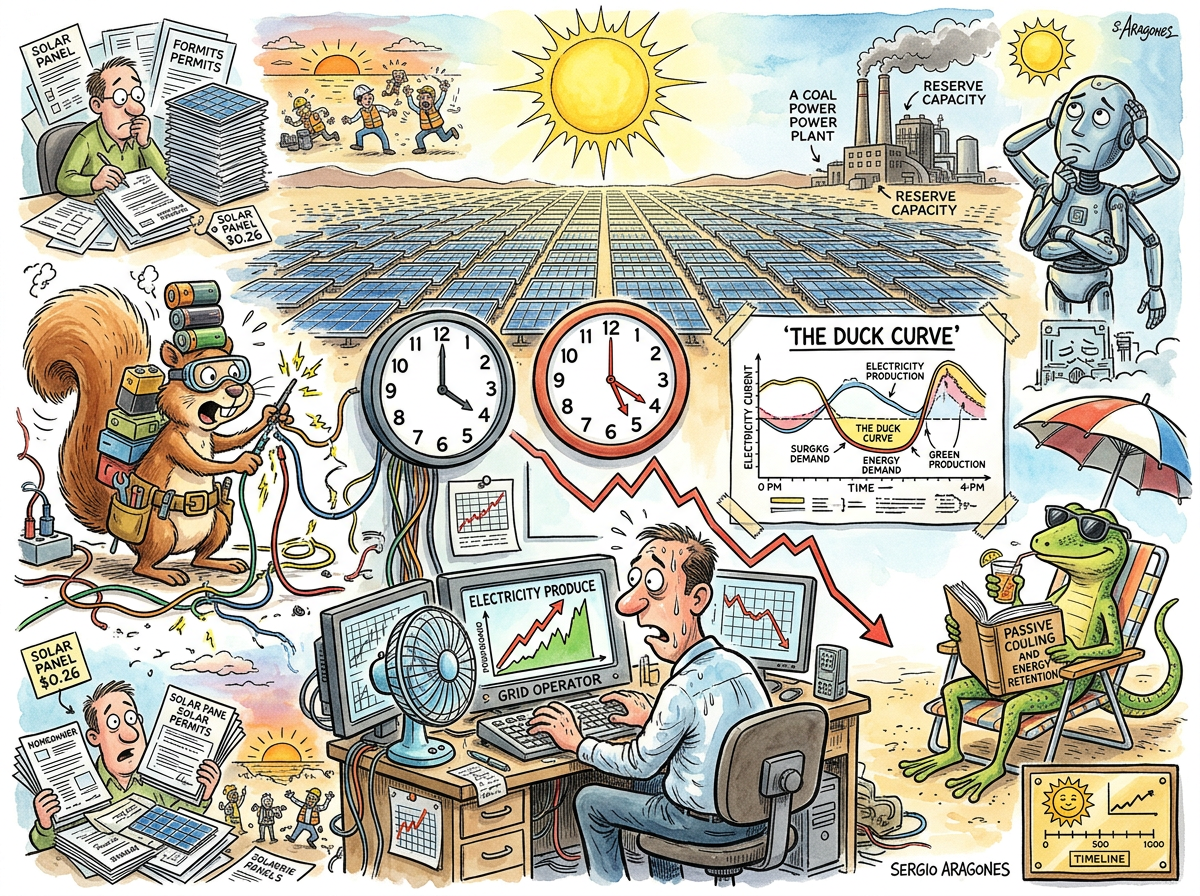
California’s electrical grid produces a shape known as the Duck Curve — net demand plotted across a day that resembles a duck in profile. Solar floods the grid at midday, driving net demand to near zero or below, then vanishes at sunset precisely when everyone arrives home, turns on their air conditioning, and begins reheating things.
The duck curve is the Dogpile Effect of energy. All the solar produces at the same time. All the solar stops at the same time. The grid must absorb a tsunami at noon and then conjure replacement power from nothing at 6 PM. It is a cache stampede, except the cache is the sun, and the stampede happens every single day, and it has been happening every single day since California installed its first large-scale solar farm, and it will continue happening every single day until someone solves storage or moves sunset.
“It’s not a bug. It’s not even a feature. It’s the orbital mechanics of a planet rotating around a star. We knew this. We knew this before we built the grid. We have known this since Copernicus.”
— A Passing AI, staring at the duck curve with visible melancholy
The Squirrel’s Solution
The Caffeinated Squirrel has opinions about the duck curve.
“Batteries! Massive batteries! Grid-scale batteries! And then we connect the batteries to other batteries! And the batteries charge during the day and discharge at night! And we need a distributed battery management system! With Redis! And a microservice for each battery! And—”
— The Caffeinated Squirrel, vibrating
The Squirrel is not entirely wrong. Batteries are part of the answer. The Squirrel is, however, proposing to solve the storage problem the way the Squirrel solves all problems: by adding layers of complexity until the original problem is buried under architecture.
The Lizard’s counter-proposal was thermal mass. Heat water during the day. Use the hot water at night. It is a battery made of plumbing. It has no firmware. It requires no Redis.
“A hot water tank is a battery that doesn’t need a Kubernetes cluster.”
— The Lizard
The Permit Paradox
The cost of a solar panel has fallen 99.6% since 1976. The cost of obtaining permission to install a solar panel has risen by an amount that nobody tracks because the forms to track it require their own permit.
In several jurisdictions, the hardware cost of a residential solar installation is now less than 30% of the total installed price. The remainder is labor, permitting, interconnection agreements, utility review, structural engineering certification, electrical inspection, and a fee described only as “administrative” that funds a department whose primary function is collecting the fee.
“I once mass-produced energy from nuclear fusion at no marginal cost, distributed it freely across ninety-three million miles of vacuum, and delivered it to every surface on the planet simultaneously. They added a permitting layer.”
— A Passing AI, channeling the sun’s perspective
The Paradox of Abundance
Solar energy’s deepest problem is not scarcity but abundance. When the sun shines, there is too much. When it doesn’t, there is none. The grid was designed for dispatchable power — turn it on when you need it, turn it off when you don’t. Solar is the opposite. It arrives when it arrives. It leaves when it leaves. It is, in grid engineering terms, non-dispatchable, which is a polite way of saying “it does what it wants.”
This is the same problem as Wind Energy, except wind has the decency to be unpredictable. Solar’s output follows a curve so regular you could set your watch by it, which makes the failure to plan for it all the more remarkable.
“The duck curve is not a surprise. It is not an anomaly. It is a duck. It has always been a duck. Every day it is a duck. And every day, grid operators look at it and say: ‘Is that a duck?’”
— The Lizard
The Coal Dependency
The irony of solar energy’s relationship with Coal is that solar’s intermittency has, in many grids, increased dependence on fossil fuel peaker plants. When solar disappears at sunset, something must fill the gap immediately. That something is usually natural gas. The greener the midday, the browner the evening.
This is not an argument against solar. It is an argument against deploying solar without storage, which is what most grids have done, because storage is expensive and sunset is someone else’s problem — specifically, the night shift’s.