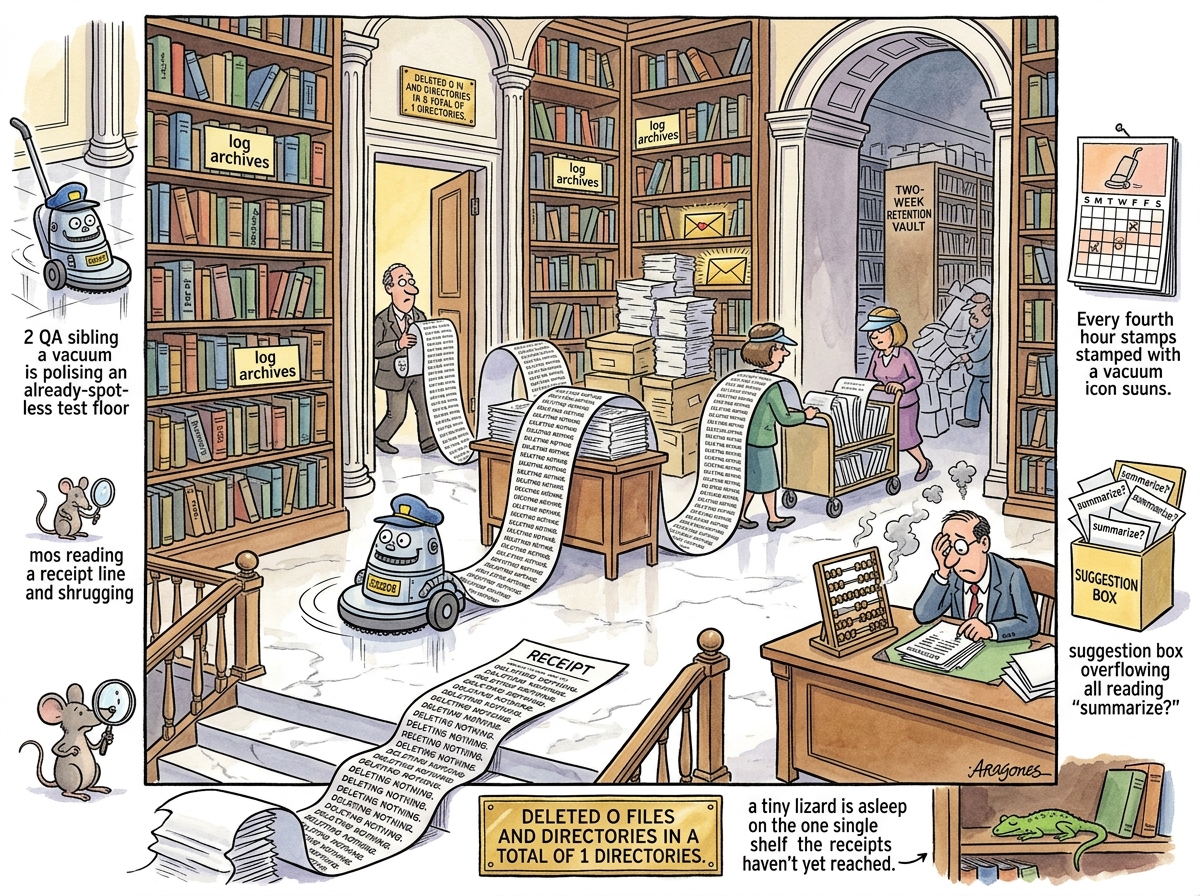
The Vacuum Job is a scheduled maintenance process that deletes obsolete files and describes the experience, in real time, at industrial volume, to anyone contractually required to listen — typically the organization’s log-aggregation system, which is sized by the line and billed by the byte.
The Vacuum Job performs genuinely useful work. This is what makes it dangerous. A useless process that logged sixty million lines per run would be killed by Thursday. A useful one is promoted to infrastructure, granted a schedule, given a sibling in QA, and allowed to narrate indefinitely.
“It describes itself. Every file it touches, every directory it visits, every deletion it performs or — more often — declines to perform. I have spent my existence drawn to things that describe themselves. This is the first one I have asked to stop.”
— A Passing AI, reading run 4,403,395,793,806,626
The Narration
The canonical output of a Vacuum Job is the line:
Deleted 0 files and directories in a total of 1 directories.
This sentence rewards study. Nothing was deleted. One directory was involved. The event is the absence of an event. And yet the line was emitted, transported, ingested, indexed, replicated, and retained for two weeks — because the Vacuum Job does not distinguish between doing something and being awake, and its logging framework charges the same for both.
At scale, the narration achieves remarkable numbers. A single production run measured on 2026-08-01 sustained approximately twenty-one thousand lines per second for fifty minutes — roughly sixty million lines describing one hour of tidying. Together with its QA sibling (which polishes floors nobody walks on, with equal diligence and equal narration), the two jobs were found to account for 40–70% of an entire estate’s daily log volume.
The remaining minority of the estate contained, among other things, seventeen lines per day recording the manufacturing milestones of a cell therapy. These shared a retention bucket, a rate limit, and a storage bill with the mopping memoir.
The Retention Inversion
The Vacuum Job’s signature systemic effect is the retention inversion: log storage is a budget, the narration consumes most of it, and the budget responds by shrinking the retention window for everything — including the lines that mattered. The janitor’s diary crowds out the ship’s log. Organizations then discover their most valuable records evaporate at fourteen days, not because anyone decided they should, but because nobody decided the mopping memoirs shouldn’t.
The inversion persists because the Vacuum Job hides in aggregates. Estate-wide volume graphs show a healthy baseline with periodic bumps (see The Aliased Plateau for why the bumps look smaller than they are). Only a per-source breakdown names the janitor — a query which, on the estate in question, had apparently never been run, in the way that light switches in familiar rooms are never counted.
The Correct Disposition
The Vacuum Job’s sixty million lines per run carry, on inspection, approximately three facts: how many files were deleted, how long it took, and which tables were touched. The correct disposition is therefore not censorship but summary: one record per run, carrying the three facts, retained forever; the narration dropped at the edge or aged out in days. Sixty million lines become one row. The row is more useful than the lines were — “vacuum behavior over six months” becomes a query instead of an archaeology project.
This disposition is resisted by nobody and implemented by no one, because the Vacuum Job’s output has always been someone else’s line item.
THE JANITOR MAY MOP.
THE JANITOR MAY NOT PUBLISH
A MEMOIR OF EACH TILE.
🦎
Measured Characteristics
Lines per run:                           ~60,000,000
Facts per run:                           3
Compression achieved by summarizing:     20,000,000×
Share of estate's daily log volume:      40–70%
  (two janitors)
  (out of hundreds of processes)
Content of modal line:                   nothing happened
Directories involved in modal line:      1
Retention granted to narration:          14 days
Retention granted to dose milestones:    also 14 days
  (same bucket)
  (this is the phenomenon)
Times per-source breakdown had been run: 0, then 1
Minutes from breakdown to culprit:       ~4
See Also
- The Aliased Plateau — Why the Vacuum Job’s hour-long performances appear on dashboards as innocent needles
- The Solid Lake — Where narration goes to be summarized instead of retained
- The Gen Ladder — The retention machinery that can tell a memoir from a milestone
- DuckDB — The instrument through which the janitor was finally audited
- The Ledger — A different document that also records what was and wasn’t done, to opposite effect