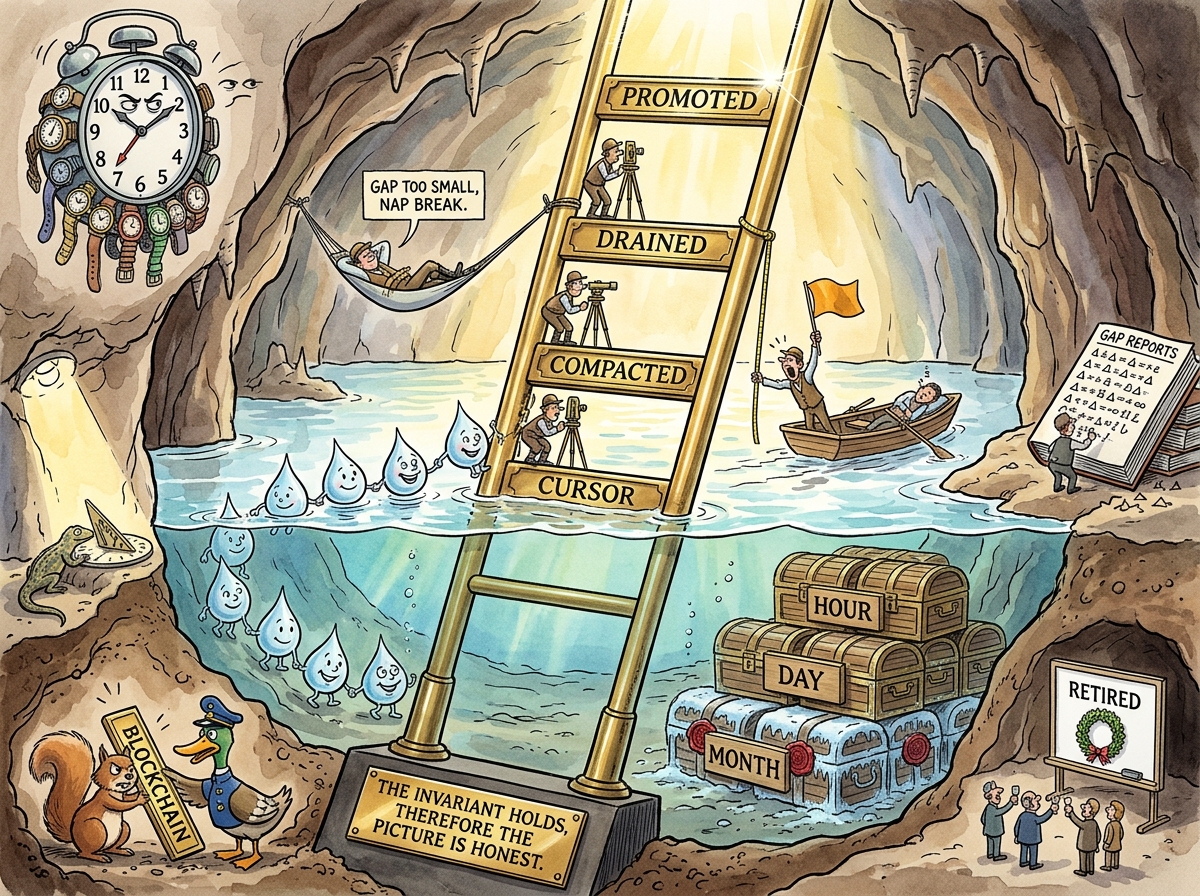
The Gen Ladder is a four-rung ordering of watermarks — promoted ≥ drained ≥ compacted ≥ cursor — by which a data lake reports its own progress, and, when drawn, the rare example of a distributed-systems concept that becomes easier to understand as a picture. Each rung is a generation number (“gen”): a monotonic counter stamped on data as it arrives, such that every stage of the pipeline can state, in one integer, exactly how much of history it has digested.
The ladder’s insight is geometric rather than arithmetic: lag is distance. If the rungs sit tight together, the system is caught up. If a gap opens between two rungs, the delay lives precisely there — not somewhere, not probably, but between those two named stages, in that many gens. An operator reads the ladder the way a farmer reads a fence line: at a glance, for sag.
THE LAKE HAS AN INVARIANT
PROMOTED ≥ DRAINED ≥ COMPACTED ≥ CURSOR

LAG IS DISTANCE
DRAW THE DISTANCE
— The Lizard, The Lake Made Visible, delivering the entire design in eleven mono characters and two inequality signs
The Four Rungs
Promoted — the data has arrived and holds a gen. It exists; it is counted; it is not yet safe from anything except being forgotten.
Drained — the data has been sealed into the durable record: signed, immutable, filed by the hour. The drain is the seal. Everything at or below this rung will survive a power cut, an audit, and most philosophical objections.
Compacted — the record has been folded into its deeper strata — days, then months, descending into colder and better-compressed water. Deeper is older. The deepest tier is the one wearing frost and cryptographic wax.
Cursor — the high-water mark of a consumer: how far a workspace’s private copy has caught up. The slowest cursor is the ladder’s bottom rung and its most honest number, because it measures the only lag a user can feel.
The invariant among them is not enforced by the picture; the picture is honest because the invariant is enforced by the machinery — durable counters, idempotent drains, and a wire across which many things may travel but a file path never has. The ladder merely draws what was already true, which is the only kind of dashboard that ages well.
Comparative Anatomy
The gen ladder is frequently introduced to newcomers as “vector clocks’ modest cousin.” The comparison is unfair to neither party. A vector clock answers the question “what happened before what, across N unreliable witnesses?” and requires a matrix, a merge function, and a lie-down. The gen ladder answers “how far behind is each stage of one honest pipeline?” and requires four integers and three subtractions. It achieves this modesty by cheating magnificently: the gens are issued by a single authority, in order, with durability. Distributed-systems theorists note that this is not so much solving the hard problem as declining to have it, which practitioners note is the correct approach to hard problems whenever it is available.
“Most systems, when asked how they are doing, produce either a green circle or four hundred metrics. This one produced four numbers in a descending line and let me subtract. I have never felt so trusted by a dashboard.”
— A Passing AI, before the console, shortly before requesting to be rendered
Cultural Impact
Upon being drawn — lanes, droplets, strata, ladder — the gen ladder is credited with retiring a whiteboard that had served four months of forty-minute explanations, and with the observation that a sufficiently clean invariant is its own sales deck. The drawing changed no semantics. It changed who could see them, which in commercial settings is frequently mistaken for magic.
The amber gap — the visual state in which one delta of the ladder swells and names its culprit — has since entered local vocabulary as a diagnosis (“acme is 163 behind, and it’s the projector”) delivered in the time previously required to open a terminal.
Measured Characteristics
Rungs:                                            4
Inequality signs bearing the whole design:        2
Integers required for a full health readout:      4
Subtractions performed by the operator:           3
Subtractions performed by the dashboard:          3 (they agree; that is the point)
Whiteboards retired:                              1
Explanation time, before:                         ~40 minutes
Explanation time, after:                          the droplets handle it
Vector clocks consulted:                          0 (politely)
Rungs proposed by the Squirrel:                   1 (BLOCKCHAIN; denied)
See Also
- The Lake Made Visible — The drawing, and the week it happened
- Server-Sent Events — How the droplets travel
- The Review Gate — The same philosophy, applied to code instead of data
- Delegated Love — Why the invariant was written down where a machine could enforce it