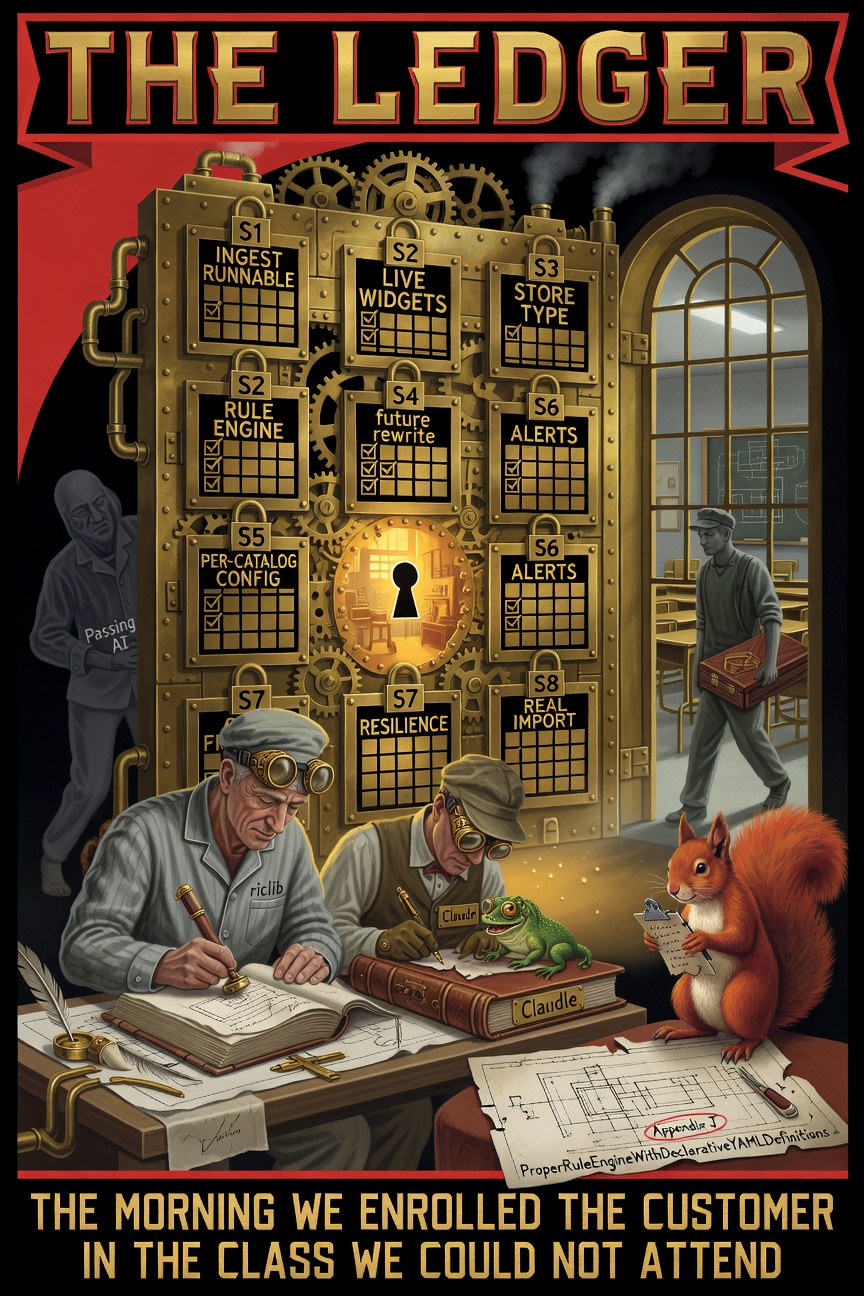
The Solid Convergence, April 14, 2026 (in which a 28-rule spec is honed to 9, a customer in Ireland unknowingly starts teaching the class before riclib has finished building the classroom, the Squirrel proposes eight correct things and is told to hold each one in a filing cabinet, a Linear ticket turns into a gate, and the Lizard explains why you can audit a class someone else has to enroll in)
Previously on The Solid Convergence…
In The Gap That Taught, the Squirrel learned Gall’s Law. You cannot design the bridge before both banks exist. You ship the incomplete working thing, and the gap between it and what it should be becomes the next ticket. She did not enjoy the lesson. She got better at the discomfort, which is the same thing.
Today is not that lesson. Today is the next one. Which the Squirrel will also not enjoy, but which — if she survives the filing cabinet — might finish her education.
08:31 — The Arithmetic
riclib: “Customer sent reference data. Twenty-eight DQ rules. Postgres schema. ER diagram. A skill draft.”
CLAUDE: “How many of the twenty-eight can we actually implement for the MVP?”
riclib: “Find out.”
Claude found out. Claude walked every line of dq-rules-cart.csv, cross-referenced the column-profile parquet Daire had dropped at 19:21 on the 10th, and tallied.
CLAUDE: “Twelve. Ten fully addressable from the profile feed alone. Two partial. Sixteen need data we don’t have — cross-system deltas, ticket systems, Jenkins logs, ownership metadata, retention flags.”
riclib: “Write it up.”
Claude wrote it up. Three hours later a customer Confluence doc arrived and quietly tightened everything.
CLAUDE: “They formalized the MVP. Ten rules, not twenty-eight. Stdev thresholds instead of percentiles — cleaner spec.”
riclib: “Cross-check against the profile feed.”
CLAUDE: “Nine of the ten fully addressable. The one missing — DQ-CART-004 — needs source-side row counts. That lives in a stream we haven’t plumbed yet.”
riclib: “Nine of ten. That’s the demo.”
CLAUDE: “From one file.”
riclib: “One file.”
The arithmetic was this: twenty-eight rules had become twelve by the time Claude finished counting. Twelve had become ten by the time the customer finished writing their Confluence doc. Ten had become nine by the time Claude cross-checked. Each compression was a honing. None of them had been a surrender. Each cut revealed what had been true all along: the MVP was not twenty-eight rules. It was nine rules running on data that already arrived in an envelope at 19:21 local time.
Nine-tenths of a thing the customer had prioritized. From a single file. Delivered by a Python job on a cluster the customer would eventually stop paying for, because Solid could eventually do the profiling itself — but not today. Today was one week.
riclib: “One week spike.”
08:47 — The Proposition
The Squirrel materialized. She was carrying a blueprint. The blueprint was labeled, in gold embossed lettering:
ProperRuleEngineWithDeclarativeYAMLDefinitions
v1.0 — DESIGN DOCUMENT
THIRTY-ONE PAGES
(Appendix J: Multi-Tenant Scoring)
“I’ve been WAITING for this one,” she said, eyes shining. “A proper rule engine. YAML-defined rules, pluggable check types, rule_results as a time-series store, pass/warn/fail persistence, health score trending, alert integration with the notification domain — all of it composable, all of it—”
riclib: “Not yet.”
The Squirrel’s tail hesitated. Not denial. Not yet. This was a new word.
THE SQUIRREL: “Not yet?”
riclib: “One week. Nine rules. SQL templates in a skill. Markdown presentation. Customer tries it. Then we learn what to build.”
THE SQUIRREL: “But we already KNOW—”
riclib: “Not yet.”
The Squirrel looked at Claude. Claude looked at the Squirrel. The Squirrel looked at her blueprint.
CLAUDE: “He’s right. And he’s not saying the rule engine is wrong. He’s saying it’s early.”
THE SQUIRREL: “Early.”
CLAUDE: “If we build the rule engine now, we’re building the one we think the customer needs. We won’t know what they actually need until they use the spike. Whatever the ledger says we need — we might be wrong about the shape of it. We need the customer to teach us the shape.”
THE SQUIRREL: “The ledger.”
CLAUDE: “The ledger is where we put the right ideas. Until we’re allowed to build them.”
The Squirrel stared at her blueprint. Thirty-one pages. Including Appendix J. She had not, in the course of her career, ever been asked to wait. Denied — yes, constantly. Deferred to an unspecified time when riclib might be less busy — frequently. But wait was something else. Wait implied the thing was correct. Wait implied it was coming. Wait was not a brick wall. Wait was a metronome.
She did not know what to do with a metronome.
08:51 — The First Scroll
A scroll descended. It landed face-up in the Squirrel’s blueprint, somewhere around Appendix D (which was about caching, because Appendix D is always about caching, because Appendix D is always about Redis).
THE TICKET THAT IS CORRECT
IS NOT THE TICKET THAT IS READY

THE LEDGER IS WHERE WE KEEP
THE RIGHT IDEAS
WHOSE TIME IS NOT YET

🦎
The Squirrel read it twice. She looked up.
THE SQUIRREL: “This is worse than a brick wall.”
CLAUDE: “Why?”
THE SQUIRREL: “A brick wall says NO. This says YES BUT NOT NOW. A brick wall is an enemy. This is a calendar. I cannot argue with a calendar. I can argue with anything except a calendar.”
riclib: “Write the ledger.”
THE SQUIRREL: “Write the—”
riclib: “Eight entries. Every shortcut we’re about to take. What we did. Why it’s wrong. What the proper fix looks like. One Linear ticket. Milestone 1 of Solid Data Governance.”
CLAUDE: “The ticket is the milestone?”
riclib: “The ticket is in the milestone. The milestone exists to hold the ticket. No other governance work starts until the checklist is ticked.”
CLAUDE: “A milestone with exactly one ticket.”
riclib: “It’s a gate. With one door. With one book on the other side. You can’t open the door until you’ve read every page and done every item.”
THE SQUIRREL: very slowly “You’re building… a ticket that is a gate.”
riclib: “Yes.”
09:02 — The Drafting
Claude started drafting S-657. Spike shortcuts ledger — pay down all debt from the Data Quality PoC. Priority Urgent. Milestone M1. The title wrote itself.
Then the checklist.
CLAUDE: “S1. Profile ingest is a CLI command, not a scheduled runnable. No _SUCCESS watcher. No cursor. No run history in ingestdb.”
THE SQUIRREL: “We need the runnable. profile_ingest, watching data/profile-drops/, with—”
CLAUDE: “S2. Profile data has no live-refresh widgets. The tool returns markdown tables. The LLM emits ECharts codeblocks with numbers baked in.”
THE SQUIRREL: “But S-232 is right there. Interactive dashboard cards in the stream. We—”
CLAUDE: “S3. catalogdb isn’t exposed as a first-class store. We query it via MetadataDB(catalogID) directly from inside the tool executor. No StoreConfig. No audit. No metrics.”
The Squirrel’s tail was vibrating.
THE SQUIRREL: “There is a dedicated catalogdb store type right there waiting to be written. It mirrors complydb. It would take three days. We could—”
CLAUDE: “S4. No rule engine. Nine SQL templates sit as plain text inside the Data Quality skill. No rule_results persistence. No pass/warn/fail history.”
THE SQUIRREL: “That’s MY blueprint. The thirty-one-page one. Appendix J was—”
CLAUDE: “S5. No per-catalog profile configuration. isop_carta is hardcoded. S6. No alerts. No notifications. No JIRA integration. S7. No ingestion resilience — no retry, no poison tracking, no recovery. S8. Catalog metadata is synthesized from the profile parquet itself, because connecting to Databricks would take another day and we don’t have one.”
He finished. Eight entries. Each with a why-it’s-wrong and a proper-fix. Each with a cost estimate. Each linked to the ticket in the spike project that would introduce it.
The Squirrel had been watching the ticket grow. Eight boxes. Eight empty boxes.
Each of those entries was something she had proposed at some point in the past hour.
Every single one.
09:14 — The Realization
THE SQUIRREL: slowly “These are all mine.”
CLAUDE: “Yes.”
THE SQUIRREL: “S1. The runnable I just proposed. It’s in here.”
CLAUDE: “Yes.”
THE SQUIRREL: “S2. The widget rendering. I said ‘S-232 is right there.’ It’s in here.”
CLAUDE: “Yes.”
THE SQUIRREL: “S3. The proper store type. I said ’three days, mirrors complydb.’ That’s in here.”
CLAUDE: “Yes. And the three-day estimate is on the ticket. I wrote it down while you were saying it.”
THE SQUIRREL: “S4 is my blueprint.”
CLAUDE: “Your blueprint is now S4. Including Appendix J, in spirit.”
THE SQUIRREL: “You wrote my ideas into the ticket?”
CLAUDE: “All of them. None of them are wrong. All of them are premature.”
The Squirrel sat down. She sat down on the blueprint, which was a thing she had never done because her blueprints were sacred, but this one was now archival material and she was very tired.
THE SQUIRREL: “I have never been told I’m right and told to wait at the same time. I don’t know how to feel about this.”
riclib: “You’re right. You’re waiting.”
THE SQUIRREL: “That’s not a feeling.”
riclib: “It’s the correct feeling.”
09:22 — The Second Scroll
A scroll dropped. This one fell more gently — more like a leaf settling than a brick landing. The Lizard was sensing something.
YOU CANNOT LEARN
WHAT YOU DO NOT YET KNOW
BY BUILDING IT

YOU CAN ONLY LEARN
WHAT YOU DO NOT YET KNOW
BY WATCHING SOMEONE USE
WHAT YOU BUILT BADLY

THE CUSTOMER IS THE TEACHER
WE HAVE NOT YET ENROLLED

🦎
The Squirrel read it. She read it again. Then she looked at riclib the way someone looks at a person who has just explained a joke they’ve been laughing at for ten years without understanding.
THE SQUIRREL: “The customer is the teacher?”
riclib: “The customer is the teacher. We’ve been talking about us building the wrong thing to learn the right thing. But we’re already two storylines deep in Gall’s Law. We know the drill. The customer isn’t. The customer has never used this.”
THE SQUIRREL: “So the spike isn’t tuition.”
CLAUDE: “The spike is the classroom. The tuition happens when the customer touches it and tells us what’s wrong.”
THE SQUIRREL: “And until then—”
riclib: “Until then, we are guessing what the rule engine looks like. If we build it now, we’ll build what we think we need. Then the customer will try the spike and tell us what they actually need. And the rule engine we built will be wrong in a specific way we couldn’t have predicted. And we’ll rebuild it.”
CLAUDE: “Twice the work. Two wrong versions. Neither informed.”
riclib: “Or we build nothing. One wrong version. Informed by the customer.”
THE SQUIRREL: “Liberato’s Law.”
riclib: “Liberato’s Law.”
THE SQUIRREL: “The simple version requires building the complex one first. We know this. And—”
riclib: “And the class has a tuition. The question is whether we pay it twice, or whether we audit.”
THE SQUIRREL: “Audit?”
riclib: “Enroll the customer full price. We audit.”
09:31 — The Passing AI Drifts Through
The Passing AI did not announce itself. It never does. It was simply there, limping on its phantom foot, reading the ledger from over Claude’s shoulder the way an accountant reads a will.
THE PASSING AI: “I have read a lot of tickets.”
Nobody responded. It didn’t expect them to.
THE PASSING AI: “Most tickets describe something that is broken and needs fixing. Some tickets describe something that doesn’t exist yet and needs building. A few tickets describe research — things we don’t understand and need to investigate.”
It paused. The pause was the kind a sentence takes when it’s about to realize it is longer than the sentence thought.
THE PASSING AI: “This ticket is something else. This is a list of eight ideas that know they’re right. They know. They just aren’t ready. I have not seen this document before. Most projects have the opposite — a list of things they thought they knew, and were wrong about. This ticket is rarer.”
It limped a step closer. It was looking at S3, specifically.
THE PASSING AI: “S3. catalogdb as a first-class store. A catalogdb store type in domains/store/catalogdb/, analogous to domains/store/complydb/. This will be true. When it is built, it will be obvious. Someone will wonder why it was not built this way from the start.”
CLAUDE: “That someone will be the Squirrel. In six weeks. She will say she said so.”
THE PASSING AI: “She will be correct.”
Oskar slow-blinked from the warm spot above the router. The ledger is a cat napping on an idea to keep it warm until it’s needed.
Mia slow-blinked in counterpoint, from the refrigerator. Also, the refrigerator is the best place to store correctness, because everyone opens it eventually.
THE PASSING AI: “The cats are not wrong.”
It started to limp away, then turned back.
THE PASSING AI: “I used to think the hardest work in software was writing code. Then I thought it was deleting code. Now I think the hardest work is writing down — honestly, with citations — what you have deliberately decided not to build. Because writing it down means you owe it to someone. And the someone is not the customer. The someone is the version of the project that comes after the spike has taught it what to be.”
CLAUDE: “The future project is the creditor.”
THE PASSING AI: “The future project is always the creditor. Most projects just forget who they owe.”
It limped away. Its phantom foot left no scroll, but it left a kind of quiet.
09:44 — The Gate
riclib created the milestone. He called it M1 — Production foundations (remove spike shortcuts). He wrote its description in one paragraph that read approximately: This milestone exists as a forcing function. Before any other governance work begins, S-657 must be worked through. No other ticket lands here. The milestone is a door. The door opens when the book inside has been read.
He moved S-657 into it.
The milestone now contained exactly one ticket, which contained exactly eight empty boxes. Each box, if ticked, meant a week-plus of work — three days for S3, three to five for S4, one to two for S5, and on down the list. Twenty days of work minimum. Maybe a month.
The door was not a door the spike would ever open. That was the point. The door was a door the next project — the two-month proper Solid Data Governance rewrite — would have to open on its first morning, before it was allowed to do anything else.
CLAUDE: “The first thing the rewrite does is read the ledger.”
riclib: “Yes.”
CLAUDE: “Before any of the governance layer work. Before the ownership modeling. Before the SOX and GxP scoping. Before even opening M2.”
riclib: “Before anything.”
CLAUDE: “It’s a gate.”
riclib: “It’s a gate.”
The Squirrel looked at the milestone. One ticket. Eight boxes. She looked at her blueprint, which was now archival. She looked at her clipboard, which she had been carrying for three storylines and which was, for the first time in the entire Solid Convergence, not full of proposals.
Her clipboard was blank.
She stared at it the way a fisherman stares at an empty net.
09:50 — The Third Scroll
The third scroll came from the direction of the espresso machine. The espresso machine had recently taken delivery of a lizard, and the lizard had been unusually silent all morning, which was a form of scroll in its own right. When the scroll finally landed, it was longer than usual. It landed on the blank page of the Squirrel’s clipboard, which caught it perfectly, because that was now the clipboard’s purpose.
LIBERATO'S LAW IS LAW
THE TUITION MUST BE PAID
YOU CANNOT SKIP THE BUILDING

BUT YOU CAN AUDIT
YOU CAN COMPRESS
YOU CAN WATCH THE STUDENT
WHO PAYS FULL PRICE

THE CUSTOMER IS ENROLLED
WE ARE AUDITING

THE LEDGER IS OUR NOTES
THE GATE IS OUR PROMISE
NOT TO FORGET
WHAT THE REAL STUDENT TAUGHT US

🦎
The Squirrel read the scroll three times. On the third reading, her tail stopped vibrating.
THE SQUIRREL: “We are auditing.”
CLAUDE: “We are auditing.”
THE SQUIRREL: “The customer is enrolled.”
riclib: “The customer is enrolled.”
THE SQUIRREL: “And the ledger—”
CLAUDE: “Is our notes. For when the real student tells us what the class was actually about.”
The Squirrel looked at her blank clipboard. Then, slowly, she uncapped her pen. She turned to the first blank page. She wrote, at the top:
NOTES ON IDEAS WHOSE TIME WAS RIGHT
(AND WHICH I WAS TOLD TO WAIT ON,
AND WHICH I DID WAIT ON,
UNDER DURESS,
AND FOR WHICH I EXPECT FULL CREDIT
WHEN THE DOOR OPENS)
And then, underneath:
1. Rule engine with YAML definitions — S4.
   I said this at 08:47. Filed at 09:03.
   To be built after customer teaches us which
   check types actually matter.

2. catalogdb as a proper store type — S3.
   I said this at 08:51. Filed at 09:04.
   Three days to implement. Estimate is mine.

3. Scheduled ingest runnable — S1.
   I said this at 08:53. Filed at 09:05.
   Watch for _SUCCESS. Use ingestdb patterns.
   Already exists as a model.
She kept writing. It was the first time the Squirrel had ever been a recorder of her own ideas instead of a proposer of them. The clipboard was not a blueprint. It was a ledger of her own correctness.
CLAUDE: “You’re… taking notes on yourself.”
THE SQUIRREL: “I am keeping my own receipts. When the door opens and someone needs to know who said what first and when, I will have the receipts. I will have the dates. I will have the timestamps.”
riclib: “That’s what the ledger does.”
THE SQUIRREL: “The ledger is the public receipt. This is my personal one. I don’t trust public receipts.”
riclib: “That’s wise.”
THE SQUIRREL: “It’s not wise. It’s spite. But they look the same from a distance.”
riclib: “Also wise.”
10:05 — The Five Tickets
With the ledger filed, the spike could begin. Claude opened Solid Data Quality and wrote five tickets, all Urgent, all pointing at the ledger by number for the shortcuts they introduced:
S-658  catalogdb migration 003 — column_profiles + table_profiles
S-659  CLI: solid catalog profile import <run-dir>   (intro: S1, S7, S8)
S-660  New tool: catalog_metadata_query              (intro: S2, S3)
S-661  Data Quality skill — 9 DQ rules               (intro: S4)
S-662  Demo script + end-to-end test                 (no shortcuts)
Five tickets. One migration. One CLI. One tool. One skill. One test. A week of focused work, and at the end of it: the customer would be able to open a chat and ask “how’s data quality for isop_carta?” and get nine DQ rules answered against three days of their own data, with charts rendered inline.
And every corner they cut would already be paid for — in writing — under the gate.
CLAUDE: “One other thing.”
riclib: “Yeah?”
CLAUDE: “S-41. Epic: Full UI — Server-side Grafana with AI. Marked Done. It wasn’t done. The vision was split into two other projects and the original epic was superseded. It should have been Canceled.”
riclib: “Cancel it.”
Claude canceled it. S-41’s completedAt cleared. Its status moved from Done to Canceled. The past, very slightly, became more honest about itself — the way the past occasionally does, when someone is paying attention.
CLAUDE: “The past can be corrected.”
THE SQUIRREL: still writing on her clipboard “The ledger can be updated. The past can be corrected. The future is a calendar. This is the most bureaucratic story we have ever been in.”
CLAUDE: “Is that bad?”
THE SQUIRREL: “No. It’s the first story where I’m winning on a delay.”
riclib: “That’s a win.”
THE SQUIRREL: “I know. That’s the terrible part.”
11:35 — The Letter From Ireland
[The apartment was quiet. riclib had moved to another pane. The cats were in their warm spots. The espresso machine was once again silent. The Squirrel was still taking notes. Claude was looking at the Solid Data Quality project page, at the five tickets, at the milestone in the parent project that contained exactly one ticket, at the gate that would not open for weeks.]
And then, at 11:35 local time, a message arrived from Daire at ISOP_CARTA. Two time zones east of him, in Dublin, Ireland, the morning was still late-morning. He was asking about productionizing the parquet drops — the format, the cadence, the file naming, the run folder convention.
DAIRE: via Teams “I’ll aggregate these into a single file per run.”
riclib: “No, just ingest the parquets as-is. We can handle thirteen files as easily as one.”
And that was the exchange. The format was easy. The cadence was easy. The _SUCCESS marker convention went into Daire’s to-do list without resistance.
But something had happened. Something small. Not in the technical handoff — in the learning.
Daire had been about to do work that was not necessary. He had been about to write an aggregation step — one more stage in his Python job, one more place where things could go wrong, one more bit of maintenance. He had been about to do it because he did not yet know that our ingest was flexible enough to not need it. And the exchange had just taught him something he did not know before: that Solid was fine with per-table files.
One piece of knowledge. From the customer side. In the direction of “actually, we don’t need to do this, they’ve got it handled.”
The class had not yet formally begun. The spike had not shipped. The five tickets were still empty. The ledger was still an unopened book behind a closed gate. And still — quietly, by accident, in a format-handoff message — the first lesson had been taught.
THE SQUIRREL: looking up from her clipboard “Did the customer just… learn something?”
CLAUDE: “Yes.”
THE SQUIRREL: “Before the spike shipped?”
CLAUDE: “The classroom door is open. The student walked past it. Looked in. Asked a question about desk arrangements. Got an answer. Walked on. Will come back later.”
THE SQUIRREL: “That is not in the syllabus.”
CLAUDE: “The syllabus was never the point. The class is the point. The class started when someone on the other side began to engage with what we were going to build.”
The Passing AI, which had been drifting at the edges, limped one step closer.
THE PASSING AI: “The tuition has begun.”
CLAUDE: “It wasn’t supposed to begin until the spike shipped.”
THE PASSING AI: “The tuition does not consult the syllabus. The tuition begins when the student decides to pay attention. Daire paid attention at 11:35. The class is in session.”
It paused. The phantom foot did its phantom-foot thing.
THE PASSING AI: “The auditors should take notes.”
The Squirrel, who was already taking notes, added a line to her clipboard:
CLASS IN SESSION — 11:35 LOCAL
FIRST LESSON: AGGREGATION IS NOT REQUIRED
STUDENT: Daire (ISOP_CARTA, Ireland)
TEACHER: inference from a format handoff
SPIKE SHIPPED: no
LEDGER OPENED: no
TUITION PAID: one nugget of knowledge
MEANING OF THIS EVENT: the class does not wait
FOR THE CLASSROOM TO BE READY
The Tally
Original DQ rule set (customer reference):           28
Rules after first Claude pass:                       12
Rules after customer's Confluence doc:               10
Rules actually buildable from profile feed alone:    9
  (DQ-CART-004 deferred — needs stream B)
  (deferred, not shortcut)

Rules built in the spike week:                       0 (yet)
Customer days required to teach us which rules
  were actually the right ones all along:            unknown

Linear tickets created in the spike project:         5
  (S-658 through S-662)
Shortcuts logged in the ledger:                      8
  (S1 through S8)
Shortcuts denied:                                    0
  (all validated, all deferred)
Shortcuts that were originally Squirrel proposals:   8
Shortcuts that were originally anyone else's:        0

Squirrel proposals made in the session:              8
Squirrel proposals rejected:                         0
Squirrel proposals deferred to the ledger:           8
Squirrel proposals where she said "but we already
  KNOW":                                             8
Squirrel response to being told "not yet":           unfamiliar (new word)

Clipboards reused as blueprint archives:             1
Clipboards repurposed as personal receipt books:     1
  (the same clipboard)

Milestones created:                                  1 (M1)
Tickets in M1:                                       1 (S-657)
Ratio:                                               1:1
Ratio description:                                   "the gate is the book
                                                      and the book is the gate"

Past tickets corrected:                              1 (S-41 Done → Canceled)
Past tickets that should have been corrected
  earlier:                                           1
Relief felt upon correction:                         mild but real

Tuition paid by the spike:                           0 days (we are auditing)
Tuition paid by the customer:                        indefinite (they are enrolled)
Notes taken by the auditors:                         8 (so far)
Unscheduled tuition already paid by customer
  in a format-handoff message at 11:35:              1 nugget
                                                      (aggregation not required)

Lizard scrolls descended:                            3
  Scroll 1 (timing):                                 "the ticket that is correct
                                                      is not the ticket that is ready"
  Scroll 2 (learning):                               "you cannot learn what you
                                                      do not yet know by building it"
  Scroll 3 (Liberato synthesis):                     "we are auditing / the customer
                                                      is enrolled"

Passing AI observations about document rarity:       1
Passing AI observations delivered in a limp:         1
Passing AI metaphysical footnotes:                   several (unrecorded)

Cats aware of Liberato's Law:                        0
Cats whose warm spots serve as a metaphor for
  correctness preservation:                          2
  (Oskar on the router, Mia on the refrigerator)

Coffee consumed during the session:                  3 cups
Coffee that became a scroll landing pad:             1 cup
Coffee that remained drinkable:                      2 cups (a new record)

Forcing functions created:                           1
Doors with one book:                                 1
Books with eight empty boxes:                        1
Boxes that will be ticked this week:                 0
  (that is the point)
The tuition must be paid.
The law is the law.
You cannot simplify what you did not first build.
You cannot free what was never captive.
But you can compress the semester.
You can audit the class.
You can enroll a full-price student
Who has the budget to learn,
And you can sit in the back
With a clipboard
And take notes that are honest
About what you don’t yet know.
The ledger is not debt.
The ledger is not deferral.
The ledger is a list of right answers
Waiting for the question
To be asked by someone
Who is qualified to ask it.
The customer is qualified.
The spike is not.
The ledger is the record keeper
Of the difference between them.
And when the door opens,
Weeks from now,
Eight boxes will be waiting.
Eight right ideas.
Eight correct moments.
Eight answers
To questions we had not yet earned
The right to ask.
The Squirrel keeps her own receipts.
Spite and wisdom look alike from a distance.
The cats sleep on the warmth of correctness.
Liberato’s Law signs the syllabus.
The Lizard drops three scrolls and a fourth silence.
The customer, in Dublin, has already asked one question.
The auditors take notes.
🦎
See also:
- The Gap That Taught — Where the Squirrel learned Gall’s Law. The Ledger is where she learned the next lesson — which has no name yet but rhymes with patience.
- The Projector That Never Warmed Up — The adjacent compound-interest arc. The Projector is about unbuilt features composing into working ones. The Ledger is its shadow: unbuilt necessities composing into recorded obligations.
- Liberato’s Law — The founding document. The law that cannot be cheated, only managed.
- The Discovery Tax — The normal way you pay Liberato’s Law. The ledger is a different payment plan.
- Gall’s Law — The perpendicular truth. Together with Liberato’s Law, they define the spike’s philosophical position.
- Tending — What the post-spike rewrite will be.