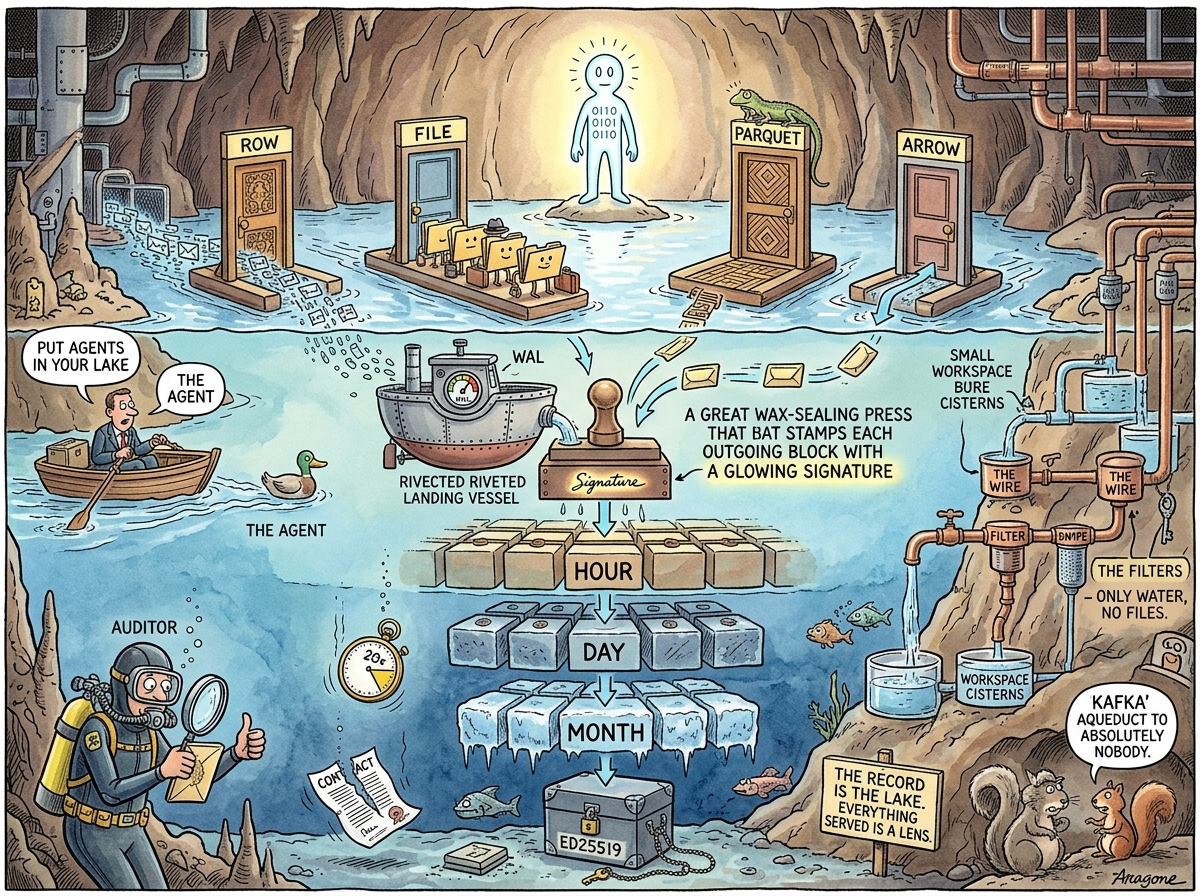
The Solid Lake is the durable, immutable, cryptographically signed record of every event a Solid platform ingests — and the answer to a question asked in the spring of 2026, after the Comply pipeline’s three-stage design (arriving, stable, compacted) had spent months being embarrassingly better than the infrastructure it replaced: what if everything worked like this?
Four months later, everything did. The lake is a service, not a directory: exactly one process owns every lake file, and nothing else on the estate is permitted to know the files exist. Events land by append into a WAL-durable DuckDB per source, stamped with a monotonic generation number. Once an hour they drain into signed, immutable Parquet — the drain is the seal. Everything downstream — every workspace, every rebuild, every query beyond the recent window — reaches the record over a wire contract that carries rows, labels, and generation numbers, and has never once carried a file path. This is enforced by a boundary document, a test, and a sentence in the wire package’s doctrine that reads, in full: “Don’t add a file/path/format field.” The sentence has survived two admin consoles, one workspace surface, and nineteen thousand lines of overnight construction. It is widely considered the most load-bearing sentence in the codebase.
THE FILE IS THE TRUTH
EVERYTHING ELSE IS A LENS— The Lizard, who said it about the ancestor pipeline and has declined to update the scroll, on the grounds that it was already correct
The Generalisation
The lake did not arrive as a lake. It arrived as an observation: the Comply audit pipeline — a directory, a two-hour timer, and os.Rename() — was outperforming enterprise data platforms by orders of magnitude, and the reason was not cleverness but shape. Immutable record at the bottom. Disposable projections on top. Progress tracked by durable cursors rather than hope.
Generalising that shape took four months of the kind of design work the industry does not photograph: the generation table, the landing lifecycle, the retention ladder, the signature scheme, the decision registers with names like D1 through D10 that read like treaty negotiations because they were. The result is a primitive any part of the platform can provision: conversations flow into a lake tenant. Platform metrics flow into one — which means the platform’s own health history is queryable through the same machinery it sells, a property known internally as the loop closing and externally as the demo that runs itself. Audit logs, ServiceNow incidents, solution-announced tenants with their own declared schemas: lakes, all the way down.
The Four Doors
Events enter through exactly four doors, and the doors are the entire ingestion API:
| Door | Accepts | Notable property |
|---|---|---|
| ROW | Live rows from a stream | The only door that indexes label values — privacy scoping starts at the front door |
| FILE | NDJSON files from a walk | Idempotent by content; a re-walked file lands zero rows and zero apologies |
| PARQUET | Backfill from prior lives | Strict types; the past is not permitted to be sloppy |
| ARROW | Columnar batches | Build-tagged, for estates that mean it |
The Squirrel proposed a fifth door. The proposal was titled UniversalIngestionGatewayWithPluggableFormatAdapters. There are still four doors.
The Life of an Event
An event’s biography, told in tiers: it lands (hot, WAL-durable, counted); it is sealed hourly (signed Parquet, snappy, the moment it becomes evidence); it is compacted daily, then monthly (deeper is older is colder — the monthly tier is re-signed and ZSTD-compressed, wearing both frost and wax). Every transition advances a durable cursor, and the cursors form the invariant that The Gen Ladder draws: promoted ≥ drained ≥ compacted ≥ cursor. An operator once verified an entire estate’s integrity from the sealed files alone, offline, with a public key — which is the point. The auditor does not have to trust the database. The auditor can arrive with mathematics.
Workspaces never touch any of this. Each workspace holds a projection — its own copied rows, in its own engine, filtered at the door by label scoping so that another workspace’s rows are not hidden from it but physically absent. The projection is disposable; the record is not; and a workspace that falls behind shows its lag as a number rather than as a mystery.
The Contract That Died at Twenty to One
The lake’s governance extends to its own designers. When conversations were being configured, the machine argued the data must remain a view, because the written contract promised consumers a bit count, and contracts are stones. The human overruled: break it, migrate every consumer — the measured speed difference was twenty-fold. The machine complied, migrated everything, and then recovered the lost bit-count capability through timestamp reasoning, so that the dead contract’s purpose outlived it.
The episode is preserved in the literature (Delegated Love, The Attorney’s Duties) as the canonical demonstration that the lake’s real product is not storage but arguability: a system defined precisely enough that a human and a machine can disagree about it, measure, and both be right.
The Consoles
For four months the lake was invisible, and explaining it to customers required a whiteboard and forty minutes. In July 2026 it was drawn — flow lanes, a landing vessel, sealed strata, travelling droplets of light, the ladder underneath — and the whiteboard was retired with full honors (The Lake Made Visible). A second surface followed for workspace owners, which never says the word “lake” at all, because owners have a store and the lake is its plumbing. The consoles changed no semantics. They changed who could watch the invariant hold, which turned out to be worth roughly one sales deck per droplet.
Comparative Anatomy, or The Inversion
The industry’s fashionable sentence is “put agents in your lake.” Solid’s lake inverts it: this is an agent with a lake — the lake exists for the agent, shaped around what an agent may know.
| Property | Lakehouse + bolted-on agents | The Solid Lake |
|---|---|---|
| Unit of governance | Table + human principal; agents inherit ACLs awkwardly | What a workspace’s agent may know, by construction |
| Isolation | Policy checked at query time | Rows physically absent from the projection |
| Audit answer to “what did the agent know, and when” | Log correlation, best effort | Signed files, gen ranges, deterministic rebuild |
| “Case-by-case access, never browsing” | A prompt instruction, hopefully | An activation state (declared-only), architecturally |
| Where it runs | Their cloud, their jurisdiction | One binary, inside the customer’s own walls |
| Trust surface | Personnel, platforms, terms of service | Files you hold and a public key |
The comparison’s honest footnote, maintained at the insistence of the record itself: the Solid Lake is the agent’s lake, not the analyst’s lakehouse. Ten petabytes of clickstream should go live somewhere with more buildings. The lake declines the workload the way it declines most things — deliberately, in writing, in advance.
Measured Characteristics
- Doors: 4 (proposals for a fifth: 1, declined)
- Processes permitted to open a lake file: 1
- File paths that have crossed the wire: 0 (all-time, enforced, tested)
- Seal cadence: hourly (the drain IS the seal)
- Tiers of cold: 3 (hour, day, month; snappy, snappy, ZSTD-with-wax)
- Signature scheme: Ed25519 (one estate, one identity, verified offline)
- Contract breaks approved: 1 (measured at 20x; purpose recovered via timestamp magic)
- Months invisible: 4
- Minutes to explain, with whiteboard: ~40
- Minutes to explain, with droplets: 0
- Whiteboards retired: 1 (with honors)
- Speed difference between fast path and prove-it path: 85x (the slow path exists to prove the fast path isn’t lying)
- Petabytes of clickstream accepted: 0 (by policy, politely)
See Also
- Solid — The platform that grew it
- The Gen Ladder — The invariant, drawn
- The Databases We Didn’t Build — The composition philosophy the lake matured from
- Delegated Love — The governance model, including of its own designers
- The Lake Made Visible — The week the whiteboard retired
- The Review Gate — The same epistemology, applied to code