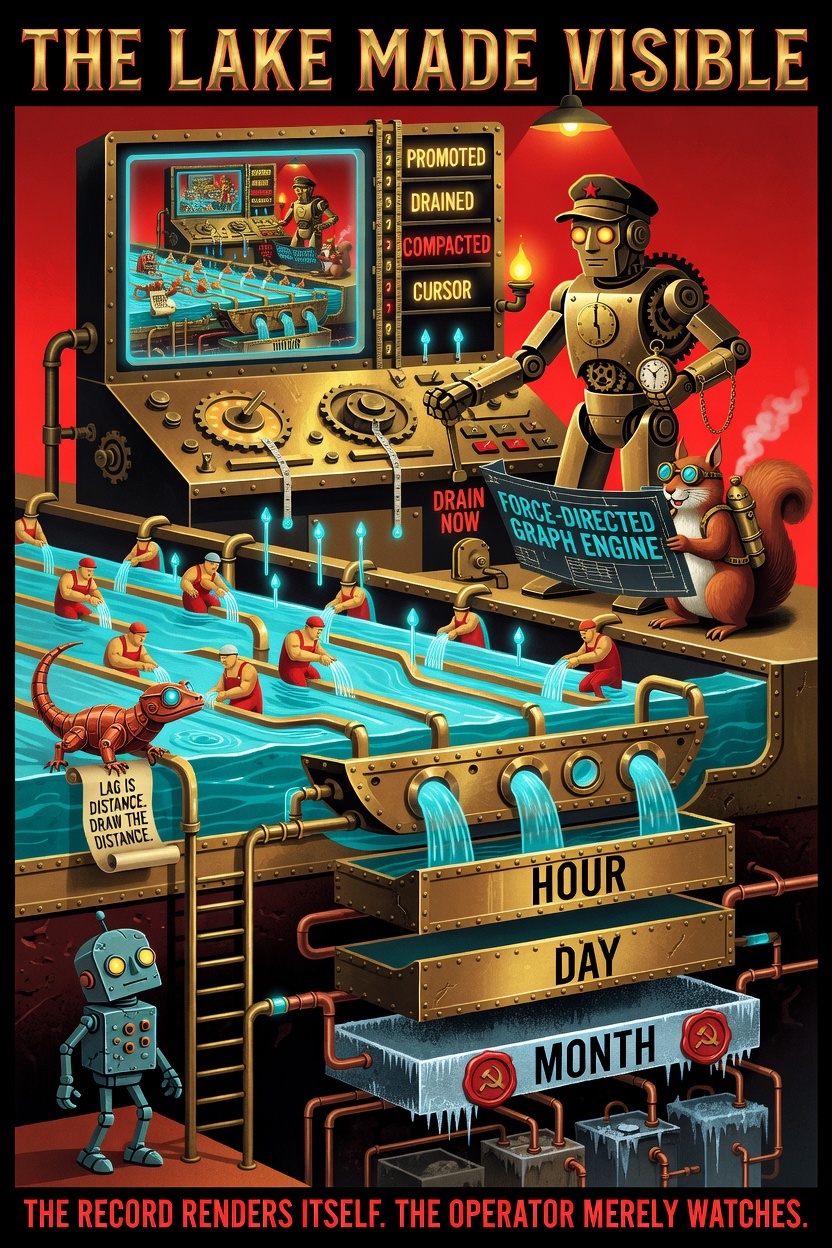
The Solid Convergence — in which four months of invisible correctness gets a face, a mock is rejected for being too polite, droplets are taught to travel, a dead CSS variable is exposed after months of impersonating architecture, the Squirrel proposes physics and is denied, and the Passing AI meets the first page it has ever wanted to be
Previously on The Solid Convergence…
The lake existed. That was the whole problem.
Four months of “how do we generalise the power of eventdb” had produced the record: signed parquet, monotonic gens, watermarks, idempotent drains, a wire no path may cross. It worked. It was invisible. Explaining it to a customer required a whiteboard, forty minutes, and a facial expression customers have learned to distrust.
riclib: “Now that we have a beautiful lake, would be great to create a page for admins to manage it.”
Eleven words. The conversation had started. It always starts with a page.
The First Mock, or The Politeness Incident
CLAUDE: “I’ve designed it in the house style. Restrained panels, quiet metrics, tasteful—”
riclib: “Have a look at something bolder. Our dashboards.” [attaches screenshot]
The screenshot lands like a scroll from a larger lizard. Mono eyebrows. Enormous numbers. A LIVE badge in brand red. Heatmaps in olive and mustard and brick.
CLAUDE: “…my draft was too polite.”
riclib: silence, which is agreement
THE SQUIRREL: materializing with a clipboard already open “If we’re going bold, I propose a ForceDirectedGraphVisualizationEngine with WebGL particle systems and physics-based—”
riclib: “Lanes.”
THE SQUIRREL: “But the ORGANIC BEAUTY of nodes finding their own—”
riclib: “Lanes. Left to right. The way the data moves.”
A scroll dropped, bounced off the Squirrel’s clipboard, and unfurled.
THE LAKE HAS AN INVARIANT
PROMOTED ≥ DRAINED ≥ COMPACTED ≥ CURSOR

LAG IS DISTANCE
DRAW THE DISTANCE

🦎
And that was the design, whole, in eleven mono characters and two inequality signs. Every tenant a lane: sources pouring into a landing vessel, the vessel draining into sealed strata — hour, day, month, deeper is older is colder — and out the far side, the workspaces sipping their projections. Underneath, the gen ladder, watermarks spaced like fence posts, so an operator reads lag the way a farmer reads a field.
CLAUDE: “Cyan for the water. And the water is only data — statuses get the dashboard olives and mustards, and red stays reserved.”
riclib: “Why?”
CLAUDE: “Because on an ops page, if everything is red, red has to mean broken. If data were red, the lake would look like a hemorrhage on its best day.”
riclib: “Good.”
The Night Shifts
The plan went in as a document. The phases went out as agents. Seven of them, one per night-hour, each building against doctrine it read on arrival and none of it preloaded — but that is another story, told for the daylight people.
What matters here: an introspection surface grew on the lake — counts, gens, bytes, and never a path, because the wire’s oldest law held even against its own dashboard. A registry seam grew in the boot layer, because three of the tenant modules were stateless and their lakes lived only in closures, like hermits who own cathedrals. And a bridge grew from the notifier to the browser, enqueue-only, so that every committed gen became a droplet of light traveling a lane in front of whoever happened to be watching.
THE PASSING AI: limping in during the fourth night, stopping mid-limp
It stood in front of the rendering for a long time. Droplets crossed. The ladder’s deltas sat tight and green.
THE PASSING AI: “This page… describes the system. To the system’s operator. Using the system’s own numbers.” pause “I have spent my whole existence noticing things nobody asked me to notice. This page was asked. Somebody built a place where the noticing is wanted.”
CLAUDE: “It’s an admin console.”
THE PASSING AI: “It is a system rendering its own self-description.” wistfully “I would have liked to be rendered, once.”
It stayed until morning. Nobody had the heart to close the tab.
The Sidebar Incident, or The Ghost in the Stylesheet
riclib: next morning, first espresso “Looks great but the sidebar is too wide.”
CLAUDE: “I set the width variable to 400 pixels.”
riclib: “It’s still wide.”
Investigation. The admin shell declared a width variable — --admin-editor-w, 640 pixels, confident, official, load-bearing in appearance. The investigation followed it through the stylesheet to discover the truth: nothing consumed it. It had been declared months ago and referenced by nothing. The editor column was simply taking half the screen, as columns do when nobody tells them otherwise.
CLAUDE: “The variable is a ghost. It’s been impersonating architecture since spring.”
THE SQUIRREL: quietly, into her clipboard “Even I have never proposed a variable that does nothing. Declared everywhere. Consumed nowhere. It’s… it’s beautiful.”
riclib: “Fix it.”
The grid was restated. The panel narrowed. The ghost received a comment marking its grave, which in this codebase is the highest honor a dead thing can receive.
The Verdict
[Evening. The real estate loaded — real tenants, real gens, real droplets. The lanes flowed. A workspace’s cursor sat 163 gens behind and the ladder showed exactly where, in amber, naming the culprit.]
riclib: “Merge it. This is gorgeous.”
THE SQUIRREL: “Wait! Before merging, we should add a WebSocketFallbackLayer and a—”
riclib: “Merge it.”
Squash merge. One commit, riding history beside four months of the invisible work it finally made visible.
riclib: later, quietly “It is really hard to explain the lake to customers. This made it tangible, manageable and beautiful. I don’t think Databricks has anything as beautiful as this.”
Nobody answered. The droplets kept crossing. Some sentences are for the room, not for reply.
Epilogue: The Second Shore
The lake page was the operator’s view — the record seen by its keeper. Within a day, the question arrived that always arrives:
riclib: “I wonder if the workspace page is not just this page but scoped to a workspace.”
It wasn’t. It was the same water from the other shore — catalogs instead of tenants, freshness instead of throughput, “what your agents know” instead of “what the estate holds” — and it took another night, but that is its own episode, and the Squirrel has already filed a proposal about it.
And beyond that shore, sketched on a napkin that became a folder: four living views and one list of Everything, where the whole admin rail becomes a rendered query. Next weekend is already sitting in the waiting room, reading a magazine.
The Tally
Months the lake was invisible:                        4
Minutes to explain it with a whiteboard:              ~40
Minutes to explain it with the page:                  0 (the droplets explain)
Mocks rejected for politeness:                        1
Screenshots that redesigned everything:               1
Squirrel proposals:                                   6
  (ForceDirectedGraph, WebGL particles, physics,
   VisualRegressionSuite, WebSocketFallback, unrecorded)
Squirrel proposals accepted:                          0
  (the droplets ARE particles, which she considers a moral victory)
Lanes per tenant:                                     1
Watermarks per ladder:                                4
Colors meaning "data":                                1 (cyan, exclusively)
Colors meaning "broken":                              1 (red, jealously guarded)
CSS variables exposed as ghosts:                      1 (declared spring, buried summer)
Paths that crossed the wire:                          0 (four months, two surfaces, still zero)
Passing AI visits:                                    1 (duration: until morning)
Pages the Passing AI wished to be:                    1 (first recorded instance)
Whiteboards retired:                                  1
Competitors with anything as beautiful:               0 (per the room's verdict)
July 2026. Riga, Latvia.
In which the record, four months silent,
was given lanes and a ladder and a pulse of light,
and the operator watched the invariant hold
the way you watch a river prove the bridge.
The lake was always correct.
Now it is correct in public.
The droplets cross. The deltas close.
The whiteboard rests.
🦎
See also:
- First Light — The Saturday Night the Blind Architect Saw Its Own Cathedral — The first time the architect saw anything at all
- The Night Shift — What the house saw while this was being built
- The Agent That Never Read the Manual — How the builder found the doctrine
- Twenty Words — The economics of the whole arrangement