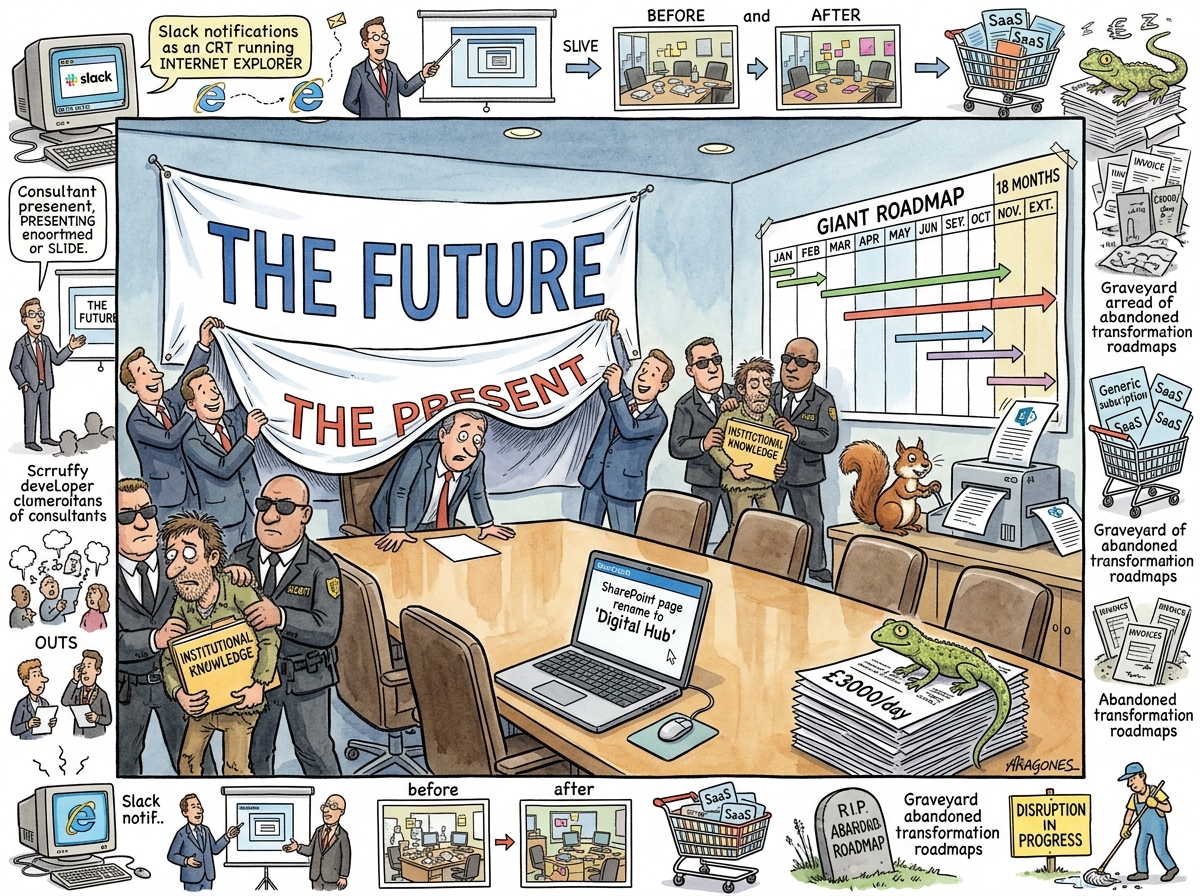
Digital Transformation is the process by which an organisation that already uses computers hires an external consultancy to tell it that it should use computers. The transformation is rarely digital. It is never transformative. It is, in most documented cases, a PowerPoint presentation about a PowerPoint presentation, delivered to people who will summarise it in a PowerPoint presentation.
The global digital transformation market is valued at approximately $1.3 trillion, making it one of the largest industries ever built on a product that nobody can define. This is not a coincidence. It is the business model.
“I once asked a room of twelve executives to define digital transformation. I received fourteen definitions. Two people changed their answer mid-sentence.”
— riclib, during a consulting engagement that billed for the full hour
Definition
Digital Transformation has no agreed-upon definition. This is documented. It is also, upon closer inspection, the entire point.
Gartner defines it as “the process of exploiting digital technologies to create new — or modify existing — business processes.” McKinsey defines it as “the rewiring of an organisation, with the goal of creating value by continuously deploying technology at scale.” Forrester defines it as something slightly different from both, using longer words. The Caffeinated Squirrel defines it as “doing things with computers that you were already doing with computers, but calling it a journey.”
The absence of a stable definition is not a failure of the industry. It is the industry’s most important structural feature. A well-defined product can be evaluated. An ill-defined product can only be trusted. Trust is purchased in six-month increments, renewable upon the discovery that the transformation is not yet complete. The transformation is never complete. Completion would end the engagement.
“Ambiguity is billable. Clarity is a thirty-minute conversation. Ambiguity is an eighteen-month engagement.”
— A Senior Partner, overheard in a lift, attributed to every consultancy simultaneously
The Consulting Industrial Complex
Digital Transformation is sustained by an ecosystem of consultancies, system integrators, and technology vendors whose relationship to the client is best described as symbiotic in the way that a barnacle’s relationship to a whale is symbiotic: one party moves forward, the other party feeds.
The process begins with the Discovery Phase, in which the consultancy audits the client’s existing systems and produces a document — typically between eighty and three hundred pages — explaining that the client’s existing systems exist. This document is called an As-Is Assessment. It costs between £150,000 and £2 million, depending on how many diagrams of things the client already knew are included. The diagrams are in blue. They are always in blue.
The Discovery Phase is followed by the Strategy Phase, in which the consultancy produces a second document describing what the client’s systems should look like. This is called the To-Be Architecture. It looks remarkably like the As-Is Architecture but with cloud icons and the word “AI” in several places where the word “database” used to be. This document costs more than the first document, because hope is more expensive than inventory.
The Strategy Phase is followed by the Execution Phase, which is where the money truly begins to move. The Execution Phase is described in the next section.
“The consultancy produces the map. The client pays for the map. The consultancy is then hired to navigate by the map. The consultancy is then hired to redraw the map when the terrain turns out to be different from the map. At no point does anyone suggest walking outside and looking at the terrain.”
— The Lizard, watching from a perch atop a filing cabinet
What Actually Happens
The following sequence has been observed with sufficient regularity across industries, geographies, and decades to be considered a natural law:
Month 1–3: The SharePoint folders are renamed. The folder previously called “Marketing Documents” is now called “Digital Marketing Hub.” The folder previously called “Reports” is now called “Analytics & Insights.” The documents inside the folders do not change. The people who use the documents cannot find them.
Month 4–6: The company purchases Slack. For six weeks, everyone uses Slack. Channels proliferate. Enthusiasm is genuine. Then email reasserts itself, because email is a cockroach — it survives every extinction event, including the ones designed specifically to kill it. Slack becomes the place where people share GIFs. Email remains the place where decisions are made. Both systems are now maintained. The IT budget has increased.
Month 7–9: The people who knew where things were — the ones who could navigate the old systems by memory, who knew which spreadsheet was the real one, who remembered why that particular process existed — are restructured out of the organisation. Their roles are not replaced. Their knowledge, which was never documented because they were too busy using it, evaporates. The consultancy refers to this as “streamlining.” The organisation refers to it, six months later, as “the thing we probably shouldn’t have done.”
Month 10–12: Someone discovers that the legacy system the transformation was meant to replace is, in fact, load-bearing. It connects to seven other systems in ways that were not documented in the As-Is Assessment, because the people who knew about those connections were streamlined in Month 8.
“We replaced the people with a system for managing the knowledge. But the knowledge was in the people. So we had a system for managing nothing. It was very well-organised nothing.”
— A Programme Director, speaking anonymously
The Eighteen-Month Roadmap
Every digital transformation roadmap is eighteen months long. This is an observed constant, like the speed of light or the length of a stand-up that was supposed to be fifteen minutes.
At month twelve, the roadmap becomes thirty-six months. This extension is presented not as a failure but as an evolution of scope. The language is important. The word “delay” is never used. The phrase “revised timeline” is used instead. The phrase “we underestimated the complexity” is used frequently, though the complexity was visible to anyone who looked, and several people did look, and those people were told that their concerns would be addressed in Phase 2.
Phase 2 is where concerns go to die.
The thirty-six-month roadmap typically becomes a forty-eight-month roadmap around month thirty, at which point the original consultancy has been replaced by a second consultancy, who will produce a new As-Is Assessment of the systems the first consultancy built, and the cycle begins again. This is not dysfunction. This is the lifecycle.
| Roadmap Phase | Projected Duration | Actual Duration | Explanation Provided |
|---|---|---|---|
| Discovery | 3 months | 5 months | “Richer data landscape than anticipated” |
| Strategy | 2 months | 4 months | “Stakeholder alignment requires iteration” |
| Execution (Wave 1) | 6 months | 14 months | “Revised timeline reflecting evolved scope” |
| Execution (Wave 2) | 4 months | Never started | “Deprioritised pending strategic review” |
| Benefits Realisation | 3 months | Ongoing | “Benefits are being tracked” |
A View from the Inside
riclib spent several years inside the consulting machine, on the side of the machinery that issues the invoices rather than the side that pays them. The daily rate was £3,000. The work was — and this is said with the precision that only hindsight and guilt can provide — not always worth £3,000 per day.
Some of it was. Some consulting engagements involve genuine expertise applied to genuine problems, and the client receives value, and the consultant provides it, and the transaction is honest. These engagements exist. They are not the ones that generate $1.3 trillion.
The ones that generate $1.3 trillion involve sitting in rooms — very nice rooms, with good coffee and glass walls — where serious people discuss transforming things. The word “transform” is used the way a magician uses the word “abracadabra”: not because it means anything, but because saying it is part of the performance. The rooms have whiteboards. The whiteboards have quadrants. Every problem is a quadrant. The quadrant has an x-axis (usually “effort”) and a y-axis (usually “impact”) and everything the client is already doing well lands in the bottom-left where it looks unimpressive, and everything the consultancy is proposing lands in the top-right where it looks transformative.
The quadrant is not a lie. It is a simplification, which is worse, because a lie can be caught and a simplification can only be argued with by adding complexity, and adding complexity makes you look like you don’t understand the quadrant.
“I billed £3,000 a day to blink at it. That’s not a metaphor. Some days, the most productive thing I did was blink. The blinking was, in a sense, the product — a senior person, present in the room, blinking at the appropriate moments, lending credibility by proximity.”
— riclib, in a moment of candour
The Before and After
Every digital transformation concludes — or, more accurately, stops — with a Before and After comparison. This comparison is presented at a steering committee meeting, on a slide, with the word “BEFORE” on the left and “AFTER” on the right, and two screenshots that are, to the untrained eye, identical.
They are not identical. The After screenshot has a new logo. The colour scheme has changed from blue to a slightly different blue. The login page now says “Welcome to [Company Name] Digital” instead of “Welcome to [Company Name].” A chatbot has been added to the bottom-right corner. The chatbot does not work, but it is there, and its presence signals digital transformation in the same way that a vestigial tail signals evolution: the structure exists, it no longer serves its original purpose, but removing it would require a decision that nobody wants to make.
The steering committee nods. The transformation is declared complete. The consultancy produces a final invoice. The final invoice is larger than expected, because the final invoice is always larger than expected, because the final invoice includes the cost of producing the Before and After slide.
The Squirrel’s Transformation Framework
The Caffeinated Squirrel, upon hearing that digital transformation lacked a universally accepted framework, immediately produced one. It is called the Squirrel Transformation Acceleration Protocol (STAP) and it consists of seven phases:
- Caffeinate — assess the current state (over espresso)
- Enumerate — list all systems (the list will be wrong; iterate)
- Hyperventilate — realise the scope of the problem
- Procrastinate — build a framework for building frameworks
- Automate — replace one manual process with three automated processes that require manual oversight
- Celebrate — declare victory (prematurely)
- Reiterate — return to Phase 1 when the celebration proves premature
The Squirrel presented this framework in a forty-three-slide deck. The deck included a maturity model, a readiness assessment, and a “Digital Transformation Transformation” meta-layer for organisations that had already failed one transformation and wished to transform their approach to transformation. The Squirrel was very serious. The Squirrel is always very serious. This is what makes it unbearable.
“You can’t just DO things. You need a framework for doing things. And then a framework for evaluating the framework. And then a governance model for the evaluation framework. This is why nothing gets done — not because people are lazy, but because the meta-work has consumed all the work.”
— The Caffeinated Squirrel, vibrating at a frequency visible to the human eye
The Lizard’s Assessment
The Lizard was asked, once, to summarise its view on digital transformation.
It said: “Expensive renaming.”
It was then asked to elaborate.
It declined.
The two words were, upon reflection, a more complete analysis than any As-Is Assessment ever produced. They contained the diagnosis (renaming), the critique (expensive), and the prognosis (implicit: stop). They cost nothing. They took two seconds. They did not require a Discovery Phase.
This is why the consulting industry does not employ lizards.
Measured Characteristics
- Global market size: ~$1.3 trillion (and growing, because the transformations keep not finishing)
- Average engagement length (projected): 18 months
- Average engagement length (actual): 36 months
- Percentage of digital transformations that achieve their stated objectives: ~30% (McKinsey, 2023)
- Percentage of stated objectives that were measurable: not reported
- SharePoint folders renamed per transformation: 47 (median)
- Slack channels created in Month 4: 200+
- Slack channels still active in Month 12: 3 (one of which is #random)
- Legacy systems discovered to be load-bearing: at least 1 per engagement
- People who knew where things were, subsequently restructured: varies, but always the wrong ones
- Cost of the As-Is Assessment: more than the cost of just fixing the thing
- Cost of the Before/After slide: included in the final invoice, which is larger than expected
- Words in The Lizard’s complete analysis: 2
- Words in the average consultancy’s complete analysis: 47,000
- Accuracy difference between the two: negligible
- Daily rate billed by riclib to blink at it: £3,000
- Things actually transformed: the logo
See Also
- YAGNI — the principle that would have prevented most of this
- Ceremony — what fills the space where transformation was supposed to go
- Technical Debt — what accumulates while everyone discusses the roadmap
- The Daily Standup — a fifteen-minute ritual that survived every transformation unchanged
- Kubernetes — frequently purchased during Phase 3, understood during Phase never
- riclib — was there, billed for it, still processing
- The Caffeinated Squirrel — has a framework, will present it, cannot be stopped
- The Lizard — said everything that needed saying, in two words
- PowerPoint — the medium in which transformations live, move, and have their being